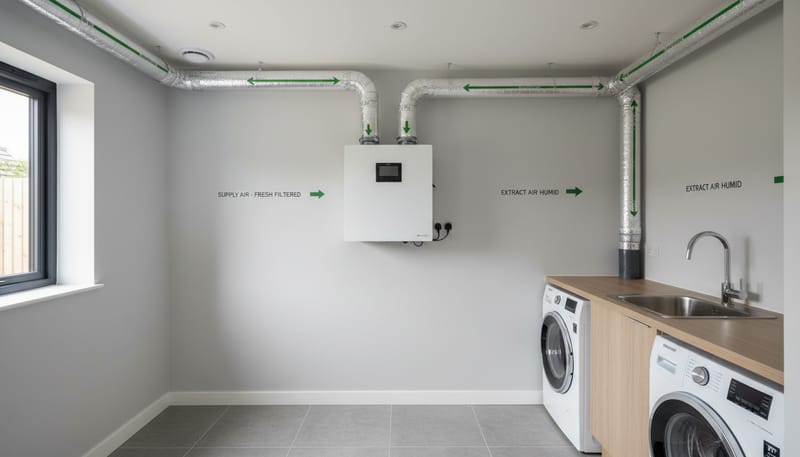
What Is MVHR and Why Do New Builds Have It?
MVHR stands for Mechanical Ventilation with Heat Recovery. It is a whole-house ventilation system that continuously extracts stale, moisture-laden air from wet rooms (kitchens, bathrooms, utility rooms, and en-suites) while simultaneously supplying fresh, filtered air to living spaces (bedrooms, living rooms, and studies). The clever part is the heat exchanger at the heart of the system, which transfers the warmth from the outgoing stale air to the incoming fresh air, so you get constant ventilation without losing the heat you have already paid for.
Modern new build homes are built to be extremely airtight as part of achieving high energy efficiency ratings. While this is excellent for keeping heating bills low, it creates a problem: without proper ventilation, moisture from cooking, showering, breathing, and drying clothes has nowhere to go. This trapped moisture leads to condensation, mould growth, and poor indoor air quality — issues that have plagued poorly ventilated new builds for years. MVHR solves this problem elegantly by providing constant, controlled ventilation while recovering the vast majority of the heat that would otherwise be lost through open windows or extract fans.
Building Regulations Part F (ventilation) and Part L (energy efficiency) work together to require adequate ventilation in new homes while minimising energy loss. For well-insulated, airtight new builds — particularly those achieving air permeability rates below 5 m³/hr/m² at 50 Pa — MVHR is the most effective way to meet both requirements simultaneously. This is why it has become standard in many new build developments across the UK.
How MVHR Works: The Technical Basics
Understanding how your MVHR system works is essential for getting the most out of it. The system consists of four main components: the central unit (containing fans and the heat exchanger), the ductwork, supply and extract valves in each room, and filters to clean the incoming and outgoing air.
Supply Air Path (Fresh Air In)
Extract Air Path (Stale Air Out)
The two airstreams never mix inside the heat exchanger — they pass through separate channels, with only heat transferring between them. This means that odours, moisture, and pollutants are removed from your home while the warmth is retained. The process runs continuously, 24 hours a day, providing a constant supply of fresh air without the need to open windows.
MVHR Speed Settings and When to Use Them
Most MVHR units in new build homes have multiple speed settings, typically controlled either by a wall-mounted controller, a humidity sensor, or both. Understanding when to use each setting is important for maintaining good air quality while minimising energy use and noise.
Most systems are designed to run on the normal setting (Speed 2) for the majority of the time, with automatic boost activation triggered by humidity sensors in bathrooms or manual boost switches. The key principle is that the system should never be turned off completely — even when you go on holiday, leave it running on the trickle setting to prevent moisture build-up and stale air.
Summer Bypass Mode
One of the most common questions about MVHR is what happens in summer when you do not want to recover heat. The answer is the summer bypass — a feature built into most modern MVHR units that allows fresh air to bypass the heat exchanger when the outdoor temperature is warm enough.
When bypass mode is active, incoming fresh air skips the heat exchanger entirely, so it enters your home at the cooler outdoor temperature rather than being warmed. This is particularly useful during summer nights when outdoor temperatures drop below indoor temperatures — the system can provide free night-time cooling, making your home significantly more comfortable without air conditioning.
Winter Mode (Heat Recovery Active)
- ● Outside temp: 0–15°C
- ● Heat exchanger active, recovering 90%+ warmth
- ● Incoming air pre-warmed to ~18–19°C
- ● Maximum energy savings on heating bills
Summer Bypass Mode
- ● Outside temp: above 18–22°C (adjustable)
- ● Heat exchanger bypassed, air enters at outdoor temp
- ● Provides free night-time cooling in summer
- ● Prevents unwanted heat gain on hot days
Most modern MVHR units activate the bypass automatically based on temperature sensors. If yours has a manual bypass switch, you should enable it when the outdoor temperature is consistently above about 18°C and the indoor temperature is above your desired comfort level. Check your system’s manual for the specific bypass activation temperature — this can usually be adjusted by the installer or through the control panel.
Maintenance: The Essential Filter Schedule
MVHR maintenance is straightforward but absolutely essential. The single most important task is changing the filters regularly. Dirty filters reduce airflow, increase energy consumption, lower air quality, and can eventually damage the fans. Yet this is the task that new build homeowners most commonly neglect, often because they were never properly shown how to access and change the filters during their home demonstration.
MVHR Maintenance Schedule
Understanding MVHR Filters
MVHR systems use two types of filter, and it is important to understand the difference when ordering replacements. The supply filter (which cleans the incoming fresh air) is typically a finer F7 grade filter, while the extract filter (which protects the heat exchanger from dust in the outgoing air) is usually a coarser G4 grade filter.
Filters are available from the manufacturer directly, from specialist ventilation suppliers like BPC Ventilation and EnviroVent, or from Amazon. Always use the correct filter for your specific unit — generic filters may not fit properly and can compromise the system’s performance. Set a reminder on your phone to check filters every three months; in most UK homes, replacement every three to six months is appropriate, with more frequent changes needed if you have pets, live near a busy road, or are in a high-pollen area.
Leading MVHR Brands in UK New Builds
Several manufacturers dominate the UK new build MVHR market. Knowing which brand your system is can help you source replacement filters, find the correct user manual, and access technical support. Here is a comparison of the most common brands you will encounter.
Vent-Axia and Nuaire are the most commonly installed brands in UK new build developments, as they are domestic manufacturers with strong relationships with major housebuilders. Zehnder and Brink are premium European brands that offer marginally higher efficiency but at a greater cost; they are more common in bespoke or high-end developments. All five brands offer good after-sales support and readily available replacement parts.
MVHR Costs and Energy Savings
Understanding the financial picture of MVHR helps you appreciate its value and plan for ongoing costs. While the system has both upfront and running costs, the energy savings can be substantial in a well-insulated new build.
The maths works in MVHR’s favour. In a typical well-insulated new build home, the system recovers enough heat to save £200–£400 per year on heating bills, while costing only £30–£60 per year in electricity to run. Even after accounting for filter replacement costs of £30–£80 per year, the system delivers a net annual saving of £90–£310 compared to ventilating the same home with trickle vents and extract fans alone.
Commissioning: Why It Matters
Commissioning is the process of adjusting the airflow rates through each valve in your home to ensure that the system is properly balanced. This is a critical step that should be carried out by the installer before you move in, and a commissioning certificate should be included in your handover documentation.
Unfortunately, poor commissioning is one of the most common problems with MVHR in new builds. If the system has not been properly balanced, some rooms may receive too much air (causing draughts and noise) while others receive too little (leading to stale air and moisture problems). Signs of poor commissioning include noisy valves, rooms that feel stuffy despite the system running, persistent condensation on windows, and extract valves in bathrooms that do not seem to clear steam effectively.
- ✓ Has the system been commissioned and is a certificate available?
- ✓ What are the measured airflow rates for each room?
- ✓ How do I access the unit to change filters?
- ✓ Which filter types and sizes does my unit use?
- ✓ How do I activate boost mode and summer bypass?
- ✓ What should I do if the system displays a fault code?
Common MVHR Problems and Solutions
While MVHR is a reliable technology when properly installed and maintained, new build homeowners do encounter common issues. Here are the most frequently reported problems and how to resolve them.
MVHR vs Other Ventilation Systems
Not all new builds have MVHR. Some use alternative ventilation strategies, and it is useful to understand how they compare. Your home’s ventilation approach depends on its air-tightness level and the energy efficiency requirements it needs to meet.
MVHR is the gold standard for ventilation in airtight new builds, and it is the only system type that recovers heat. MEV and dMEV are commonly found in less airtight new builds where the cost of MVHR is not justified by the energy savings. PIV (Positive Input Ventilation) is more common in retrofits than new builds. If your new build has MVHR, you have the most advanced and energy-efficient ventilation system available.
Living With MVHR: Practical Tips
Once you understand how your MVHR works and how to maintain it, living with it is straightforward. Here are some practical tips to maximise the benefits and avoid common pitfalls.
- ✓ Keep internal doors ajar or use undercut gaps to allow air to circulate between rooms
- ✓ Use the boost setting when cooking, showering, or drying clothes indoors
- ✓ Do not block or cover supply or extract valves with furniture or decorations
- ✓ You can still open windows — MVHR works alongside open windows, not instead of them
- ✓ If you have a cooker hood, choose a recirculating model rather than an externally ducted one to maintain the home’s airtightness
- ✓ Set phone reminders for filter checks every 3 months
- ✓ Keep the area around the MVHR unit clear and accessible for maintenance
One of the most frequently asked questions is whether you can still open windows when you have MVHR. The answer is a clear yes — you can and should open windows whenever you want fresh air or to enjoy a breeze. The MVHR system simply provides a guaranteed baseline of ventilation regardless of whether windows are open or closed. In winter, keeping windows closed and relying on MVHR maximises energy efficiency, but in summer, opening windows for natural cross-ventilation is perfectly fine and complements the system.
MVHR and Indoor Air Quality
Beyond heat recovery, one of the most significant but often overlooked benefits of MVHR is its impact on indoor air quality. The supply filter in your system removes pollen, dust, and fine particulate matter (PM2.5) from the air entering your home, which is particularly valuable for allergy and asthma sufferers.
For hay fever sufferers, MVHR can be transformative. With windows closed and the system running with a clean F7 filter, the air inside your home can be significantly cleaner than the air outside during peak pollen season. Some systems offer upgraded supply filters (F9 or even HEPA grade) for enhanced particulate removal, though these restrict airflow more and need changing more frequently. Speak to a ventilation specialist if you are interested in upgrading your supply filter for allergy relief.
MVHR Benefits for Air Quality
- ● Filters out pollen (relief for hay fever sufferers)
- ● Removes fine dust and PM2.5 particles
- ● Reduces indoor CO2 levels with constant fresh air
- ● Prevents mould by controlling moisture levels
Without Adequate Ventilation
- ● CO2 levels rise, causing headaches and poor sleep
- ● Moisture build-up leads to condensation and mould
- ● VOCs from new materials accumulate
- ● Dust mites thrive in humid, stale conditions
Your MVHR system is one of the most valuable features of your new build home. It protects the building fabric from moisture damage, keeps your air clean and fresh, recovers heat that would otherwise be wasted, and creates a comfortable, healthy living environment. With basic maintenance — primarily regular filter changes — it will serve you reliably for 15 to 20 years or more. Take the time to understand it, look after it, and it will look after you.