Understanding Your New Build Garden’s Soil
Before you plant anything, it is essential to understand what you are working with. New build garden soil is fundamentally different from established garden soil, and treating it the same way is a recipe for disappointment. Developers are required to provide a minimum of 150 mm (about 6 inches) of topsoil over subsoil, but in practice the quality varies enormously between developments.
The topsoil provided is often “screened” topsoil that has been stripped from the site before construction and stored in mounds, sometimes for years. This storage process kills much of the beneficial soil life, reduces organic matter content, and can compact the soil. Beneath the topsoil, the subsoil is likely to be severely compacted by heavy construction machinery, creating a hard pan that water struggles to drain through.
The single most important investment for your new build garden is improving the soil. Adding generous quantities of organic matter — garden compost, well-rotted manure, composted bark, or mushroom compost — will transform poor, lifeless topsoil into fertile growing medium over one to two seasons. Budget for at least one bulk bag (£50–£80 delivered) of good-quality compost per 10 square metres of garden bed.
Establishing Your Lawn: Turf vs Seed
The lawn is typically the centrepiece of a new build garden, and getting it right is a priority for most homeowners. Some developers lay turf as part of the purchase, but quality varies — developer-laid turf is often the cheapest available and may be laid on poorly prepared ground. Others leave you with bare soil. Either way, here is how the two main options compare.
Laying Turf
- ✓ Instant green lawn within days
- ✓ Can be laid almost any time (avoid extremes)
- ✓ Reduces mud immediately
- ✗ More expensive than seed
- ✗ Needs heavy watering for first 2–3 weeks
Sowing Seed
- ✓ Much cheaper than turf
- ✓ Greater choice of grass varieties
- ✓ Roots establish deeply from the start
- ✗ Takes 8–12 weeks to establish
- ✗ Vulnerable to birds, heavy rain, and drought
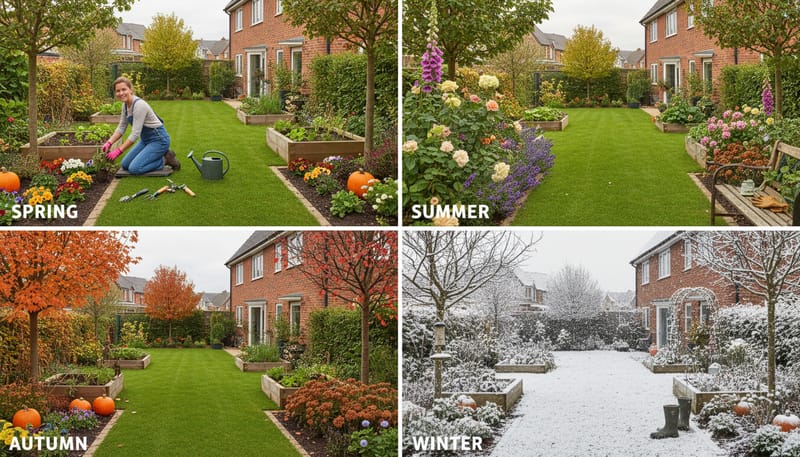
Month-by-Month Gardening Calendar
This calendar is tailored for new build gardens in the UK. Adjust timings slightly depending on whether you are in the milder south or cooler north of the country — northern gardeners should typically allow an extra 2–3 weeks for spring tasks and start autumn tasks 2–3 weeks earlier.
January & February
Planning & Preparation Season
- ✓ Plan your garden layout on paper or using free tools like SmartDraw
- ✓ Order a soil test kit (£15–£30) to check pH and nutrient levels
- ✓ Clear construction debris and remove any large stones
- ✓ Install fencing or boundary treatment if not yet done
- ✓ Prune any developer-planted trees or shrubs if needed
- ✓ Order bare-root trees and hedging plants (cheapest option)
March & April
Spring Awakening
- ✓ Spread 5–10 cm of compost over all beds and dig in
- ✓ Lay turf from mid-March (if ground is not waterlogged)
- ✓ Plant evergreen shrubs and container-grown perennials
- ✓ Sow hardy annuals (sweet peas, cornflowers, poppies)
- ✓ Apply first lawn feed if turf was laid previously
- ✓ Begin mowing new turf when it reaches 5 cm (on highest setting)
May & June
Peak Planting Season
- ✓ Plant out summer bedding after last frost (typically mid-May)
- ✓ Sow lawn seed if you have not laid turf
- ✓ Install raised beds, planters, or patio containers
- ✓ Plant climbers against fences (clematis, honeysuckle, jasmine)
- ✓ Mulch all beds to retain moisture and suppress weeds
- ✓ Water new plantings regularly — new build soil dries out fast
July & August
Maintenance & Enjoyment
- ✓ Water deeply in dry spells (once a week, thoroughly > daily light)
- ✓ Mow lawn regularly but raise cutting height in hot weather
- ✓ Deadhead flowering plants to encourage repeat blooming
- ✓ Feed containers and hanging baskets fortnightly
- ✓ Keep on top of weeds before they set seed
- ✓ Enjoy your garden! Set up outdoor dining, BBQ area, relaxation zone
September & October
Autumn Planting — The Golden Window
- ✓ Best time to lay turf or sow lawn seed
- ✓ Plant spring-flowering bulbs (daffodils, tulips, crocus)
- ✓ Plant trees, shrubs, and hedging — roots establish over winter
- ✓ Divide and replant perennials
- ✓ Apply autumn lawn feed (high potassium, low nitrogen)
- ✓ Add more compost to beds for winter improvement
November & December
Winter Preparation
- ✓ Plant bare-root trees and hedging (cheapest and most successful now)
- ✓ Clear fallen leaves from lawns and paths
- ✓ Clean and store garden tools and furniture
- ✓ Install outdoor lighting to enjoy the garden year-round
- ✓ Plan hard landscaping projects for spring
- ✓ Protect tender plants with fleece if frost is forecast
Fencing and Boundaries
Fencing is often the first major garden project for new build homeowners, as many developments are handed over with only post-and-wire or temporary fencing marking the boundary. Understanding your rights and responsibilities around boundaries is important before you invest in new fencing.
Before installing fencing, check your title deeds and the development’s estate management rules. Many new build estates have covenants restricting fence height (usually 1.8 m maximum), fence style, and sometimes even colour. Some estates require all fencing to match for visual consistency. Your developer’s sales team or the estate management company can clarify what is and is not permitted.
Best Plants for New Build Gardens
Choosing the right plants for a new build garden is about more than aesthetics — you need plants that can cope with poor, compacted soil, limited growing space, and often exposed conditions while the estate matures. Here are our top recommendations for reliable, UK-suited plants that thrive in new build gardens.
Evergreen Structure Plants
- Box (Buxus) — Classic hedging, topiary, containers
- Lavender — Fragrant, drought-tolerant, pollinator-friendly
- Pittosporum — Attractive foliage, versatile, compact
- Euonymus — Tough, colourful, tolerates poor soil
Flowering Perennials
- Geranium (Hardy) — Reliable, long-flowering, ground cover
- Echinacea — Bold flowers, attracts butterflies
- Nepeta (Catmint) — Easy, long-flowering, bee magnet
- Heuchera — Colourful foliage, great in shade
Climbers for Fences
- Clematis — Huge variety, flowers spring to autumn
- Jasmine (Star) — Fragrant, semi-evergreen
- Honeysuckle — Native, scented, wildlife-friendly
- Trachelospermum — Evergreen, fragrant, modern look
UK Native Options
- Foxglove — Self-seeding, tall, shade-tolerant
- Primrose — Early spring colour, woodland edges
- Red Campion — Wildflower meadow staple
- Hawthorn — Native hedging, berries for birds
Low-Maintenance Garden Design
Many new build homeowners want an attractive garden without spending hours maintaining it. With the right design choices, a low-maintenance new build garden is entirely achievable while still looking beautiful year-round.
- ✓ Use perennial plants that return each year rather than annual bedding that needs replanting
- ✓ Install a drip irrigation system for borders (£30–£80 for a basic kit)
- ✓ Mulch all beds with bark or gravel to suppress weeds and retain moisture
- ✓ Choose slow-growing hedge species (box, yew) that need trimming only once a year
- ✓ Consider artificial grass for play areas (though it adds no biodiversity value)
- ✓ Use raised beds — easier to weed, better soil control, and look smart
- ✓ Minimise lawn area if mowing is not your thing — replace with gravel or paving
Budgeting for Your New Build Garden
One of the most common mistakes new build buyers make is spending all their budget on the house interior and leaving nothing for the garden. A well-planned garden significantly improves both your quality of life and your property’s value. Here is a realistic breakdown of what different budget levels can achieve.
Common New Build Garden Problems
Every new build garden faces unique challenges. Here are the most common problems and how to tackle them.
Patios and Hard Landscaping
A patio or decking area is one of the most valuable additions to a new build garden, providing an outdoor living and dining space that extends the usable area of your home. However, hard landscaping on a new build plot requires some special considerations that do not apply to established gardens.
The key issue is ground settlement. New build gardens sit on soil that has been disturbed, backfilled, and compacted during construction. This soil will continue to settle for 12 to 18 months after completion, which means that patios and decking installed too early can develop dips, cracks, or uneven surfaces. If possible, wait at least one full winter before laying a permanent patio — the freeze-thaw cycles will help the ground settle naturally. In the meantime, a temporary solution such as a portable deck tiles or outdoor rugs over a stable base can provide a usable outdoor space.
Essential Garden Tools for New Build Owners
You do not need a shed full of specialist tools to create a beautiful new build garden. Here are the essentials that will cover the vast majority of gardening tasks in your first year, along with realistic costs from UK garden centres and DIY stores.
- ✓ Spade (border spade for small gardens) — £15–£40
- ✓ Garden fork — £15–£35 — Essential for breaking up compacted soil
- ✓ Hand trowel and hand fork — £8–£20
- ✓ Rake (for levelling soil before seeding or turfing) — £10–£25
- ✓ Secateurs (bypass type for live stems) — £10–£30
- ✓ Watering can or hose with spray attachment — £10–£30
- ✓ Wheelbarrow — £30–£60 — Invaluable for moving soil and compost
- ✓ Lawnmower (electric or cordless) — £80–£250
Where to Buy Plants and Materials
Knowing where to shop can make a significant difference to both quality and cost. Here is a guide to the best sources for new build gardeners in the UK, from budget-friendly to premium options.
For plants, independent garden centres generally offer better quality and more knowledgeable staff than supermarket garden sections, though they cost a little more. Online nurseries like Crocus, Thompson & Morgan, and Hayloft Plants offer excellent ranges with delivery to your door — particularly useful if you do not have a car large enough to transport plants. For bulk buys of hedging, trees, and bare-root plants, specialists like Hedges Direct and Ashridge Nurseries offer significant savings over garden centre prices. For compost, soil, and aggregates, builders’ merchants like Jewson and Travis Perkins are typically cheaper than garden centres for bulk quantities, and most offer delivery.
Wildlife-Friendly Gardening
New build estates are often built on former farmland or greenfield sites, displacing the wildlife that lived there. As a new build garden owner, you can make a meaningful difference by creating a wildlife-friendly space. Even a small garden can support a surprising variety of birds, bees, butterflies, and other creatures.
Simple steps include planting pollinator-friendly flowers (lavender, sedum, echinacea, verbena), leaving a small area of longer grass, providing a shallow water dish, installing a bird feeder, and asking your neighbours to create hedgehog highways — small 13 cm square holes in the bottom of fences that allow hedgehogs to roam between gardens. Many new build communities are now actively creating wildlife corridors along their estates, and you can be part of that positive trend.
- ✓ Create a hedgehog highway (13 cm hole in fence base) — free
- ✓ Install a bird feeding station — £15–£40
- ✓ Plant at least 3 pollinator-friendly plants — £10–£30
- ✓ Add a shallow birdbath or water dish — £10–£25
- ✓ Build or buy a bug hotel — £10–£30
- ✓ Leave a small log pile in a quiet corner for hibernating insects
Your new build garden may start as a patch of bare soil and builder’s topsoil, but with patience, the right planting choices, and generous amounts of organic matter, it will transform into a garden that gives you pleasure for years to come. The key is to start with the soil, take it season by season, and not try to do everything at once. Nature is remarkably forgiving, and even the most unpromising new build plot can become a thriving garden within two to three years.