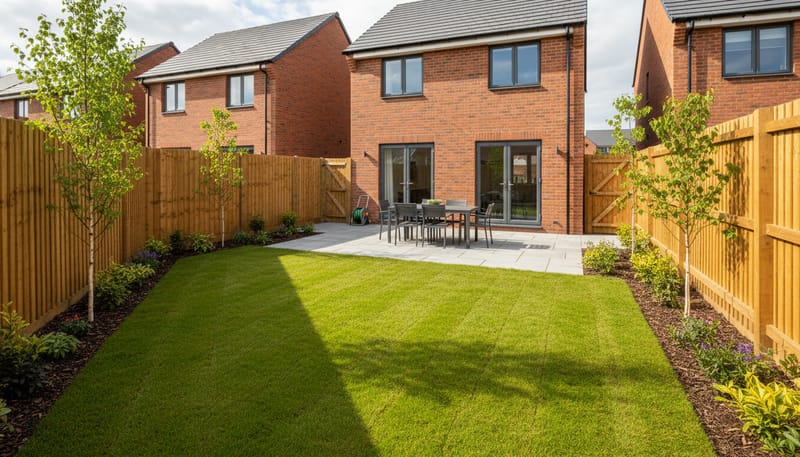
If there is one aspect of a new build home that consistently disappoints buyers on completion day, it is the garden. While the interior of your new property will be pristine and finished to specification, the garden is typically handed over as little more than a patch of compacted builder's soil — sometimes with basic turf, sometimes with nothing but bare earth, rubble, and a token fence. For buyers who have spent months poring over glossy CGI images showing beautiful landscaped gardens with established planting, mature trees, and elegant patio dining areas, the reality of a muddy rectangle can be a genuine shock. Transforming this blank canvas into a usable, attractive outdoor space is one of the most significant post-purchase costs that new build buyers face, with typical total landscaping bills ranging from £2,000 for a basic DIY approach to £15,000 or more for a professionally designed and installed garden.
This guide provides a detailed breakdown of every common landscaping cost for UK new build gardens, covering turfing, patio installation, fencing, planting, decking, sheds, and all the smaller items that add up. We compare DIY costs against professional rates, discuss the best seasonal timing for different projects, and share practical advice for getting the most value from your landscaping budget. The garden is one area where patience and phased investment pay dividends — you do not need to do everything at once, and in fact there are good horticultural reasons for taking your time. If you are still working through your overall budget, our guides on moving costs and furniture and furnishing costs will help you see the complete financial picture.
What the Developer Typically Provides
Before budgeting for landscaping, it is essential to understand what your developer does and does not include in the purchase price. This varies significantly between developers and even between different house types within the same development, so always check your specification carefully. Here is what you can typically expect.
Usually included: Rear garden boundary fencing (close-board or panel fencing, typically 1.8m high), a basic patio area immediately outside the rear door (often 2-3 metres deep in concrete or basic paving slabs), and sometimes basic turf to the rear garden. Front gardens typically get turf or basic planting as these are visible and affect the overall development's kerb appeal.
Usually NOT included: Any quality landscaping, decorative paving, decking, shed, planting beds, topsoil improvement, garden lighting, water features, and side gate/fencing (often sold as an optional extra). The turf, if provided, is often laid on inadequately prepared soil and can struggle to establish, particularly if the subsoil is compacted clay — a common issue on new build sites where heavy construction vehicles have repeatedly driven over the ground.
Turfing Costs
Laying turf is usually the first and most impactful thing you can do to transform a new build garden from a mud patch into something that actually looks and feels like an outdoor living space. The cost of turfing depends on three factors: the area to be turfed, whether you include topsoil preparation, and whether you do it yourself or hire a professional.
Turf itself costs approximately £3-£6 per square metre for standard lawn turf, or £6-£10 per square metre for premium or hardwearing varieties. A typical new build rear garden of 40-80 square metres therefore needs £120-£480 worth of turf. However, the turf itself is only part of the cost. New build soil almost always needs significant preparation: clearing rubble and construction debris (extremely common), rotavating compacted ground, and adding topsoil. Topsoil costs approximately £30-£50 per bulk bag (approximately 0.7 cubic metres), and a typical garden might need 3-8 bags depending on the depth required and existing soil quality. Soil preparation adds £100-£400 to the project.
Turfing is one of the more DIY-friendly garden projects. The physical work is demanding (carrying heavy rolls of turf is hard graft), but the skill level required is relatively low. The most important factor for success is thorough soil preparation — skimping on this stage is the number one reason new build lawns fail. The best times to lay turf in the UK are spring (March-May) and early autumn (September-October), when the soil is moist and temperatures are mild enough for the grass to establish its root system. Summer turfing is possible but requires constant watering, while winter turfing risks waterlogging on heavy clay soils.
Patio and Paving Costs
A well-laid patio is the centrepiece of most new build gardens, providing a hard-standing area for outdoor dining, barbecues, and general relaxation. If your developer has provided a basic patio, you may be satisfied with it or may choose to extend or upgrade it. If no patio is included, this will be one of your biggest landscaping expenses.
Patio costs depend on the size, the material chosen, and whether you DIY or hire a professional. Materials range from affordable concrete paving slabs (£15-£30 per square metre) through mid-range porcelain or Indian sandstone (£30-£80 per square metre) to premium natural stone like York stone, granite, or limestone (£60-£150+ per square metre). Labour costs for professional patio installation typically run £40-£70 per square metre on top of materials, including excavation, sub-base preparation, and laying.
DIY patio laying can save 40-50% on the total cost, but it is significantly more challenging than turfing. A well-laid patio requires precise excavation, a properly compacted sub-base of MOT Type 1 aggregate, a mortar bed, and careful attention to falls (slight slopes for drainage). Poor installation leads to uneven surfaces, puddles, sinking slabs, and weed growth. Unless you have some DIY experience and the right tools, we generally recommend hiring a professional for patio work — the difference in finish quality between professional and amateur patio laying is usually very apparent.
Fencing Costs
As mentioned, rear boundary fencing is usually included with a new build, but there are several fencing costs you may still face. Side gates (often sold as developer extras for £300-£600, but can be installed independently for £150-£350), front garden fencing or railings (if you want to separate your front garden from the street or neighbouring properties), and replacement or upgrading of developer-provided fencing (which is often the minimum specification).
Standard close-board or lap panel fencing costs £40-£80 per linear metre (supply and install) depending on the panel type and post material (concrete posts are cheaper and more durable than timber). For a typical new build rear garden requiring fencing on three sides (approximately 20-30 linear metres), the total cost is £800-£2,400 if you need to install or replace all of it. However, since most developers provide rear fencing, your actual cost may be limited to a side gate (£150-£350), any front fencing (£300-£800 for a short run), or upgrades from basic panel to premium styles.
Decking
Decking provides an alternative or complement to a traditional patio, creating a raised or level outdoor platform that works particularly well on sloping sites or as an extension of your living space at bi-fold or patio door level. There are two main material choices: timber decking and composite decking.
Softwood timber decking (typically pressure-treated pine) is the most affordable option at £50-£90 per square metre installed, including the subframe. It looks attractive when new but requires annual treatment with decking oil or stain and can become slippery when wet unless you add anti-slip strips. Hardwood timber decking (such as balau or ipe) costs £90-£150 per square metre installed and is more durable and naturally more resistant to weathering.
Composite decking, made from a mix of recycled wood fibres and plastic, costs £100-£200 per square metre installed. While more expensive upfront, composite decking requires virtually no maintenance, does not splinter, and many products come with 20-25 year guarantees. The long-term cost is often comparable to timber when you factor in the annual maintenance costs avoided. For a typical deck of 10-15 square metres, budget £500-£1,350 for softwood, £900-£2,250 for hardwood, or £1,000-£3,000 for composite.
Planting and Garden Beds
Planting transforms a functional garden into an inviting outdoor space with colour, fragrance, and seasonal interest. New build gardens benefit from having no existing planting to work around, giving you a clean slate to create exactly the garden you want. However, the soil conditions are typically poor (compacted, lacking organic matter, potentially contaminated with lime morite and construction debris), so soil improvement is the first priority.
For planting beds, you will need to dig out the border area, remove any rubble, and incorporate generous amounts of compost and organic matter. A 10-metre border that is 1 metre deep needs approximately 2-3 bulk bags of topsoil/compost mix (£60-£150). Plants themselves vary enormously in cost depending on size, species, and source. Here is a rough guide.
For a typical new build garden, a sensible planting budget is £200-£500 for a basic scheme (a handful of shrubs, some perennials, and seasonal bedding), £500-£1,500 for a more comprehensive design with structural planting, or £1,500-£4,000+ for a professionally designed and planted scheme with semi-mature specimens. Buying smaller plants and being patient saves enormously — a lavender bush in a 2-litre pot (£6-£10) will reach the same size as one in a 10-litre pot (£20-£30) within 12-18 months.
Hedging for privacy (common on new build estates where gardens can feel overlooked) costs £3-£8 per plant for bare-root hedging plants (available October-March) or £10-£30 per plant for container-grown specimens. A 10-metre hedge requires approximately 20-30 plants depending on species and spacing, so budget £60-£240 for bare-root or £200-£900 for container-grown. Popular choices include laurel (fast-growing, evergreen), privet (classic, easy to maintain), beech (deciduous but retains brown leaves in winter), and yew (slow-growing but extremely long-lived and attractive).
Shed and Storage
A garden shed is near-essential for storing garden tools, lawn mower, outdoor furniture cushions, children's toys, and all the other items that accumulate in a home but do not belong inside. New builds rarely include a shed, so this is typically one of your first outdoor purchases.
A basic 6x4 foot overlap shed costs £200-£350, while a more robust 8x6 foot tongue-and-groove shed costs £400-£800. Premium sheds (10x8 foot workshop-style with windows and shelving) cost £800-£2,000. The shed itself is only part of the cost — you also need a base (concrete slab or plastic grid base: £50-£200 DIY, £200-£400 professional), a padlock (£10-£30), shelving (£20-£60), and potentially treatment/stain (£15-£30 for a basic shed). Delivery is usually £30-£80 for flat-pack or included for assembled delivery.
Garden Tools and Equipment
Maintaining your new garden requires a basic set of tools. If you are a first-time homeowner coming from a flat, you may need to purchase everything from scratch. Essential garden tools include a spade (£15-£40), fork (£15-£40), rake (£10-£25), hoe (£10-£25), hand trowel and fork set (£8-£20), secateurs (£10-£30), watering can (£5-£15), hosepipe and fittings (£25-£60), wheelbarrow (£30-£80), and a garden broom (£10-£20). A complete basic tool kit costs approximately £150-£350.
A lawn mower is the most significant garden equipment purchase. For typical new build garden sizes (40-80m²), a cordless electric mower offers the best balance of convenience and performance. Budget cordless mowers from Bosch or Flymo cost £150-£250, mid-range options from Ego or Makita cost £300-£500, and premium robotic mowers (the ultimate in convenience) cost £500-£1,500. For very small gardens, a manual push mower (£50-£80) or even a grass trimmer (£40-£80) may suffice. Petrol mowers are overkill for most new build gardens and involve more maintenance.
DIY vs Professional: When to Hire Help
Choosing between DIY and professional landscaping depends on your budget, skill level, available time, and the complexity of the project. Here is our honest assessment of which tasks are suitable for DIY and which are better left to professionals.
Planting beds and borders
Assembling flat-pack sheds
Painting/staining fences
Container gardening
Simple raised beds
Gravel paths and areas
Hedge planting
Decking construction
Drainage work
Retaining walls
Electrical work (lighting)
Tree planting (large specimens)
Major earthworks/levelling
Water features
A landscape gardener or landscaping company typically charges £150-£250 per day per person. For a complete garden makeover including patio, turfing, fencing, and planting, expect the labour portion alone to cost £1,500-£4,000 depending on the garden size and complexity, on top of material costs. Getting at least three written quotes is essential — landscaping quotes can vary enormously, and the cheapest option is not always the best value. Ask to see examples of previous work and request references from recent clients.
Seasonal Timing Guide
The timing of your landscaping work affects both cost and success. Here is an overview of the best times of year for different garden projects in the UK.
Complete Garden Budget Summary
Final Thoughts
Landscaping a new build garden is a substantial investment, but it is one that directly enhances your quality of life and adds real value to your property. A well-designed, well-maintained garden can add 5-10% to a property's value according to estate agents, making it one of the better returns on investment in the home improvement category. More importantly, a garden you enjoy spending time in transforms your new build from a house into a home.
Our advice is to take a phased approach: address the essentials first (turf, basic patio, functional paths), then add features over subsequent months and years as your budget allows and as you learn how you use your outdoor space. Be patient with planting — small, well-chosen plants will grow, and gardens always improve with time. Budget realistically (£3,000-£8,000 for a typical mid-range garden), take advantage of the best seasonal windows for each type of work, and do not be afraid to mix DIY projects with professional help for the more technical tasks.
For related cost guides, see our articles on moving costs, furniture and furnishing costs, and estate management fees on new build developments.