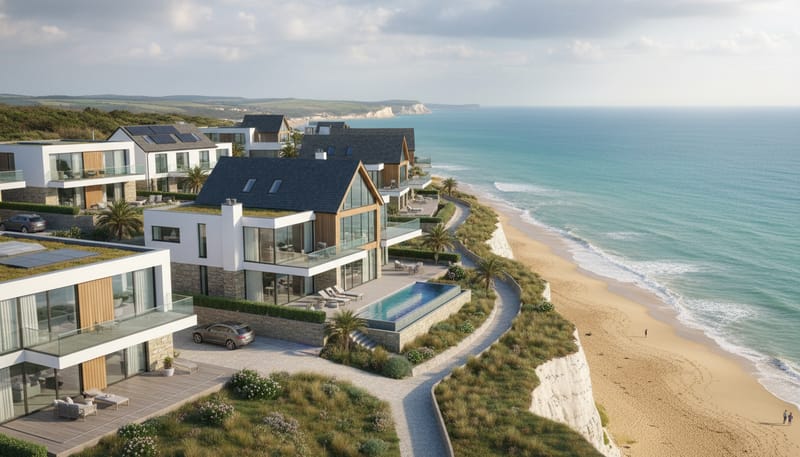
Why Buy a Coastal New Build?
The pandemic-era “race for space” fundamentally reshaped UK housing preferences, and coastal areas were among the biggest beneficiaries. Remote and hybrid working freed millions of people from the daily commute, making seaside towns viable options for professionals who previously had to live near city centres. While the initial rush has settled, the underlying shift persists: coastal property searches on major portals remain 25–30% above pre-2020 levels, and developers have responded with a wave of new schemes in seaside locations across Britain.
New builds offer particular advantages in coastal settings. Modern construction techniques mean better insulation against sea air and salt corrosion, higher energy efficiency ratings (typically EPC A or B), and warranties that protect against structural issues for ten years. Unlike period coastal properties, which can suffer from damp, poor insulation, and expensive maintenance, a new build on the coast gives you all the lifestyle benefits without the hidden costs that older homes can bring.
There are also significant wellbeing benefits backed by research. Studies by the University of Exeter’s BlueHealth programme have shown that living within sight or walking distance of the sea is associated with better mental health outcomes, lower stress levels, and higher levels of physical activity. For families, the coast offers children natural play spaces, outdoor education opportunities, and a connection to the environment that is increasingly valued by parents seeking an alternative to screen-dominated urban childhoods.
Advantages of Coastal Living
- ● Proven mental health and wellbeing benefits from proximity to the sea
- ● Strong holiday let income potential during peak seasons
- ● Lower crime rates than equivalent urban areas on average
- ● Outstanding outdoor leisure: sailing, surfing, walking, cycling
- ● Unique character and community spirit in many coastal towns
- ● Long-term price resilience — sea views are a finite resource
Considerations for Buyers
- ● Flood and coastal erosion risk in certain areas
- ● Seasonal fluctuation in local services and amenities
- ● Potentially longer commutes to major employment centres
- ● Higher insurance premiums in some coastal zones
- ● Salt air can accelerate wear on external building materials
- ● Tourism traffic congestion during summer peak periods
South Coast: Brighton, Bournemouth, Poole, Portsmouth & Worthing
England’s South Coast represents the most established and arguably most sought-after stretch of coastline for new build buyers. The combination of relatively mild climate, proximity to London, excellent transport links, and diverse employment opportunities makes this region a perennial favourite. Prices here reflect the premium status, but the lifestyle returns are equally substantial.
Brighton and Hove commands the highest prices on the South Coast, reflecting its status as London-by-the-Sea. The city’s vibrant cultural scene, outstanding food and drink offering, and fast rail connections to London (just over an hour to Victoria or London Bridge) make it enormously popular with commuters and remote workers. New build developments have proliferated along the seafront and in regeneration areas like the former gasworks site in Black Rock, where a major mixed-use scheme is planned. Two-bedroom new build apartments in central Brighton typically start at £375,000, with sea-view properties commanding £500,000 or more. In the wider Brighton and Hove area, including Shoreham-by-Sea and Portslade, more affordable options can be found from around £280,000 for a two-bedroom flat.
Bournemouth and Poole together form one of the South Coast’s most appealing new build markets. Bournemouth offers seven miles of sandy beach, a growing digital economy centred around Bournemouth University and the town’s thriving tech sector, and a vibrant nightlife that attracts young professionals. Poole, with its spectacular natural harbour (the second largest in the world), offers a more refined, family-oriented atmosphere with outstanding sailing facilities and access to the Jurassic Coast World Heritage Site. Taylor Wimpey, Barratt Homes, and Bellway have all been active across the BCP (Bournemouth, Christchurch, and Poole) council area, delivering developments ranging from waterfront apartments to family estates on the outskirts of town.
Portsmouth has undergone a remarkable transformation in recent years. The city’s naval heritage remains a central part of its identity, but the Gunwharf Quays waterfront development, the ongoing regeneration of the Hard interchange area, and the growth of the University of Portsmouth have diversified both the economy and the housing market. New build apartments in the Gunwharf Quays area and along the seafront typically range from £230,000 for a one-bedroom unit to £450,000 for premium three-bedroom homes with harbour views. Portsmouth also benefits from direct rail services to London Waterloo in around 90 minutes, making it a viable (if longer) commuter option.
Worthing, long overshadowed by its flashier neighbour Brighton, has emerged as one of the South Coast’s most exciting emerging markets. The town’s more relaxed pace, significantly lower prices compared to Brighton, and improving cultural scene have attracted both young families and creative professionals seeking coastal life at a more accessible price point. Several new build developments have been delivered around the town centre and seafront, with Roffey Homes and Barratt among the active developers. A two-bedroom new build apartment in Worthing typically costs between £260,000 and £340,000 — a substantial saving compared to equivalent properties just 11 miles east in Brighton.
Along the wider South Coast, Chichester and the surrounding area offer a more upmarket feel, with proximity to Goodwood, the South Downs National Park, and Chichester Harbour AONB. New build developments here often take the form of smaller, boutique schemes rather than large-scale estates, reflecting the area’s conservation sensitivities. Eastbourne, further east, provides more affordable coastal options with new build houses available from around £250,000 for a three-bedroom home — though the town lacks the buzz of Brighton or Bournemouth. Southampton, while primarily known as a port city, also offers waterfront and marina-adjacent new build options, particularly around the Ocean Village development and the Woolston area, where prices are notably lower than in neighbouring areas.
South West: Cornwall, Devon & Dorset
The South West of England occupies a special place in the British imagination. Cornwall’s dramatic cliffs, turquoise coves, and artistic heritage; Devon’s rolling hills meeting red sandstone cliffs; Dorset’s Jurassic Coast with its fossil-rich shores — these are landscapes that inspire devotion and, increasingly, significant property investment. The South West experienced the most dramatic house price growth of any UK region during 2020–2023, with Cornwall alone seeing average prices rise by over 25% in just three years.
For new build buyers, Cornwall presents both enormous appeal and genuine challenges. The county’s strict planning policies, designed to protect its outstanding landscape, mean that large-scale developments are relatively rare compared to other regions. When new build schemes do come to market, they are often oversubscribed almost immediately, particularly in popular areas like St Ives, Padstow, Newquay, and Falmouth. Developers active in Cornwall include Barratt Homes, Taylor Wimpey, and regional specialists like Linden Homes, alongside a growing number of boutique developers delivering high-specification homes designed to complement the local vernacular.
Newquay has become Cornwall’s new build hotspot, with several major developments on the outskirts of town offering family homes from around £290,000 for a three-bedroom semi-detached. The town’s surfing culture, improving restaurant scene, and Cornwall Airport Newquay (with flights to London and other UK cities) have transformed its appeal beyond the traditional bucket-and-spade holiday market. Truro, Cornwall’s only city, offers a more year-round proposition with better employment and retail facilities, with new build three-bedroom houses typically costing between £310,000 and £420,000.
Devon offers a broader range of coastal options. The South Devon coast, from Torbay (encompassing Torquay, Paignton, and Brixham) through to Dartmouth, Salcombe, and Plymouth, provides everything from affordable seaside living to some of the most expensive coastal property in England. Salcombe, often called “Chelsea-on-Sea,” regularly features as one of Britain’s most expensive seaside locations, with new build homes commanding prices well in excess of £1 million. At the other end of the scale, Plymouth offers genuine urban coastal living at prices that would be considered remarkably affordable by South East standards, with new build two-bedroom apartments available from around £190,000 and three-bedroom houses from £260,000.
North Devon’s coast, including Ilfracombe, Woolacombe, and Croyde, appeals to surfers and outdoor enthusiasts, though the area’s relative remoteness means new build development is more limited. Barnstaple, the area’s main town, sits slightly inland but serves as the gateway to the North Devon coast and has seen modest new build development with prices starting from around £230,000 for a three-bedroom house.
Dorset completes the South West coastal picture. Beyond the Bournemouth and Poole conurbation discussed in the South Coast section, the Dorset coast extends through Swanage, Wareham, Weymouth, and Lyme Regis. Weymouth, with its Georgian harbour and Olympic sailing legacy, has seen targeted new build development, with three-bedroom houses available from around £295,000. The town benefits from direct rail services to London Waterloo (approximately three hours), though this longer journey time limits its appeal for regular commuters. Dorchester, just inland, offers better value and has attracted developers including Persimmon and David Wilson Homes.
Cornwall
Devon
Dorset
Welsh Coast: Swansea, Barry & Beyond
Wales boasts 870 miles of coastline, much of it designated as Areas of Outstanding Natural Beauty or Heritage Coast, and it offers some of the most affordable coastal new build opportunities in Britain. The Welsh Government’s proactive approach to housing delivery, combined with significantly lower land values than England’s South Coast, means that buyers can access brand-new coastal homes at prices that would be unimaginable in Cornwall or Brighton.
Swansea is Wales’s second city and its most significant coastal new build market. The city’s Copr Bay development has transformed the city centre, creating a new urban quarter with an arena, hotel, and residential components adjacent to Swansea Bay’s sweeping sandy beach. The SA1 waterfront district, developed over the past two decades on former docklands, continues to see new apartment schemes with prices starting from around £165,000 for a one-bedroom unit and rising to £320,000 for premium two-bedroom apartments with marina views. Swansea benefits from direct rail services to London Paddington (approximately three hours) and proximity to the Gower Peninsula, Britain’s first designated Area of Outstanding Natural Beauty.
Barry, in the Vale of Glamorgan, has undergone something of a renaissance, partly driven by the success of the BBC television show Gavin and Stacey but more fundamentally by the town’s regenerated waterfront and its excellent commuter connections to Cardiff (just 20 minutes by rail). Barry Island’s beaches and the surrounding Heritage Coast provide genuine coastal appeal, while the town’s lower prices compared to Cardiff itself make it attractive for first-time buyers and families. New build three-bedroom houses in Barry typically start from around £240,000, with four-bedroom detached homes available from £330,000. Persimmon, Taylor Wimpey, and Bellway have all delivered developments in the Barry and wider Vale of Glamorgan area.
Swansea Bay Area
Price guide for new builds
Barry & Vale of Glamorgan
Price guide for new builds
Further west along the Welsh coast, Pembrokeshire offers spectacular scenery and some of Britain’s finest beaches, including Barafundle Bay (regularly voted among the UK’s best). New build options here are more limited due to the national park’s planning restrictions, but towns like Milford Haven, Haverfordwest, and Pembroke Dock see occasional developments with three-bedroom houses available from as little as £195,000. North Wales offers coastal living along the Llandudno, Conwy, and Anglesey coast, with prices generally higher than South Wales due to the areas’ popularity with retirees and holiday home buyers from North West England.
It is worth noting that Wales operates under its own planning and taxation framework. The Land Transaction Tax replaces Stamp Duty Land Tax, with slightly different rate bands, and there are specific regulations around second homes and holiday lets that Welsh buyers should investigate thoroughly. Some Welsh councils have introduced council tax premiums of up to 300% on second homes, which could significantly impact the viability of a coastal holiday let investment.
North West Coast: Blackpool, Southport & Morecambe
The North West coast of England offers arguably the best-value coastal new builds anywhere in Britain. While these towns lack the balmy temperatures and turquoise waters of Cornwall, they compensate with outstanding affordability, improving infrastructure, and distinctive character that is increasingly appreciated by buyers looking beyond the traditional coastal hotspots.
Blackpool remains one of the most affordable places in England to buy a new build home, with two-bedroom houses available from around £130,000 and three-bedroom semi-detached homes from £175,000. The town has invested heavily in its infrastructure, including a £300 million tramway extension, conference centre upgrades, and improved public realm along the promenade. Blackpool’s illuminations, Pleasure Beach, and three piers continue to draw millions of visitors annually, and for investors, the holiday let market remains robust with strong weekend and holiday-period demand. However, buyers should research specific locations carefully, as there are significant variations in desirability and long-term prospects between different parts of the town.
Lytham St Annes, immediately south of Blackpool, offers a dramatically different coastal experience. This elegant Victorian town, home to Royal Lytham & St Annes Golf Club, has wide tree-lined streets, independent shops, and a refined atmosphere that appeals to affluent families and retirees. New build developments here command prices more in line with the wider Lancashire market, with three-bedroom houses typically ranging from £270,000 to £400,000 and executive homes exceeding £500,000. Lytham St Annes consistently ranks among the best places to live in the North West in quality-of-life surveys.
Southport, on the Sefton coast between Liverpool and the Lancashire border, sits in an interesting position between resort town and commuter hub. Lord Street, one of England’s finest Victorian shopping streets, anchors a town that blends faded grandeur with genuine charm. The town’s flat topography and wide beaches appeal to families, while its rail connection to Liverpool (approximately 45 minutes to Liverpool Central) and proximity to the Formby coast make it viable for Merseyside commuters. New build three-bedroom houses in Southport typically range from £220,000 to £320,000, with some executive developments approaching £450,000 in premium locations like Birkdale.
Morecambe, overlooking the vast sweep of Morecambe Bay towards the Lake District fells, has perhaps the most dramatic views of any affordable coastal town in England. The town has faced economic challenges but is benefiting from the “Eden Project North” development (now called Eden Project Morecambe), which promises to transform the seafront with a major visitor attraction and associated regeneration. This investment, combined with Morecambe’s proximity to Lancaster (a university city with good rail links) and its extraordinary natural setting, makes it one of the most interesting emerging coastal markets in the UK. New build three-bedroom homes can still be found from around £180,000, making it accessible to first-time buyers and investors alike.
East Coast: Whitby, Scarborough & Norfolk
England’s East Coast stretches from the Scottish border to the Thames Estuary and offers a remarkably varied range of coastal experiences. From the dramatic cliffs of Yorkshire to the wide, flat beaches and marshlands of Norfolk and Suffolk, the East Coast combines outstanding natural beauty with some of the most affordable coastal property in England.
Whitby, perched on the North Yorkshire coast, is one of England’s most atmospheric coastal towns. Its harbour, abbey ruins, jet jewellery heritage, and association with Bram Stoker’s Dracula give it a distinctive character that draws visitors year-round. For new build buyers, Whitby’s small size and conservation area restrictions mean supply is limited, but developments on the outskirts of town offer three-bedroom houses from around £265,000. The town’s popularity as a holiday destination makes it an excellent prospect for holiday let investment, with properties achieving strong occupancy rates throughout the year thanks to the town’s all-season appeal.
Scarborough, Yorkshire’s largest seaside resort, offers a broader range of new build options. The town’s two bays, castle headland, and spa heritage provide genuine coastal charm, while its larger size supports a more diverse economy than many seaside towns. New build developments from Keepmoat, Persimmon, and Strata Homes have delivered family housing on the town’s expanding edges, with three-bedroom semi-detached houses typically priced from £210,000 to £280,000. Scarborough also benefits from a direct rail connection to York (approximately 50 minutes), making it theoretically possible to commute to York or even Leeds (via change at York) for work.
Filey, a smaller and more genteel resort between Scarborough and Bridlington, has become increasingly popular with buyers seeking a quieter coastal lifestyle. Its long, clean beach and village atmosphere appeal to families and retirees, and limited new build supply keeps demand strong. Further south, Bridlington offers even more affordable options, with new build houses available from as little as £165,000 for a two-bedroom home.
The Norfolk coast deserves special attention as one of Britain’s most desirable and varied coastal markets. The North Norfolk coast, stretching from Cromer through Sheringham, Blakeney, Wells-next-the-Sea, and Burnham Market, is often called “Chelsea-on-Sea” (competing with Salcombe for the title) due to the number of affluent second-home owners from London. Prices here are significantly higher than inland Norfolk, with new build options limited by stringent planning policies. However, larger developments can be found in nearby Fakenham and around King’s Lynn, where three-bedroom new builds start from approximately £250,000.
Great Yarmouth and Lowestoft offer the most affordable East Coast options in the Norfolk/Suffolk area. Both towns have experienced economic challenges but are benefiting from the offshore energy industry (particularly offshore wind farm servicing from Great Yarmouth) and targeted regeneration investment. New build houses in these areas can be found from as little as £175,000 for a three-bedroom home, making them accessible entry points for first-time buyers and investors seeking strong rental yields. Hopkins Homes, a well-regarded regional developer, is active across Norfolk and Suffolk, alongside national builders like Persimmon and Taylor Wimpey.
Scottish Coast: Aberdeen, Dundee & Beyond
Scotland’s coastline is longer than any other UK nation and among the most spectacular in Europe, yet it often receives less attention from new build buyers compared to English and Welsh coastal locations. For those willing to look north, Scotland offers exceptional value, stunning landscapes, and a quality of life that many coastal buyers find irresistible once they experience it firsthand.
Aberdeen, the Granite City, sits on the North Sea coast and has a unique position in Scotland’s property market. The city’s economy, long dominated by the oil and gas industry, is diversifying into renewable energy, technology, and life sciences, creating more stable long-term prospects. Aberdeen’s new build market offers some of the best-value city-coastal combinations in the UK, with three-bedroom houses available from around £220,000 and apartments from £150,000. The city’s beaches, particularly Balmedie Beach to the north, provide genuine coastal appeal, while the cultural offerings — including the revamped Aberdeen Art Gallery and the P&J Live arena — have improved markedly in recent years. CALA Homes, Barratt, and Stewart Milne have all been active developers in the Aberdeen area.
Dundee, on the Tay Estuary, has undergone one of Scotland’s most impressive urban regenerations, anchored by the Victoria & Albert Museum of Design and the wider waterfront development. This transformation has renewed interest in Dundee as a place to live, and new build developments along the waterfront and in surrounding areas like Broughty Ferry (a charming coastal suburb with its own sandy beach and castle) offer outstanding value. A new build three-bedroom house in Dundee typically costs between £210,000 and £300,000, while Broughty Ferry commands a modest premium. The city’s two universities (University of Dundee and Abertay University) drive demand from young professionals and academics.
The Fife coast, stretching from the Forth bridges to St Andrews and beyond, is another compelling option for Scottish coastal living. The East Neuk of Fife — a string of picturesque fishing villages including Anstruther, Pittenweem, and Crail — is one of Scotland’s most beautiful stretches of coastline. New builds here are rare due to conservation restrictions, but developments in Dunfermline, Kirkcaldy, and other Fife towns offer modern homes with easy access to the coast and excellent commuter connections to Edinburgh via the Forth Road Bridge. St Andrews, home of golf, offers premium coastal living but at premium prices that reflect the town’s unique global status.
Scotland’s property taxation system differs from England. The Land and Buildings Transaction Tax (LBTT) replaces Stamp Duty, with its own rate bands. Importantly, Scotland does not have a direct equivalent of England’s Help to Buy equity loan scheme, although other forms of assistance are available. Buyers should also be aware that Scottish property transactions follow a different legal process (the “offers over” system), which can catch those used to the English system off guard.
Coastal Premium Analysis: How Much More Do You Pay?
One of the most important questions for any coastal buyer is how much premium you can expect to pay compared to similar inland properties. The answer varies significantly by region, property type, and proximity to the actual shoreline. Our analysis of new build prices across coastal and corresponding inland areas reveals a consistent but variable premium pattern.
Coastal Premium by Region (New Builds)
The premium tends to be highest for properties with actual sea views, which can add an additional 10–20% on top of the general coastal premium. First-line properties (those with no buildings between them and the sea) command the highest premiums of all, sometimes exceeding 40–50% above comparable inland properties. For new builds specifically, developers price this premium into the initial sale price, meaning you pay for the location from day one rather than discovering it through subsequent market appreciation.
It is worth noting that the coastal premium has been relatively stable over the long term. While it spiked during the pandemic rush, it has settled back to historical norms in most areas. This stability suggests that the premium reflects a genuine, sustained preference for coastal living rather than a speculative bubble — good news for buyers who plan to hold their properties long-term.
Flood Risk and Environmental Considerations
No guide to coastal property would be complete without a thorough discussion of flood risk and environmental factors. Climate change is accelerating coastal erosion and increasing the frequency of severe weather events, making these considerations essential for any buyer looking at seaside new builds. The good news is that new build homes are generally much better protected than older properties, but the risks vary significantly by location and must be assessed individually.
Coastal erosion is a distinct risk from flooding and is particularly relevant on sections of the East Coast (particularly Holderness in East Yorkshire, which is one of the fastest-eroding coastlines in Europe), parts of the Norfolk and Suffolk coast, and certain sections of the South Coast. New build developments should not be located in areas at imminent risk of erosion, but it is prudent to check the Shoreline Management Plans (SMPs) for your area of interest. These plans, produced by coastal authorities, outline the long-term strategy for managing each stretch of coastline and can indicate whether an area will be protected, allowed to retreat, or managed through natural processes.
Insurance is another practical consideration. Properties in flood risk zones can face higher insurance premiums, and in some cases, it may be difficult to obtain standard home insurance at all. The Flood Re scheme, established by the UK government and the insurance industry, helps ensure that most homes can access affordable flood insurance, but it applies only to residential properties built before 2009. New builds, therefore, fall outside this safety net, making it all the more important to choose a development where flood risk has been properly assessed and mitigated. Most responsible developers will be happy to discuss the flood risk measures incorporated into their schemes and provide relevant documentation.
On a more positive note, environmental considerations increasingly work in favour of new builds. Modern coastal developments are designed with sustainability in mind, incorporating features such as solar panels, heat pumps, rainwater harvesting, and enhanced insulation that reduce both environmental impact and running costs. Some developments go further, incorporating green infrastructure such as sustainable drainage systems (SuDS), wildlife corridors, and native planting that can actually improve the local environment compared to the previous use of the land.
Holiday Let Potential: Income Analysis
For many coastal new build buyers, the potential to earn rental income from holiday lets is a significant factor in the purchasing decision. The UK holiday let market has boomed since the pandemic, with domestic tourism remaining strong even as international travel has recovered. A well-located, well-presented coastal property can generate impressive returns, but it is essential to go in with realistic expectations and a thorough understanding of the costs involved.
These figures represent gross yields before costs. Running costs for a holiday let typically include management fees (if using a letting agency, usually 15–25% of gross income), cleaning and laundry between guests, utility bills, council tax or business rates, insurance, maintenance, and platform fees if listing on Airbnb or similar sites. A realistic net yield is typically 2–3 percentage points below the gross figure. Despite these costs, holiday lets can significantly outperform standard buy-to-let yields, particularly in high-demand coastal locations during peak season.
Regulatory changes are worth monitoring carefully. Several councils in popular coastal areas have introduced restrictions on holiday lets, and the government has announced plans for a national registration scheme for short-term lets in England. In Wales, stricter licensing requirements have already been introduced, and some councils are using planning powers to limit conversions from residential to holiday let use. These changes could affect both the supply of holiday lets (potentially reducing competition) and the ease of operating one, so buyers with holiday let intentions should stay informed about the regulatory landscape in their chosen area.
Key Developers in Coastal Areas
The range of developers active in coastal areas reflects the diversity of the market. National housebuilders, regional specialists, and boutique developers all play a role, and understanding who builds where can help you find the right development for your needs and budget.
When choosing a coastal developer, pay particular attention to the materials and construction methods used. The marine environment is harsher than inland settings, and quality developers will specify marine-grade fixings, enhanced weatherproofing, and durable external materials designed to withstand salt air and high winds. Ask the developer about their coastal-specific specifications and how these differ from their standard inland offerings. For more information on evaluating builders, see our guide to what to expect from major UK developers.
Expert Tips for Coastal Buyers
Buying a coastal new build involves considerations that go beyond a standard property purchase. Here are our top recommendations, drawn from conversations with coastal buyers, estate agents, and property professionals across Britain.
- ✓ Visit in winter: A coastal town that sparkles in July may feel very different in a January storm. Visit out of season to see the year-round reality.
- ✓ Check broadband speeds: If you plan to work remotely, verify that the development has adequate broadband. Coastal areas historically have weaker coverage, though full-fibre rollout is improving this.
- ✓ Investigate healthcare access: Some coastal areas have limited GP and hospital provision. Check NHS waiting lists and A&E distances for your chosen location.
- ✓ Understand parking realities: Many coastal towns have severe parking constraints during tourist season. Ensure your new build includes adequate off-street parking.
- ✓ Review flood risk maps: Check the Environment Agency, NRW, or SEPA flood maps before committing. Ask the developer about flood mitigation measures built into the scheme.
- ✓ Assess year-round amenities: Restaurants and shops that thrive in summer may close or reduce hours in winter. Check what remains open year-round.
- ✓ Check school provision: Coastal areas often have fewer school choices. If you have children, research Ofsted ratings and availability before committing.
- ✓ Research local employment: If you’re not fully remote, investigate the local job market. Coastal economies can be seasonal and limited in certain sectors.
For holiday let buyers specifically, we recommend speaking to local letting agents about realistic occupancy rates and income expectations before purchasing. Online platforms like Airbnb and Vrbo can give you a sense of what comparable properties charge and how frequently they are booked, but remember that established listings with strong reviews typically perform better than newly listed properties. Budget for a ramp-up period of 12–18 months before achieving full market-rate bookings. Consider also whether you need planning permission to operate a holiday let in your chosen area, as some councils now require this even for new builds.
For those seeking a permanent coastal home, the most successful moves tend to be by people who have spent time in their chosen area before buying. Renting for six to twelve months, or using a holiday let as a trial run, can be an excellent way to test whether coastal life suits you before making the significant financial commitment of a purchase. This trial period also allows you to explore different neighbourhoods, commute routes, and local services in a way that weekend visits simply cannot match.
Comprehensive UK Coastal Price Comparison
To bring everything together, the following table provides a comprehensive comparison of new build prices across all the major UK coastal regions covered in this guide. Use this as a quick reference tool to benchmark your budget against available options in different parts of the country.
As the table illustrates, there is an enormous range in coastal new build prices across the UK. A buyer with a budget of £250,000 could afford a substantial three-bedroom family home on the North West coast or in Scotland, but would be limited to a small one-bedroom apartment in Brighton. This variation underscores the importance of looking beyond the traditional South Coast hotspots to discover coastal locations that match both your lifestyle aspirations and your financial reality. For broader guidance on regional pricing, see our guide to new build prices across the UK.
Looking Ahead: The Future of Coastal Living
The coastal new build market is likely to continue evolving in response to several significant trends. The normalisation of hybrid and remote working means that coastal living is no longer a retirement dream or holiday luxury — it is a viable year-round option for working-age professionals and families. As digital infrastructure continues to improve in coastal areas, with full-fibre broadband reaching even remote locations, this trend will only strengthen.
Climate change will increasingly shape both the opportunities and risks of coastal property. Rising sea levels and more frequent extreme weather events will make flood risk assessment and coastal defence investment ever more important factors in purchasing decisions. At the same time, warmer summers may enhance the appeal and rental income potential of UK coastal properties as domestic holidaymakers seek reliable warm-weather destinations closer to home.
Sustainability requirements for new builds will continue to tighten, with the Future Homes Standard (expected to come into full effect by 2025) mandating significantly higher energy efficiency and lower carbon emissions from new construction. For coastal buyers, this means that new builds from 2025 onwards should be substantially better insulated and cheaper to run than even recent new builds, further widening the advantage of new construction over older coastal properties.