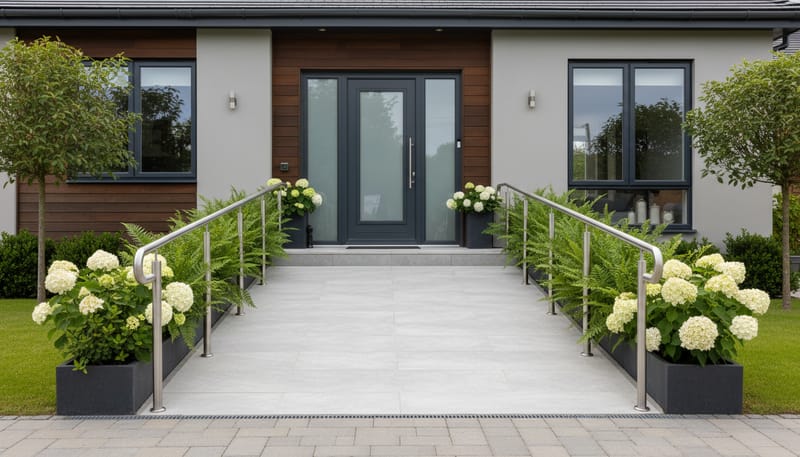
Why Accessibility Matters in New Build Homes
Accessibility is no longer a niche concern — it is a fundamental aspect of modern home design that affects everyone at some point in their lives. Whether you are a wheelchair user, a parent with a pushchair, someone recovering from an injury, or simply planning for the future as you age, the accessibility of your home determines how comfortably and independently you can live.
In the UK, approximately 14.6 million people live with a disability, representing around 22% of the population. As life expectancy increases, the demand for homes that can adapt to changing needs is growing rapidly. The good news for new build buyers is that modern construction standards require a significantly higher level of accessibility than older homes, and many developers go beyond the minimum requirements.
This guide explains the Building Regulations Part M framework that governs accessibility in new homes across England, the three compliance categories, and what features you can expect as standard. We also cover Lifetime Homes standards, adaptable design principles, and the grants and funding available if you need additional accessibility features.
Understanding these standards is important whether or not you currently have accessibility needs. A home built to higher accessibility standards is easier to live in for everyone, and it future-proofs your investment for whatever life may bring. Many buyers also find that accessible features — wider doorways, level thresholds, and ground-floor bathrooms — simply make a home more practical and comfortable for day-to-day living.
Building Regulations Part M: Access to and Use of Buildings
Approved Document M of the Building Regulations for England sets out the requirements for access to and use of buildings. Part M was significantly updated in 2015 to introduce a three-tier system of accessibility standards for new dwellings, replacing the previous one-size-fits-all approach.
These regulations apply to all new homes in England. Scotland, Wales, and Northern Ireland have their own building regulations with similar (and in some cases more stringent) accessibility requirements.
The Three Categories of Part M
Part M Volume 1 (dwellings) defines three categories of accessibility:
| Category | Name | Requirement | When Applied |
|---|---|---|---|
| M4(1) | Visitable dwellings | Basic accessibility allowing visitors with mobility needs to access the home | All new homes (mandatory minimum) |
| M4(2) | Accessible and adaptable dwellings | Enhanced features that allow future adaptation for changing needs | When required by planning condition |
| M4(3) | Wheelchair user dwellings | Full wheelchair accessibility, either ready (3a) or adaptable (3b) | When required by planning condition, usually affordable housing |
Category 1: M4(1) – Visitable Dwellings
This is the mandatory minimum standard for all new homes in England. Category 1 ensures that any person, including those with limited mobility, can visit the home. Key requirements include:
- An approach route from the edge of the plot to the principal entrance that is reasonably level (gradient no steeper than 1:15)
- A principal entrance with a level threshold (maximum 15mm upstand)
- Corridors and internal doorways wide enough for comfortable access
- A WC on the entrance storey (in dwellings of two or more storeys) or accessible from the entrance level
- Switches, sockets, and controls at accessible heights
Category 2: M4(2) – Accessible and Adaptable Dwellings
Category 2 goes significantly further than Category 1 and is designed to make homes easily adaptable for residents with changing needs over their lifetime. An increasing number of local authorities are requiring Category 2 as a condition of planning permission, particularly in areas with ageing populations. Key features include:
- Step-free access to the home and all habitable rooms on the entrance storey
- Wider doorways: minimum 850mm clear opening width for all habitable rooms
- Wider corridors: minimum 1,050mm width (compared to 900mm in Category 1)
- Accessible bathroom: space for future installation of a level-access shower, with walls strong enough to support grab rails
- Potential for ground-floor bedroom: at least one room on the entrance storey that could be used as a bedroom
- Kitchen designed for seated use: layout that can be adapted for wheelchair users
- Private outdoor space that is step-free and accessible
- Increased storage to accommodate mobility equipment
Category 3: M4(3) – Wheelchair User Dwellings
Category 3 provides full wheelchair accessibility and comes in two sub-categories:
- M4(3)(2)(a) – Wheelchair adaptable: The home is designed so it can be easily adapted for a wheelchair user in the future, but is not fitted out for wheelchair use at the point of sale. This is the more common requirement for market housing.
- M4(3)(2)(b) – Wheelchair accessible: The home is fully fitted out for a wheelchair user from day one, including wheelchair-height kitchen worktops, accessible bathroom fittings, and powered door entry. This is typically required for affordable rented housing only.
Accessibility Features by Compliance Level
The following table provides a detailed comparison of the accessibility features required at each Part M category. This is invaluable when assessing new build specifications and understanding exactly what level of accessibility your home provides.
| Feature | Cat 1: M4(1) | Cat 2: M4(2) | Cat 3: M4(3) |
|---|---|---|---|
| Step-free approach | Level or gently sloping approach to principal entrance | Step-free access to all entrance storey rooms | Step-free access throughout, including to outdoor space |
| Door widths | 750mm minimum clear opening | 850mm minimum clear opening | 850mm+ clear opening, power-assisted where required |
| Corridor widths | 900mm minimum | 1,050mm minimum | 1,200mm minimum for wheelchair turning |
| Entrance-level WC | Required in 2+ storey homes | Required, with potential for level-access shower | Fully accessible bathroom with level-access shower |
| Kitchen accessibility | Standard kitchen | Layout adaptable for seated use | Wheelchair-height worktops, knee recess under sink |
| Bedroom on entrance level | Not required | Potential for bedroom on entrance storey | Minimum one bedroom on entrance storey |
| Bathroom grab rails | Not required | Walls reinforced for future installation | Grab rails fitted as standard |
| Socket and switch heights | Accessible heights (450–1,200mm) | Accessible heights (450–1,200mm) | Wheelchair-accessible heights (400–1,000mm) |
| Staircase | Standard building regulation width | Suitable for future stairlift installation | Lift or through-floor lift provision required |
| Parking | Standard allocation | Wider parking space recommended | Minimum 3.3m wide accessible parking bay |
| Private outdoor space | No specific requirement | Step-free access to outdoor space | Level, hard-surfaced outdoor space |
When viewing a show home, ask the sales advisor which Part M category the development has been built to. If the development includes a mix of categories, check which applies to your specific plot.
Lifetime Homes and Designing for Ageing in Place
The Lifetime Homes Standard was developed by the Joseph Rowntree Foundation and Habinteg Housing Association as a set of 16 design criteria that make homes more accessible and adaptable for residents throughout their lives. Although the Lifetime Homes Standard was formally replaced by Part M Category 2 in 2015, its principles continue to influence design thinking and some local authorities still reference it in planning policies.
The 16 Lifetime Homes Criteria
The original 16 criteria covered the following areas, many of which have been incorporated into Part M Category 2:
- Parking width and approach
- Approach from parking to entrance
- Approach from the street to the entrance
- Entrances
- Communal stairs and lifts
- Internal doorways and hallways
- Circulation space
- Entrance-level living room
- Potential for entrance-level bed space
- Entrance-level WC and shower drainage
- WC and bathroom walls
- Stairs and potential for stairlift
- Potential for through-floor lift
- Bathroom layout
- Window specifications
- Controls, switches, and sockets
Ageing in Place: Why It Matters
The concept of ageing in place — the ability to continue living in your own home safely and independently as you get older — is a powerful argument for buying an accessible new build. Consider these facts:
- The UK population aged 65 and over is projected to grow by 40% over the next 25 years
- Around 1 in 3 people aged 65+ will experience a fall each year, making step-free living and grab rails genuinely life-saving features
- Adapting an older home for accessibility can cost £15,000 to £50,000+, whereas buying a new build to Category 2 standard from the outset costs the developer only around £1,500 extra per home
- Accessible homes have broader appeal at resale, as they serve the needs of a wider range of buyers
If you are planning to stay in your home for the long term, choosing a new build with Category 2 compliance or better is one of the smartest decisions you can make. Even younger buyers benefit, as accessible features make daily life easier for everyone — carrying shopping, managing a pushchair, or recovering from a sports injury.
What Accessibility Features New Builds Include as Standard
All new build homes in England must meet Part M Category 1 as a minimum. In practice, this means every new home you view will include certain baseline accessibility features, regardless of the developer or price point. Here is what to expect as standard:
Baseline Accessibility Features (Category 1)
- Level or ramped access from the pavement or parking area to the front door
- Low threshold at the front door (maximum 15mm upstand) for easy entry with a wheelchair, pushchair, or walking aid
- Ground-floor WC in homes with two or more storeys, accessible from the entrance level
- Internal door widths of at least 750mm clear opening, allowing passage with a walking frame
- Corridor widths of at least 900mm on the entrance storey
- Light switches and sockets positioned between 450mm and 1,200mm from the floor
- Wall-mounted consumer unit (fuse box) at an accessible height between 1,350mm and 1,450mm
What Developers Commonly Add Beyond the Minimum
Many leading UK developers go beyond Category 1 for all or part of their developments. Features commonly offered include:
Estimated percentage of new build developments including each feature as standard (across all categories). Based on industry data and developer specifications, 2024/25.
When reviewing the specification for a new build home, ask specifically about the Part M category and any accessibility features that go beyond the minimum. If you have specific needs, discuss these with the sales team early in the process — some developers will accommodate customisation requests before construction is complete.
Accessibility in Apartments vs Houses
The accessibility considerations differ depending on whether you are buying a new build apartment or a house. Each has distinct advantages and challenges.
New Build Apartments
Apartments in new build developments typically offer good accessibility for several reasons:
- Lift access: Most multi-storey apartment buildings include lifts, providing step-free access to upper floors. Check whether the lift is large enough for a wheelchair and what happens if the lift breaks down.
- Single-level living: Apartments provide all habitable space on one level, eliminating the need for stairs within the home.
- Communal entrance: Modern apartment buildings have automatic doors, wide corridors, and level access to communal areas.
- Considerations: Check corridor widths in communal areas, parking bay widths in underground car parks, and whether accessible storage is available for mobility scooters or wheelchairs.
New Build Houses
Houses offer more space for adaptation but introduce the challenge of stairs:
- Ground-floor living: Two-storey houses typically have a living room, kitchen, and WC on the ground floor. Category 2 homes also provide potential for a ground-floor bedroom.
- Staircase width: Category 2 homes have staircases designed to accommodate a future stairlift, with a minimum clear width of 850mm.
- Garden access: Houses usually have a private garden with step-free access from the rear of the property.
- Bungalows: Some developers offer bungalows or single-storey homes that provide all living space on one level. These are particularly popular with downsizers and buyers with mobility needs.
Accessibility Comparison: Apartments vs Houses
| Feature | New Build Apartment | New Build House (2-storey) | Bungalow |
|---|---|---|---|
| Single-level living | Yes (all on one floor) | No (ground floor + upper floors) | Yes (all on one floor) |
| Lift access | Typically included in building | Not applicable | Not applicable |
| Stairlift potential | Not needed | Yes (Cat 2+) | Not needed |
| Through-floor lift | Not needed | Space provision (Cat 3) | Not needed |
| Private outdoor space | Balcony (limited) | Private garden | Private garden |
| Wheelchair turning | Good in modern builds | Varies by house type | Generally excellent |
| Parking accessibility | Underground may be tight | On-plot or driveway | On-plot or driveway |
| Adaptation potential | Limited by building rules | Good (within structure) | Excellent |
Grants and Funding for Accessible Homes
If you need additional accessibility features beyond what is included as standard in your new build home, several grants and funding sources are available in the UK. These can help cover the cost of adaptations ranging from grab rails and ramps to more significant modifications.
Disabled Facilities Grant (DFG)
The Disabled Facilities Grant is the primary government funding source for home adaptations in England and Wales. Key details include:
- Available to homeowners and tenants (including those in new build homes)
- Maximum grant of £30,000 in England and £36,000 in Wales
- Means-tested for adults (not means-tested for children under 18)
- Covers essential adaptations such as stairlifts, wet rooms, widened doorways, kitchen adaptations, and ramps
- Applied for through your local council, which arranges an assessment by an occupational therapist
- No repayment required for grants under £5,000; grants over £5,000 may have a charge on the property
Other Funding Sources
| Funding Source | What It Covers | Maximum Amount | Eligibility |
|---|---|---|---|
| Disabled Facilities Grant | Major adaptations (stairlifts, wet rooms, ramps) | £30,000 (England) | Means-tested (adults) |
| NHS Wheelchair Services | Wheelchairs and powered mobility aids | No fixed limit | Referral by GP or OT |
| Motability Scheme | Adapted vehicles, powered wheelchairs | Varies | Higher-rate mobility component of PIP/DLA |
| Local authority minor adaptations | Grab rails, key safes, small ramps | Usually up to £1,000 | Usually not means-tested |
| Charitable grants | Varies by charity (e.g., Turn2us, Family Fund) | Varies | Depends on charity criteria |
| VAT relief | Zero-rate VAT on qualifying adaptations | 17.5% saving on works | Disabled person (self-declaration) |
It is worth noting that many adaptations for disabled people are zero-rated for VAT, which can save a significant amount on the cost of works. This applies to items such as stairlifts, ramps, widened doorways, and accessible bathrooms when supplied to a chronically sick or disabled person.
For more information on the financial aspects of buying a new build, including schemes that can help with the purchase itself, see our guide to shared ownership and our overview of stamp duty for new build homes.
Frequently Asked Questions
Are all new build homes wheelchair accessible?
No. All new build homes in England must meet Part M Category 1 (visitable dwellings), which provides basic accessibility features such as a level entrance, ground-floor WC, and accessible switch heights. However, full wheelchair accessibility (Category 3) is only required when specified as a condition of planning permission, which is most common in affordable housing schemes. If you need wheelchair-accessible housing, check with the developer which plots are built to Category 3.
Can I ask a developer to build my new build home to a higher accessibility standard?
In some cases, yes. If you are buying off-plan or at an early stage of construction, it may be possible to request upgrades such as wider doorways, reinforced bathroom walls, or a level-access shower. Discuss your needs with the sales team as early as possible, as structural changes become increasingly difficult once construction progresses beyond the foundation stage.
What is the difference between Lifetime Homes and Part M Category 2?
The Lifetime Homes Standard was a voluntary design standard with 16 criteria covering accessibility and adaptability. It was largely replaced by Part M Category 2 when the Building Regulations were updated in 2015. Category 2 incorporates most of the Lifetime Homes principles into mandatory building regulations, though some specific details differ. If a development advertises compliance with Lifetime Homes standards, it meets or exceeds Category 2 requirements.
How do I find new build homes built to Category 2 or Category 3?
Check the specification for each development, which should state the Part M category. You can also ask the developer directly. Many local authority planning policies now require a percentage of homes on larger developments to be built to Category 2, so new developments in these areas will often include accessible homes. For Category 3 homes, contact your local authority’s housing team, as these are often allocated through affordable housing schemes.
Will accessible features affect my home’s resale value?
Accessible features generally enhance resale value rather than diminish it. Wider doorways, level-access showers, and step-free entrances appeal to a broad range of buyers, including families, older people, and those with temporary or permanent mobility needs. As the UK population ages, demand for accessible homes is increasing, and properties that meet higher accessibility standards are likely to command a premium in the future.
Future-Proof Your Home With Accessible Design
Accessibility is not just about meeting the needs of disabled people — it is about creating homes that work for everyone, at every stage of life. Whether you are buying your first home, growing your family, or planning for retirement, the accessibility features built into modern new build homes offer genuine practical benefits and long-term peace of mind.
When comparing new build developments, check the Part M category for your chosen plot, review the specification for accessibility features, and consider whether the home will still meet your needs in 10, 20, or 30 years. If you need additional adaptations, explore the grants and funding available through the Disabled Facilities Grant and other sources.
For a complete guide to the new build buying process, including what to check before reserving and the step-by-step buying process, explore our comprehensive resources. And browse our guide to new build property types to find the home style that best suits your accessibility requirements and lifestyle.