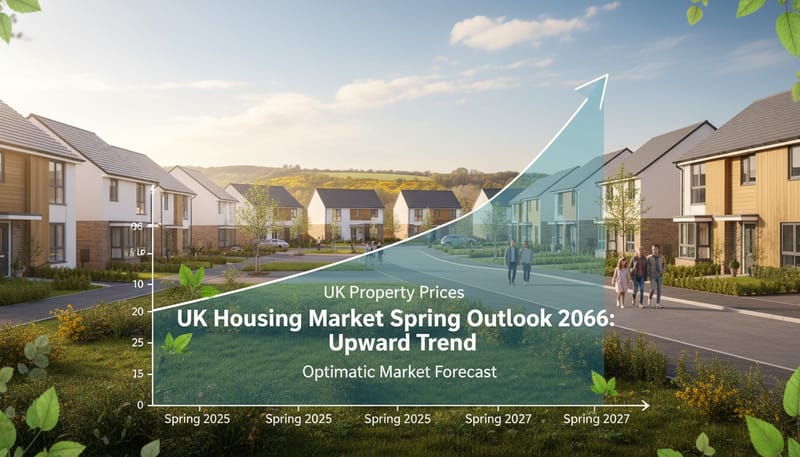
The UK new build housing market enters spring 2026 in a markedly different position from the uncertainty that characterised much of 2023 and 2024. With the Bank of England base rate having settled at 3.75% following a series of gradual cuts through 2025, mortgage affordability has improved significantly for prospective buyers. According to the latest data from the NHBC, new home registrations rose by 14% year-on-year in Q4 2025, reaching approximately 42,500 units for the quarter — the strongest final-quarter performance since 2021. This uptick signals renewed confidence from developers who had scaled back activity during the higher interest rate environment, and it sets the stage for what many industry analysts expect to be a robust spring selling season across most regions of England, Scotland, Wales and Northern Ireland.
Beyond the headline figures, the structural dynamics of the new build market are shifting in important ways. The government's revised National Planning Policy Framework (NPPF), introduced in late 2024 and now beginning to filter through into local plan decisions, is designed to accelerate housing delivery in areas of greatest need. The new Infrastructure Levy, which replaces much of the old Section 106 and Community Infrastructure Levy regime, is being piloted in a number of local authorities and promises to simplify developer contributions while potentially unlocking sites that were previously unviable. Meanwhile, the demographic picture — driven by net migration, household formation rates and an ageing population — continues to underpin long-term housing demand, with the Office for National Statistics (ONS) projecting that England alone will need around 250,000 to 300,000 new homes per year to keep pace. This article provides a detailed, data-driven analysis of what to expect from the new build market as we move through spring and into summer 2026, examining regional price forecasts, the supply pipeline, mortgage conditions, demand indicators and developer sentiment. Whether you are a first-time buyer, an investor, or simply interested in the state of housing in the UK, the outlook is nuanced but cautiously optimistic.
National Price Trends and Forecasts
After a period of modest price correction in 2023 and stagnation through much of 2024, UK new build prices have returned to positive growth territory. The HM Land Registry House Price Index showed that new build property prices in England and Wales rose by 3.8% in the year to December 2025, outperforming the wider housing market which recorded 2.9% growth over the same period. This premium reflects the continued demand for energy-efficient, modern homes that comply with the Future Homes Standard, as well as the warranty and specification advantages that new builds offer over older stock.
Looking ahead to 2026, the consensus among major forecasters is for further price appreciation in the new build sector. Savills projects national new build price growth of around 4.5% for the full year 2026, driven by constrained supply relative to demand and improved mortgage availability. Knight Frank is slightly more bullish at 5.0%, citing strong performance in the South East and East Midlands. The more conservative estimates, from the likes of the Office for Budget Responsibility (OBR), suggest around 3.5–4.0% growth, reflecting potential headwinds from global economic uncertainty and the possibility that inflation could prove stickier than hoped, delaying further base rate cuts.
It is important to note that the new build premium — the difference in price between a new build and an equivalent existing property — has been narrowing. In 2023, the average premium stood at approximately 22%, but this fell to 18.4% by end of 2025. The narrowing is largely attributable to the strong energy performance credentials of new builds becoming more widely recognised in mortgage valuations, while older stock faces increasing scrutiny over EPC ratings and the cost of retrofit. As the Future Homes Standard becomes fully mandatory from 2025 onwards, the running-cost advantage of a new build — estimated by the Home Builders Federation at £1,800–2,400 per year in energy savings — is increasingly being factored into buyer decision-making.
Regional Price Forecasts
The UK housing market is anything but homogeneous, and regional variations in new build price performance are expected to be significant through 2026. The following table summarises the latest forecast data from leading property consultancies and research houses, aggregated for each major region.
The standout story is the continued outperformance of the North and the devolved nations. Northern Ireland leads the pack with the strongest growth, driven by a combination of low base prices, strong local demand, and limited new supply. The North East and North West of England also show above-average growth trajectories, benefitting from major regeneration programmes, improved transport links (notably HS2 construction activity in the West Midlands feeding supply chain jobs northwards), and the ongoing levelling up agenda. For buyers looking for value and capital growth potential, regions such as the North East, Yorkshire and Humber, and Scotland continue to offer the most attractive entry points. For more detail on specific regional opportunities, see our guide to regional new build market hotspots in 2026.
London and the South East remain the most expensive markets and are forecast to see the slowest growth in percentage terms, though the absolute values of price increases remain substantial. The return of international buyers to the prime London market and the strong rental yield environment in zones 2–4 provide support, but affordability constraints and stamp duty costs continue to dampen demand for new build at higher price points. The South West and East of England sit in the middle, benefitting from lifestyle-driven demand and remote working trends that are now firmly embedded rather than pandemic-era anomalies.
Supply Pipeline: Where Are the New Homes Coming From?
The government's stated ambition remains to deliver 300,000 new homes per year in England, a target that has not yet been met since it was first articulated. In the year to March 2025, net additional dwellings in England totalled approximately 228,000 — an improvement on the 214,000 recorded in the previous year but still well short of the target. The new build component of this figure was around 195,000 completions, with the remainder coming from conversions, changes of use, and other gains.
The supply pipeline entering 2026 looks healthier than it has for several years. Planning permissions granted in England during 2025 totalled approximately 312,000 units, an 11% increase on the prior year, buoyed by the reformed NPPF which strengthened the presumption in favour of sustainable development and introduced mandatory housing targets for local authorities. This is a critical leading indicator, as permissions granted today typically translate into starts within 12–24 months and completions within 24–48 months. The uplift in permissions suggests that completion numbers should start rising more meaningfully through late 2026 and into 2027.
However, there are important caveats. The planning-to-completion conversion rate in England has historically averaged around 60–65%, meaning that a significant proportion of permissions never result in homes being built. Reasons for this include site viability issues, changes in developer priorities, land banking, and the time lag between permission and construction. The government's new measures to tackle slow build-out rates, including the power to issue completion notices and the requirement for developers to report annually on build-out timelines, are still in their early stages and have yet to demonstrably shift industry behaviour.
For more on how policy changes are affecting the supply picture, see our analysis of how planning reform is affecting new build supply.
The NHBC registration-to-completion ratio is a critical metric for understanding market timing. In a healthy market, the lag is typically 18–24 months. The surge in registrations in late 2025 should therefore feed through into increased completions from mid-2027 onwards. For spring 2026, the supply of newly completed homes available to buy will still be shaped by registrations made in 2024, when activity was more subdued — meaning supply constraints will persist in the near term.
Mortgage Market and Affordability
The mortgage market has undergone a significant transformation since the turmoil of late 2022 and the subsequent period of elevated rates. As of February 2026, the average two-year fixed rate for a new build mortgage stands at approximately 4.15%, down from a peak of over 6.5% in mid-2023. Five-year fixes are averaging around 3.85%, making them increasingly attractive for buyers seeking longer-term certainty. The improvement in rates has been gradual but meaningful, driven by the Bank of England's base rate reductions and a competitive lending environment among major banks and building societies.
Mortgage approvals have recovered strongly, with Bank of England data showing 68,200 approvals in January 2026, up 18% on the same month a year earlier and the highest January figure since 2022. Within this, new build-specific mortgage products have become more widely available, with several major lenders — including Nationwide, Halifax, and Barclays — introducing dedicated new build ranges with enhanced loan-to-value ratios and reduced arrangement fees. The FCA's ongoing review of the mortgage market has also encouraged greater innovation, with green mortgage products offering preferential rates for homes with EPC ratings of A or B becoming increasingly prevalent. Given that virtually all new builds meet this threshold, buyers of new homes are able to access some of the most competitive rates on the market.
Affordability, however, remains a challenge for many. The average house price to earnings ratio in England still stands at approximately 7.8x, well above the long-term historical average of around 5x. For first-time buyers, the ratio is somewhat lower at around 6.2x nationally, but significantly higher in London (approximately 10x) and the South East (approximately 8.5x). Government schemes such as the Mortgage Guarantee Scheme, which supports 95% LTV lending, continue to operate but uptake has been modest as many buyers prefer larger deposits to secure better rates. The shared ownership model remains an important pathway for many first-time buyers of new builds, and housing associations report strong demand for shared ownership properties, particularly in London and the South East where outright purchase is unaffordable for a significant proportion of prospective buyers.
Many developers are offering mortgage contribution packages for spring sales events, typically covering between £5,000 and £15,000 of mortgage costs over a set period. Combined with green mortgage discounts for energy-efficient new builds, this can represent a significant saving. Always compare the effective cost of these incentives against a straight price reduction, and consult an independent mortgage broker to ensure you are getting the best overall deal.
Demand Indicators: Who Is Buying?
Understanding demand for new builds requires looking at several buyer segments, each of which is influenced by different factors. The Home Builders Federation's quarterly buyer survey, conducted in Q4 2025, provides a useful snapshot of the current demand landscape.
First-time buyers now represent the largest single segment of new build purchasers at 38% of total sales, up 3 percentage points from a year earlier. This is encouraging, as it suggests that the combination of improved mortgage availability, developer incentives, and the inherent attraction of new builds (warranty protection, lower running costs, no chain) is drawing younger buyers into the market. The government's First Homes scheme, which provides a minimum 30% discount on new build properties in perpetuity for eligible local first-time buyers, has seen take-up grow through 2025, though the scheme remains relatively small in overall volume terms.
The downsizer segment is also growing, now at 15% of sales, as older homeowners increasingly recognise the benefits of moving to a modern, low-maintenance new build property. Many developers have responded by offering two- and three-bedroom bungalows and apartments designed specifically for this demographic, with single-level living, wider doorways, and accessible design features. This is a segment that the industry expects to grow further as the population ages and the desire to release housing equity for retirement income becomes more pressing.
Conversely, buy-to-let investor demand has continued to decline, falling to 12% of new build sales from 16% a year earlier. The cumulative impact of mortgage interest tax relief restrictions, the 3% stamp duty surcharge for additional properties, tighter regulation around energy efficiency and tenant rights, and the more recent increase in the surcharge to 5% announced in the Autumn 2024 Budget have made new build buy-to-let a less attractive proposition for many individual investors. Institutional investment via the build-to-rent sector has partially compensated, but this tends to operate in the apartment and flatted development market rather than in the traditional house-building sector. To understand how this is influencing the apartment market specifically, see our piece on new build apartment market trends and buyer preferences.
Developer Confidence and Activity
The mood among housebuilders has improved markedly. The Home Builders Federation / Glenigan Housing Pipeline Report for Q4 2025 showed that the proportion of developers reporting a positive outlook for the next 12 months had risen to 72%, the highest level since Q1 2022. This confidence is being translated into tangible action: land purchases by major housebuilders increased by 22% in value terms during 2025, and several of the UK's largest developers — including Barratt Redrow, Persimmon, Taylor Wimpey, and Bellway — have signalled increased output targets for their 2026 financial years.
The merger of Barratt Developments and Redrow, completed in 2024, created the UK's largest housebuilder by revenue and has resulted in a combined entity with the scale to accelerate delivery on larger strategic sites. Persimmon has continued its quality-improvement programme following the Stephanie Barwise KC review, investing in workforce training and customer service. Taylor Wimpey has focused on its higher-specification product range, while Bellway has expanded its geographic reach with new divisional offices in underserved regions.
SME housebuilders — those building fewer than 500 homes per year — have also seen an improvement in conditions, though their challenges remain more acute. The Federation of Master Builders (FMB) reports that access to development finance has improved, with more lenders re-entering the SME development finance market and loan-to-cost ratios improving. The government's ENABLE funding programme, which provides guarantees to lenders offering development finance to small builders, has been expanded, and this is beginning to have a noticeable impact. Nevertheless, SME builders still face disproportionate regulatory and planning burdens, and their share of total new build output — currently around 12% — remains far below the 40% they accounted for in the 1980s. Rebuilding this segment of the industry is widely recognised as essential if the 300,000 homes target is to be achieved.
The Future Homes Standard and Build Quality
All new homes in England must now comply with the Future Homes Standard, which took full effect in 2025. This mandates that new dwellings produce 75–80% less carbon emissions than the previous Building Regulations standard, achieved primarily through improved fabric efficiency (better insulation, triple glazing, airtightness) and low-carbon heating systems (primarily air source heat pumps). The standard effectively bans the installation of gas boilers in new builds and requires high levels of energy performance that should result in EPC A or B ratings as standard.
For buyers, this is a significant selling point. New build homes compliant with the Future Homes Standard are estimated to save occupants between £1,800 and £2,400 per year in energy costs compared to the average existing home, based on current energy prices. The standard also future-proofs homes against tightening EPC requirements for the rental market and the general direction of climate policy. The RICS has noted that the energy performance of a property is increasingly a material consideration in valuations, and it is likely that the gap between the value of energy-efficient and energy-inefficient homes will continue to widen.
Build quality more broadly continues to be an area of focus. The New Homes Quality Board (NHQB), established in 2022, now oversees the New Homes Quality Code which all major housebuilders have signed up to. The code provides a strengthened framework for consumer protection, including a two-year builder warranty for defects, a clear complaints and redress process, and professional standards for sales and marketing. The NHQB's New Homes Ombudsman service handled approximately 4,200 complaints in 2025, and while this represents a relatively small proportion of total transactions, the existence of the service provides an important safety net for buyers. Customer satisfaction scores as measured by the HBF 8-week survey have improved, with 91% of buyers in 2025 saying they would recommend their builder, up from 89% in 2024. For more on what buyers are looking for in their new homes, see our article on new build demand trends in 2026.
Key Risks and Headwinds
While the overall outlook for spring 2026 is positive, there are several risks that could temper the market's performance.
While CPI inflation has fallen to around 2.5%, persistent services inflation and wage growth above target mean that the Bank of England may be cautious about further rate cuts. If rates remain at 3.75% or above through 2026, the expected acceleration in demand could be more modest than forecast.
Build costs have continued to rise, with the BCIS reporting a 4.2% increase in construction cost indices during 2025. Labour shortages remain acute in several trades, including bricklaying, plastering, and electrical installation, and the cost of building materials — particularly steel, concrete, and insulation products — has not returned to pre-2022 levels. These cost pressures may limit developer margins and could feed through into prices or reduced incentive packages.
Despite planning reforms, many local planning authorities remain severely under-resourced. DLUHC data shows that the average time to determine a major housing application has risen to 16 weeks, and over a third of authorities are failing to meet the statutory 13-week determination period. Without investment in planning capacity, the pipeline of consents may not translate into starts as quickly as the headline figures suggest.
Geopolitical tensions, trade disruptions, and the possibility of a global economic slowdown could impact the UK housing market indirectly through confidence effects, supply chain disruptions, and financial market volatility. While the UK housing market is primarily a domestic story, it is not immune to international headwinds.
Timeline: Key Market Events for Spring 2026
Bank of England MPC meeting — market expects base rate to hold at 3.75%. Spring selling season officially begins for most major housebuilders with new phase launches.
New stamp duty thresholds take effect following Autumn Budget changes. NHBC publishes Q1 2026 registration data — a key leading indicator for completions in 2027/28.
Bank of England MPC meeting — possible 0.25% rate cut to 3.50% if inflation continues to moderate. ONS publishes latest household projection data. Peak period for spring sales events and show home openings.
DLUHC publishes annual housing supply statistics (net additions for 2025/26). Major housebuilders report half-year or full-year results. Land Registry publishes February 2026 price data (typical 3-month lag).
What This Means for Different Buyer Types
The spring 2026 market presents different opportunities depending on your circumstances and objectives.
The combination of lower mortgage rates, green mortgage discounts, and developer incentives makes spring 2026 one of the more favourable windows for first-time buyers in recent years. Shared ownership and First Homes schemes provide additional routes to ownership. Focus on energy-efficient new builds to maximise long-term savings.
The improving market means your existing property is likely to sell more quickly and at a fair price, facilitating an onward move. Part-exchange schemes offered by developers can simplify the process. The premium for moving from an older property to a new build is narrowing, making the upgrade more cost-effective.
The investment case for new build has become more nuanced. Higher stamp duty surcharges and regulation increase costs, but strong rental demand and the low-maintenance nature of new builds support yields. Focus on regions with strong tenant demand and capital growth potential. Build-to-rent developments may offer better value than individual buy-to-let.
Frequently Asked Questions
The consensus forecast is for new build prices in England to rise by between 4.0% and 5.5% during 2026, driven by constrained supply, improved mortgage affordability, and strong underlying demand. Some regions, particularly the North East and Northern Ireland, could see higher growth. A significant price fall is considered unlikely in the absence of a major economic shock.
For owner-occupiers buying for the medium to long term, the spring 2026 market offers competitive mortgage rates, strong developer incentive packages, and the security of buying a home built to the Future Homes Standard. However, waiting for a possible further base rate cut in May 2026 could yield slightly better mortgage terms. As always, personal circumstances should be the primary driver of timing.
An off-plan purchase typically involves a reservation followed by exchange of contracts within 28 days, with completion on the date the home is finished. Build times vary by developer and house type, but typically range from 6 to 18 months from reservation for a property not yet started. Properties already under construction may complete within 3–9 months. Always ask the developer for a realistic completion timeline and ensure your mortgage offer validity period covers it.
The main government-backed options for 2026 include: the Mortgage Guarantee Scheme (supporting 95% LTV lending), the First Homes scheme (30%+ discount for eligible local first-time buyers), shared ownership (buy a share from 25% upwards), and Right to Shared Ownership (on certain new affordable homes). Help to Buy has ended, but its legacy continues through the many first-time buyers who used it and are now trading up within the new build market.
New builds offer lower maintenance costs, tenant appeal (especially for energy efficiency), NHBC warranty protection, and often stronger rental demand. However, the premium means initial yields may be lower than for equivalent existing properties. For investment, consider regions with strong tenant demand and capital growth potential. Build-to-rent blocks may offer better management and facilities than individual new build buy-to-let. Always factor in the 5% stamp duty surcharge for additional properties when calculating returns.
Conclusion: A Cautiously Optimistic Outlook
The UK new build market enters spring 2026 in its healthiest state for several years. The fundamentals are largely supportive: mortgage rates have come down significantly from their 2023 peak, the Bank of England appears on a gradual easing path, planning reform is beginning to unlock more sites, developer confidence is at a multi-year high, and underlying demand from a growing population and evolving household structures remains robust. The introduction of the Future Homes Standard has given new builds an additional competitive edge over existing stock, particularly in the context of rising energy costs and tightening environmental regulations.
However, the market is not without risks. Inflation may prove stickier than expected, delaying further base rate cuts. Construction cost pressures and labour shortages continue to constrain margins and potentially limit output. The planning system, despite reform, remains a bottleneck in many areas. And the global economic outlook introduces uncertainty that could dampen confidence at any point.
For buyers, the message is nuanced. If you are buying to live in for the medium to long term, the spring 2026 market offers a good combination of value, choice, and financing options. Regional variations are significant, so local market research is essential. If you are investing, selectivity is key — focus on regions with strong fundamentals and be realistic about the impact of regulation and taxation on returns. And for those simply watching the market, the trajectory is clear: the UK needs more homes, the policy environment is becoming more supportive of delivery, and the new build sector is gearing up to respond.
Browse our latest new build developments across the UK, or explore specific regional hotspots for 2026 to find opportunities in your area.