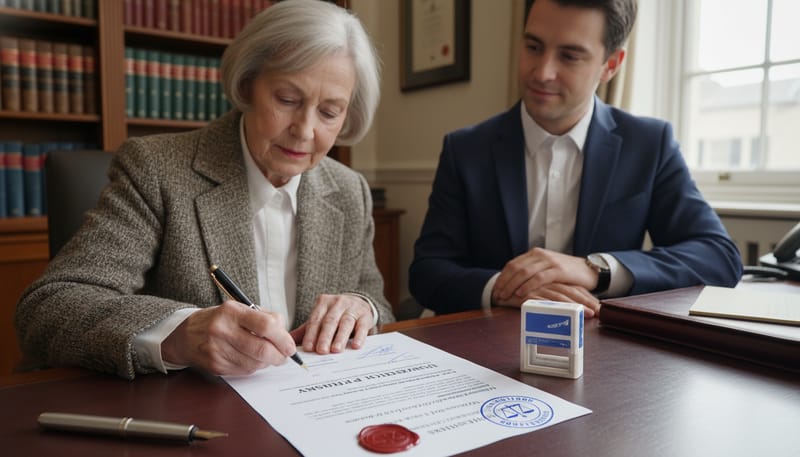
When You Might Need a Power of Attorney for a New Build Purchase
Buying a new build home is a major legal and financial commitment, and the process requires you to sign multiple documents, make time-sensitive decisions, and attend to various formalities – often at specific dates and times that may not be flexible. But what happens if you cannot be physically present for key stages of the transaction? Whether you are working abroad, serving in the military, dealing with a health condition, or simply unable to attend due to other commitments, a Power of Attorney (POA) may provide the solution.
A Power of Attorney is a legal document that allows you to appoint another person – known as your “attorney” – to act on your behalf in legal and financial matters. In the context of a new build home purchase, this means your attorney can sign contracts, exchange, complete the purchase, and handle other legal formalities on your behalf. This guide explains when a POA is needed, the different types available, how to set one up, what your attorney can do, and the specific considerations that apply to new build purchases, including off-plan transactions.
Please note: This article provides general guidance on using a Power of Attorney for property purchases in England & Wales. It is not a substitute for professional legal advice. Always consult a qualified solicitor before granting a Power of Attorney. The law in Scotland and Northern Ireland differs – in Scotland, the equivalent document is a “Power of Attorney” registered with the Office of the Public Guardian (Scotland), and the legal requirements vary.
Common Scenarios Requiring a Power of Attorney
There are numerous situations where having a Power of Attorney can be essential – or at least highly practical – when purchasing a new build home. The most common scenarios include:
Working or Living Abroad
If you are based overseas for work or personal reasons, attending key stages of the purchase in person may be impossible or impractical. New build purchases often have tight timelines, particularly around exchange and completion, and the developer may not be willing to delay the process for your travel arrangements. A POA allows your attorney (often a trusted family member, partner, or solicitor) to handle the transaction on your behalf while you are abroad.
Military Service
Members of the Armed Forces may be deployed at short notice or stationed in locations that make it impossible to attend to property transactions. Military personnel have long used Powers of Attorney to manage their financial and legal affairs during deployment, and a new build purchase is no exception. Many military families use a POA to ensure that the buying process can continue without interruption even when the service member is unavailable.
Illness or Disability
If you become ill or incapacitated during the purchase process, a POA can ensure that the transaction is not derailed. This is particularly important for off-plan purchases, where the period between reservation and completion may span many months or even years. A Lasting Power of Attorney (discussed below) provides protection in case of future incapacity, while a general POA can be used for temporary illness where you retain mental capacity but are physically unable to attend.
Joint Purchasers with Scheduling Conflicts
If you are buying with a partner or co-purchaser and one of you cannot attend at the required time, a POA allows the other person (or a third party) to sign on behalf of the absent buyer. This is more common than many people realise, particularly with new build completions where the date may be set by the developer with limited flexibility.
Off-Plan Purchases with Extended Timelines
When buying off-plan, the gap between reservation and completion can be 12–24 months or more. Circumstances can change significantly during this period – you might take a new job abroad, fall ill, or face other commitments that prevent you from being available. Having a POA in place from the outset provides a safety net, ensuring the purchase can proceed regardless of what happens in the interim.
Types of Power of Attorney: General vs Lasting
There are two main types of Power of Attorney relevant to property purchases in England & Wales: a General Power of Attorney and a Lasting Power of Attorney (LPA). Understanding the difference is critical because they serve different purposes and have different legal implications.
| Feature | General Power of Attorney | Lasting Power of Attorney (Property & Financial) |
|---|---|---|
| Governed by | Powers of Attorney Act 1971 | Mental Capacity Act 2005 |
| Registration required? | No (but can be registered voluntarily) | Yes – must be registered with OPG before use |
| Effective while donor has capacity? | Yes | Yes (if donor specifies this) |
| Continues if donor loses capacity? | No – automatically revoked | Yes – this is its primary purpose |
| Scope | Can be general or limited to specific transactions | Covers all property and financial affairs (or as restricted by donor) |
| Registration fee | None (unless voluntarily registered) | £82 per LPA to the Office of the Public Guardian |
| Registration time | N/A | 8–12 weeks (sometimes longer) |
| Best suited for | Temporary absence (travel, work abroad) | Long-term protection, potential future incapacity |
General Power of Attorney
A General Power of Attorney is a relatively simple document that authorises your attorney to act on your behalf for a defined period or specific transaction. It is commonly used when the donor (the person granting the power) is temporarily unable to act – for example, because they are travelling abroad or will be unavailable at the time of completion. Key features include:
- It can be limited to a specific transaction (e.g., “to sign all documents necessary to complete the purchase of [property address] on my behalf”) or general (covering all financial and property matters)
- It does not need to be registered with the Office of the Public Guardian, though it is valid as a deed and must be witnessed
- It is automatically revoked if the donor loses mental capacity – this is the critical limitation
- It can be revoked at any time by the donor, provided they have mental capacity
For a straightforward new build purchase where you know you will be temporarily unavailable, a General POA limited to the specific transaction is often the most appropriate and cost-effective option.
Lasting Power of Attorney (Property & Financial Affairs)
A Lasting Power of Attorney is a more comprehensive and robust document, designed to remain effective even if the donor loses mental capacity. There are two types of LPA – one for Property & Financial Affairs and one for Health & Welfare. For a property purchase, you need the Property & Financial Affairs LPA. Key features include:
- It must be registered with the Office of the Public Guardian (OPG) before it can be used – registration currently costs £82 and takes 8–12 weeks
- It can be specified to take effect immediately upon registration or only upon loss of capacity – for property purchase purposes, it is usually set up to take effect immediately
- It continues to be effective if the donor loses mental capacity, providing long-term protection
- It requires the involvement of a certificate provider (a person who confirms the donor understands the LPA and is not under undue pressure) and can include named persons who are notified when the LPA is registered
An LPA is the better choice if you are concerned about the possibility of future incapacity, or if the off-plan purchase timeline is long enough that your circumstances might change significantly. Many financial advisors recommend having an LPA in place as a general precaution, regardless of any specific property transaction.
How to Set Up a Power of Attorney: Process & Costs
Setting up a Power of Attorney requires careful planning, particularly if you need it to be in place before a specific date (such as exchange or completion of your new build purchase). The process differs depending on whether you are creating a General POA or a Lasting POA.
Setting Up a General Power of Attorney
- Instruct a solicitor – While you can technically create a General POA yourself using a standard form, it is strongly advisable to have a solicitor draft it, particularly for a property transaction where precision is important
- Define the scope – Specify whether the POA covers a specific transaction (recommended for a one-off purchase) or all financial matters during a defined period
- Sign as a deed – The General POA must be executed as a deed, which means it must be signed by the donor in the presence of a witness (who also signs)
- Provide to your solicitor – The original or a certified copy should be provided to your conveyancing solicitor, who will hold it on file and present it to the Land Registry when registering the purchase
Costs: A solicitor will typically charge between £150 and £400 to draft and advise on a General Power of Attorney. There is no registration fee.
Setting Up a Lasting Power of Attorney
- Choose your attorney(s) – Decide who you want to appoint. You can appoint one or more attorneys, and specify whether they must act jointly (all together), jointly and severally (together or independently), or jointly for some decisions and jointly and severally for others
- Complete the LPA form – This can be done online through the Government’s Make and Register a Lasting Power of Attorney service, or on paper. The form requires details of the donor, attorney(s), certificate provider, and any restrictions or conditions
- Certificate provider verification – A certificate provider (either someone who has known you well for at least two years, or a professional such as a solicitor, doctor, or social worker) must certify that you understand the LPA and are not being pressured
- Sign in the correct order – The LPA must be signed in a specific order: first the donor, then the certificate provider, then the attorney(s). Signing in the wrong order can invalidate the document
- Register with the OPG – Submit the completed and signed LPA to the Office of the Public Guardian with the registration fee of £82. Registration currently takes 8–12 weeks, though the Government has been working to reduce this
Costs: If you instruct a solicitor to prepare the LPA, expect to pay between £300 and £800 for professional fees, plus the £82 OPG registration fee. If you prepare it yourself using the Government’s online tool, the only mandatory cost is the £82 registration fee. Fee exemptions or reductions may be available if you receive certain benefits or have a low income.
| Cost Element | General POA | Lasting POA |
|---|---|---|
| Solicitor’s fees (drafting & advice) | £150–£400 | £300–£800 |
| OPG registration fee | N/A | £82 |
| Certificate provider fee (if professional) | N/A | £0–£150 (varies) |
| Processing time | Days (once signed) | 8–12 weeks (registration) |
| Typical total cost | £150–£400 | £382–£1,032 |
What Your Attorney Can Do on Your Behalf
Once a valid Power of Attorney is in place, your attorney can carry out a range of actions on your behalf throughout the new build purchase process. The exact scope depends on the terms of the POA, but for a property purchase, the attorney typically has authority to:
- Sign the reservation agreement – Although it is preferable for the buyer to do this personally, the attorney can sign if the POA is already in place and the developer accepts it
- Instruct and communicate with your solicitor – Providing instructions on legal matters, responding to enquiries, and making decisions about the transaction
- Sign the contract for exchange – The attorney signs the purchase contract on your behalf, and the exchange is legally binding on you as if you had signed it yourself
- Authorise the release of deposit funds – Directing the solicitor to transfer the deposit from your account (or from funds held by the solicitor) to the developer’s solicitor
- Sign the transfer deed (TR1) – The attorney signs the Land Registry transfer document that formally transfers the legal title to you
- Complete the purchase – Attending to all formalities on completion day, including authorising the balance payment
- Sign mortgage documents – Subject to the lender’s approval (see below), the attorney can sign the mortgage deed on your behalf
- Deal with post-completion matters – Such as signing SDLT returns or providing information for Land Registry applications
Limitations on the Attorney’s Powers
There are important limitations on what an attorney can do:
- The attorney must act in the donor’s best interests at all times – they cannot use the power for their own benefit (unless the POA specifically permits this)
- The attorney cannot exceed the scope of the POA – if it is limited to a specific transaction, they cannot use it for other purposes
- For a General POA, the attorney cannot act if the donor has lost mental capacity
- Some actions may require additional consents – particularly from mortgage lenders (see below)
- The attorney must keep proper records of all actions taken and decisions made on behalf of the donor
It is crucial that your conveyancing solicitor is aware of the POA from the outset, as they will need to verify its validity and ensure all documents are executed correctly. The solicitor should also confirm that the POA is in a form acceptable to the Land Registry, which has specific requirements for powers of attorney used in property transactions.
Mortgage Lender Requirements for Power of Attorney
If you are purchasing with a mortgage, your lender’s attitude to Powers of Attorney is a critical consideration. Not all lenders accept a POA for signing mortgage documents, and those that do often impose specific conditions. Failing to check this in advance can cause serious problems at the point of exchange or completion.
General Lender Positions
Lender policies on POA vary considerably:
- Some lenders accept a POA for all aspects of the transaction, including signing the mortgage deed, provided the POA meets their specific requirements
- Some lenders accept a POA for the purchase but not for the mortgage deed – meaning the borrower must personally sign the mortgage deed, even if everything else is handled by the attorney
- A small number of lenders do not accept a POA at all – the borrower must sign all documents in person
The lender’s requirements will be set out in the UK Finance Mortgage Lenders’ Handbook (formerly the CML Handbook), which your solicitor will refer to when acting for the lender. Common lender requirements include:
- The POA must be a specific or limited POA (not a general unrestricted power)
- The attorney must not be the other party to the transaction (e.g., the seller)
- The attorney must not be the borrower’s solicitor
- The lender may require proof that the donor had mental capacity at the time the POA was granted
- For an LPA, the lender may require a certified copy of the registered document
It is essential that your solicitor checks the specific lender’s requirements regarding POA early in the transaction – ideally at the point of mortgage application or as soon as you know a POA will be needed. If your lender does not accept a POA, you may need to consider switching lenders (which could affect your rate and terms) or making alternative arrangements to sign the mortgage deed in person. Understanding these requirements is part of the broader legal checklist before exchange.
Practical Considerations for Off-Plan Purchases
Off-plan new build purchases present unique challenges when it comes to Powers of Attorney, primarily because of the extended timeline between reservation and completion. Here are the key practical considerations:
Timing the POA Setup
If you are buying off-plan and there is any possibility that you may be unavailable during the purchase process, consider setting up a POA early – ideally at the same time as instructing your solicitor. For an LPA, the 8–12 week registration period means you need to plan well ahead. Waiting until you actually need the POA may be too late, particularly if the developer gives short notice of the completion date.
Changes in Circumstances
During a long off-plan period, your circumstances may change. Consider the following scenarios and how they affect the POA:
- You change your mind about the attorney – A General POA can be revoked at any time by written notice. An LPA can also be revoked, but this must be done formally (by written deed, sent to the OPG if already registered)
- The attorney becomes unavailable – If you have appointed only one attorney and they become unavailable (through illness, death, or unwillingness to act), the POA fails. Consider appointing replacement attorneys in your LPA to mitigate this risk
- Your mortgage offer expires – If the completion is delayed beyond the mortgage offer validity period, you may need to reapply for a mortgage. Check whether the new lender’s POA requirements differ from the original lender’s
- The developer changes the completion date – Off-plan completion dates are notoriously fluid. Ensure your POA covers the entire anticipated period, and consider an LPA (which has no expiry date) rather than a time-limited General POA. See our guide on delayed completion rights for more on this issue
Developer Acceptance
Most developers are accustomed to dealing with Powers of Attorney and will accept them without issue. However, it is good practice to inform the developer’s sales team and solicitors at an early stage that a POA may be used. Some developers may want to see a copy of the POA in advance, and their solicitors may have specific requirements regarding the form of execution.
Throughout the process, ensure you maintain clear communication with your solicitor about the POA arrangements. Your solicitor handling the legal searches and conveyancing should coordinate the POA aspects alongside the standard transaction work.
Frequently Asked Questions
Can I set up a Power of Attorney from abroad?
Yes, it is possible to set up a Power of Attorney while you are abroad, though the process may be more complex. For a General POA, you can sign the document overseas, but it must still be executed as a deed with proper witnessing. Many UK embassies and consulates offer notarial services that can assist with this. For an LPA, the signing requirements are more stringent – you will need a certificate provider who can confirm you understand the document and are not under undue pressure. If you are abroad, consider instructing a UK-based solicitor who can coordinate the process, potentially with the assistance of a local notary or solicitor in your country of residence. Allow extra time for posting documents internationally.
How much does a Power of Attorney cost for a property purchase?
A General Power of Attorney typically costs between £150 and £400 in solicitor’s fees, with no registration fee. A Lasting Power of Attorney costs between £300 and £800 in professional fees, plus £82 for OPG registration. If you prepare an LPA yourself using the Government’s online service, the only mandatory cost is the £82 registration fee, though professional advice is strongly recommended for property transactions. Some solicitors offer a combined package if you are setting up a POA as part of a broader conveyancing instruction.
Will my mortgage lender accept a Power of Attorney?
This depends on the specific lender. Many major UK mortgage lenders accept a Power of Attorney for property purchases, but their specific requirements vary. Some accept a POA for all aspects of the transaction including signing the mortgage deed, while others require the borrower to personally sign the mortgage deed. A small number of lenders do not accept a POA at all. Your solicitor should check the lender’s position early in the transaction – ideally before you submit your mortgage application – so that alternative arrangements can be made if necessary. The UK Finance Mortgage Lenders’ Handbook sets out each lender’s specific requirements.
What is the difference between a General POA and a Lasting POA for property purchases?
A General POA is simpler, cheaper, and quicker to set up. It is ideal for short-term or one-off situations where you know you will be temporarily unavailable (e.g., working abroad during completion). However, it is automatically revoked if you lose mental capacity. A Lasting POA is more comprehensive and continues to be effective even if you lose capacity. It requires registration with the OPG (costing £82 and taking 8–12 weeks) but provides long-term protection. For off-plan purchases with extended timelines, an LPA is generally the safer choice because it covers the possibility of unforeseen incapacity during the long wait for completion.
Can my attorney also be my solicitor?
While there is no absolute legal prohibition on a solicitor acting as your attorney, most mortgage lenders specifically prohibit this, and it can create conflicts of interest. The solicitor acting in the conveyancing is already acting for both you and the lender, and adding an attorney role creates an additional layer of potential conflict. It is generally best practice to appoint a trusted family member, partner, or friend as your attorney, and to keep the solicitor’s role separate. Your solicitor can advise on the best approach for your specific circumstances.
Conclusion: Planning Ahead for a Smooth Purchase
A Power of Attorney can be an invaluable tool when purchasing a new build home, particularly if your circumstances mean you may not be available for every stage of the transaction. Whether you are working abroad, serving in the military, managing a health condition, or simply want the reassurance of a backup plan for a long off-plan purchase, setting up a POA in advance ensures that the transaction can proceed smoothly regardless of your availability.
The key takeaways from this guide are:
- Plan early – If there is any chance you may need a POA, set it up at the beginning of the purchase process. LPA registration takes 8–12 weeks, and leaving it to the last minute risks causing delays
- Choose the right type – A General POA is simpler and cheaper for short-term needs; an LPA provides longer-term protection and covers the possibility of future incapacity
- Check your lender’s requirements – Not all mortgage lenders accept POAs, and those that do may have specific conditions. Check this early to avoid problems at exchange or completion
- Choose your attorney carefully – Appoint someone you trust completely, who understands the responsibility, and who will be available when needed
- Inform all parties – Tell your solicitor, the developer, and your mortgage lender about the POA arrangements from the outset
- Seek professional advice – A solicitor experienced in new build conveyancing can advise on the best POA strategy for your specific situation and ensure the document meets all necessary requirements
With proper planning and the right legal advice, using a Power of Attorney for your new build home purchase need not be complicated. It is simply a practical tool that ensures your property transaction can proceed on schedule, even when life does not go exactly to plan. For further guidance on the broader legal aspects of buying a new build, explore our guides on new build contracts and the step-by-step buying process.