What Is Part Exchange and Why Consider It?
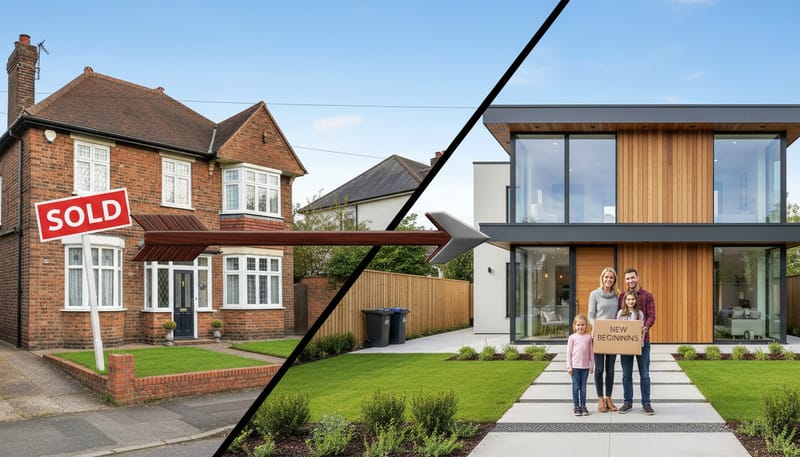
Part exchange is a scheme offered by many UK housebuilders that allows you to sell your existing property directly to the developer as part of the transaction for purchasing a new build home. In essence, the developer buys your current home and the equity you hold in it is applied towards the purchase price of your new property, much like trading in a car at a dealership. It is one of the most popular incentives offered by major developers and can be a genuinely valuable option for buyers who want to move to a new build without the stress and uncertainty of selling on the open market.
The concept is straightforward: rather than listing your current home with an estate agent, waiting for a buyer, navigating a potentially fragile chain, and coordinating completion dates, the developer takes your existing property off your hands at an agreed price. This creates a chain-free transaction, which is one of the most compelling advantages of buying new build. You know exactly when you’ll move, how much you’ll receive for your current home, and there is no risk of the sale collapsing due to chain issues.
Part exchange is particularly attractive to homeowners who need the certainty of a coordinated sale and purchase, those relocating for work to a tight deadline, families who want to minimise disruption, and anyone who has struggled to sell their property on the open market. However, it’s not suitable for everyone, and understanding the process, costs, and trade-offs is essential before committing.
In this comprehensive guide, we’ll walk you through every aspect of part exchange – from how the process works step by step to the financial implications and which developers offer the scheme. Whether you’re a first-time mover or an experienced homeowner, this guide will help you decide if part exchange is the right route for your new build purchase.
The Part Exchange Process: Step by Step
Understanding the part exchange process in detail will help you plan your timeline and set realistic expectations. While specific procedures vary between developers, the general process follows a consistent pattern across the industry.
Step 1: Reserve Your New Build Home
The process typically begins with you reserving the new build property you wish to purchase. During the reservation stage, you’ll discuss part exchange with the sales adviser, who will explain the developer’s specific scheme and confirm whether your existing property is likely to be eligible. A reservation fee – typically £500 to £1,000 – is usually required, which is refundable if the part exchange doesn’t proceed.
It’s important to note that some developers will assess your part exchange application before accepting a reservation, while others will process both simultaneously. Asking about the developer’s specific approach early on will help you manage your expectations and timeline.
Step 2: Property Assessment and Eligibility Check
The developer will conduct an initial assessment of your existing property to determine whether it meets their part exchange criteria. This typically involves reviewing basic details such as the property type, location, condition, value range, and any potential issues. Properties that clearly fall outside the scheme’s parameters – for example, those significantly above or below the value threshold – may be declined at this stage.
Step 3: Independent Valuations
If your property passes the initial assessment, the developer will arrange for independent valuations. Most developers commission two or three independent estate agents to provide market valuations of your property. These valuations are conducted at the developer’s expense, and the agents are typically local firms with strong knowledge of your area’s property market.
The valuations are genuine market appraisals – the agents assess what your property would realistically achieve if sold on the open market within a reasonable timeframe. They consider factors such as condition, location, comparable recent sales, and current market conditions.
Step 4: Part Exchange Offer
Based on the independent valuations, the developer will make you a formal part exchange offer. This offer is typically based on the average of the valuations received, though the exact methodology varies. Some developers use the lowest of three valuations, while others average all valuations and may then apply a small discount to reflect the certainty and convenience they’re providing.
The part exchange offer is usually between 90% and 100% of the estimated open market value, with most major developers offering 95% to 100%. The specific percentage depends on the developer, the property, and prevailing market conditions. You are under no obligation to accept the offer – if you feel it undervalues your home, you can decline and pursue a sale on the open market instead.
Step 5: Property Inspection
If you wish to proceed with the part exchange offer, the developer will arrange a detailed inspection of your property. This may include a structural survey or condition report, and the developer will want to assess any maintenance issues, necessary repairs, or factors that could affect the property’s value or saleability. If significant issues are identified, the offer may be adjusted to reflect the cost of remedial work.
Step 6: Legal Process and Completion
Once the offer is agreed, the legal process runs in parallel for both the sale of your existing home and the purchase of your new build. Your solicitor will handle the conveyancing for both transactions, and the developer’s legal team will manage their side. Completion dates are coordinated so that both transactions complete simultaneously – you sell your old home and move into your new one on the same day, eliminating the need for temporary accommodation or storage.
Typical timelines from initial agreement to moving day. Actual timescales may vary based on individual circumstances.
Eligibility Criteria for Part Exchange
Not every property qualifies for part exchange, and eligibility criteria vary between developers. Understanding these requirements early in the process will save you time and help you assess whether part exchange is a realistic option for your situation.
Common Eligibility Requirements
While specific criteria differ, most developers apply the following general requirements:
- Value ratio: Your existing property must typically be worth no more than 60–70% of the new build property’s purchase price. Some developers set this at a fixed percentage, while others assess on a case-by-case basis. A small number of developers accept properties worth up to 80% of the new build price.
- Property type: Most developers accept houses, bungalows, and standard flats. However, properties with non-standard construction (such as timber frame, steel frame, or prefabricated buildings), listed buildings, and houseboats are typically excluded.
- Condition: The property should be in a reasonable, saleable condition. Major structural issues, subsidence, serious damp problems, or properties requiring extensive renovation are usually excluded or may result in a significantly reduced offer.
- Location: The existing property generally needs to be within a reasonable distance of the new development – typically within a 30 to 50 mile radius, though this varies.
- Tenure: Freehold and standard leasehold properties are usually accepted. Short leases (typically under 80 years remaining) may be problematic, as can properties with unusual tenure arrangements.
- Planning and legal issues: Properties with unresolved planning issues, boundary disputes, restrictive covenants that affect saleability, or in flood risk zones may be excluded.
- Occupancy: The property should be your current main residence. Buy-to-let properties and second homes are not typically accepted for part exchange.
Properties That May Face Challenges
Certain property types can be more difficult to part exchange, even if they technically meet the eligibility criteria. These include flats above commercial premises, properties on busy roads, ex-local authority homes in certain areas, and properties with very specific or limited buyer appeal. If you’re unsure whether your property qualifies, it’s always worth enquiring with the developer directly, as many will consider borderline cases on their individual merits.
Part Exchange vs Selling on the Open Market
Deciding between part exchange and selling your home on the open market is one of the most important financial decisions you’ll make during the new build buying process. Both routes have distinct advantages and disadvantages, and the right choice depends on your individual circumstances, priorities, and the current state of the property market.
| Factor | Part Exchange | Open Market Sale |
|---|---|---|
| Sale Price | Typically 90–100% of market value | Full market value achievable |
| Timeline to Completion | 6–10 weeks typically | 14–26 weeks with chain |
| Chain Risk | None – completely chain-free | Moderate to high risk of collapse |
| Estate Agent Fees | None – developer pays | 1.0–3.0% + VAT (£2,500–£10,000+) |
| Viewings & Disruption | Minimal – valuations only | Potentially many viewings over months |
| Certainty of Sale | Guaranteed once offer accepted | No guarantee until exchange |
| Conveyancing Complexity | Simpler – coordinated process | More complex with multiple parties |
| Negotiation Power | Limited – developer sets offer | Full control over asking price |
| Property Presentation | No staging or preparation needed | May need decoration, staging, repairs |
| Stress Level | Low – managed, predictable process | Higher – uncertainty throughout |
When Part Exchange Makes Most Sense
Part exchange is generally the better option when you value certainty and speed over maximising the sale price of your existing home. Specific scenarios where part exchange particularly excels include:
- You’re relocating for work and need to move by a specific date
- Your property has been on the market for some time without selling
- You want to avoid the stress and disruption of keeping your home “show ready”
- The property market is slow or uncertain, making a quick sale unlikely
- You’re in a chain and have experienced previous fall-throughs
- The new build you want is in high demand and you risk losing your preferred plot
- You have family commitments (such as school start dates) that require a predictable timeline
When Selling on the Open Market May Be Better
Conversely, selling on the open market may be preferable if your property is in a hot market where it’s likely to sell quickly at or above asking price, if the difference between the part exchange offer and potential market price is substantial, or if you’re not under time pressure and can afford to wait for the best offer. Keep in mind that even if you achieve a higher sale price on the open market, the estate agent fees, additional legal costs, potential double-moving expenses, and the value of your time should all be factored into the comparison.
Which Developers Offer Part Exchange?
Part exchange is offered by the majority of the UK’s major housebuilders, though the specific terms, conditions, and value thresholds vary between companies. Understanding which developers participate and their particular approaches will help you choose the right developer for your needs.
Major Developers with Part Exchange Schemes
Most of the UK’s largest housebuilders offer part exchange programmes as a core part of their sales incentive packages. These include Barratt Homes and David Wilson Homes (which operate a well-established scheme known as “Smooth Move”), Taylor Wimpey (offering “easymover”), Persimmon Homes, Bellway, Redrow, and Berkeley Group, among many others.
Each developer operates its scheme slightly differently. Some commission three independent valuations and base their offer on the average; others use two valuations and may apply a fixed percentage. The value threshold – the maximum percentage of the new build price that your existing property can represent – also varies, typically ranging from 60% to 75%.
| Developer | Scheme Name | Typical Value Cap | Valuations Used | Key Features |
|---|---|---|---|---|
| Barratt / David Wilson | Smooth Move | 70% of new home price | 3 independent | One of the most established schemes; available on most developments |
| Taylor Wimpey | easymover | 70% of new home price | 2–3 independent | Flexible criteria; widely available nationwide |
| Persimmon | Part Exchange | 65% of new home price | 2–3 independent | Available on most sites; streamlined process |
| Bellway | Part Exchange Plus | 70% of new home price | 2–3 independent | Good flexibility on property types accepted |
| Redrow | Part Exchange | 70% of new home price | 3 independent | Comprehensive scheme with dedicated PX team |
| Berkeley Group | Part Exchange | 65–70% of new home price | 2–3 independent | Available on selected developments |
| Cala Homes | Part Exchange | 70% of new home price | 3 independent | Tailored approach with personal service |
Smaller and regional developers may also offer part exchange, though it tends to be assessed on a case-by-case basis rather than as a standard programme. It’s always worth asking, even if part exchange isn’t prominently advertised.
Some developers also work with specialist part exchange companies – third-party firms that purchase your property on behalf of the developer. This approach can sometimes offer more flexibility on eligibility criteria, though the process may take slightly longer. Your sales adviser will confirm which arrangement applies to the development you’re interested in.
Financial Implications, Fees, and Costs
Understanding the full financial picture of part exchange is essential for making an informed decision. While the headline benefit is convenience and certainty, the financial implications extend beyond the simple sale price comparison.
The Part Exchange Price
The most significant financial consideration is the price you receive for your existing home. Part exchange offers typically range from 90% to 100% of estimated market value, with most falling in the 95% to 100% range for properties in good condition in popular locations. For a property worth £250,000 on the open market, a part exchange offer of 95% would be £237,500 – a difference of £12,500.
However, this headline difference doesn’t tell the full story. You need to subtract the costs you would incur selling on the open market:
- Estate agent fees: Typically 1.0–3.0% + VAT of the sale price. On a £250,000 property at 1.5%, this equates to £4,500 including VAT.
- EPC certificate: Required for a sale, costing £60–£120.
- Property preparation: Decorating, repairs, staging, and professional photography can cost £500–£3,000.
- Additional mortgage payments: If the sale takes longer than expected, additional months of mortgage payments on your existing home add up. At £1,200 per month, three extra months costs £3,600.
- Potential temporary accommodation: If the chain breaks or timings don’t align, you may need temporary housing and storage, costing £2,000–£5,000 or more.
When these costs are factored in, the real financial difference between part exchange and an open market sale is often much smaller than the headline price gap suggests – and in some cases, part exchange can actually work out financially equivalent or even better, particularly in slower markets.
Stamp Duty Considerations
Stamp duty is calculated on the purchase price of your new build home, not on any net amount after part exchange. This means the full new build purchase price applies for stamp duty purposes, regardless of how much equity you’re transferring from your existing property. This is the same whether you sell via part exchange or on the open market, so it doesn’t create a relative advantage or disadvantage.
Additional Incentives
Many developers offer part exchange as part of a broader incentive package. When negotiating incentives, you may be able to combine part exchange with other benefits such as contribution towards stamp duty, free upgrades, legal fee assistance, or a reduction in the purchase price. Some developers are more flexible on combining incentives than others, so it’s always worth exploring the full range of available support.
Tips for Getting the Best Part Exchange Deal
While part exchange is a more structured process than selling on the open market, there are still steps you can take to ensure you get the best possible outcome.
Before the Valuations
First impressions matter, even for professional valuers. Before the independent estate agents visit your property, take time to present it at its best. This doesn’t mean undertaking major renovations, but basic preparation can make a meaningful difference to the valuations you receive:
- Declutter thoroughly – Remove excess furniture and personal items to make rooms feel larger and brighter
- Deep clean the entire property – Including windows, carpets, and outdoor areas
- Address minor maintenance issues – Fix dripping taps, replace cracked tiles, touch up paintwork
- Improve kerb appeal – Tidy the front garden, clean the driveway, repaint the front door if needed
- Ensure good lighting – Open curtains, replace any blown light bulbs, and turn on all lights for the valuation
- Highlight recent improvements – Provide evidence of any recent work such as a new boiler, rewiring, or extension
Negotiating the Offer
While part exchange offers are based on independent valuations, there is sometimes room for discussion. If you believe the valuations don’t accurately reflect your property’s value, you can provide evidence of recent comparable sales in your area that support a higher figure. Some developers will review their offer in light of new evidence, particularly if you can demonstrate that similar properties have recently sold for more.
You can also negotiate on the overall deal rather than just the part exchange price. If the developer won’t increase the part exchange offer, they may be willing to include additional incentives such as free upgrades, stamp duty contributions, or furniture packages. Consider what matters most to you – the absolute price for your existing home, or the overall value of the package you receive.
Getting Your Own Valuation
Before the developer’s valuations take place, it’s worth obtaining your own independent valuation from one or two local estate agents. This gives you a benchmark against which to assess the developer’s offer and ensures you have an informed view of your property’s worth. Be aware that estate agents may provide optimistic valuations if they believe they might win your instruction to sell, so ask specifically for a realistic achievable price within a three-month timeframe.
Finally, before committing to part exchange, it’s important to check everything before reserving your new build property. Understand the full terms of the part exchange agreement, including any conditions that could affect the offer, and ensure your solicitor reviews all documentation as part of the contract review process.
Frequently Asked Questions
How much less will I get for my home through part exchange compared to selling privately?
Part exchange offers typically range from 90% to 100% of the estimated open market value, with most major developers offering between 95% and 100%. The exact figure depends on the developer, your property’s desirability, and current market conditions. However, when you factor in the estate agent fees, additional mortgage payments during a potentially longer sale process, property preparation costs, and the risk of chain collapse that you avoid through part exchange, the real financial difference is often significantly smaller than the headline gap. In some cases – particularly in slower markets or with properties that may take time to sell – part exchange can work out financially equivalent to an open market sale.
Can I part exchange if I still have a mortgage on my current home?
Yes, absolutely. Having a mortgage on your existing property does not prevent you from using part exchange. The equity in your home (the difference between its value and your outstanding mortgage) is what transfers towards the purchase of your new build. The developer’s legal team and your solicitor will coordinate the mortgage redemption as part of the completion process, ensuring your existing lender is repaid in full from the part exchange proceeds. You will then take out a new mortgage for the balance of the new build purchase price, if needed. Your mortgage adviser can help you plan this transition.
How long does the part exchange process take from start to finish?
The typical timeline for part exchange from initial application to moving day is six to ten weeks, though this can vary depending on the developer, the stage of construction of your new home, and the complexity of the legal process. The initial assessment and valuation process usually takes two to three weeks, with the remaining time devoted to legal work and coordination. If your new build home is still under construction, the part exchange agreement may be reached well in advance of the actual move date, giving you certainty about the sale of your existing property while the new home is completed.
What happens to my existing home after part exchange?
Once the part exchange completes, your former property belongs to the developer. They will typically sell it on the open market, either through their own sales team or via an estate agent. Some developers have dedicated property disposal teams that manage part exchange properties, while others work with specialist firms. The developer assumes all responsibility for the property from completion, including any costs associated with selling it. This is part of the service they provide through the part exchange scheme, and it’s factored into the price they offer you.
Can I use part exchange with shared ownership or other government schemes?
Part exchange is generally available on full-market-value purchases and is not typically compatible with shared ownership schemes, as the lower purchase price and different ownership structure create complications. However, some developers may offer part exchange on other incentive programmes, so it’s always worth asking. The availability of part exchange alongside other incentives varies between developers and may depend on the specific development and prevailing market conditions.
Is Part Exchange Right for You?
Part exchange is a powerful tool in the new build buyer’s toolkit, offering certainty, speed, and convenience that an open market sale simply cannot match. For many buyers, the peace of mind that comes with a guaranteed, chain-free transaction is worth far more than the potential difference in sale price – particularly when the true costs of selling on the open market are taken into account.
The key is to approach part exchange as one option within your overall buying strategy. Obtain your own valuations, understand the developer’s specific terms, compare the full financial picture (including all fees and costs), and consider what matters most to your personal circumstances. Whether you’re moving for work, upsizing for a growing family, or simply ready for the quality and efficiency of a new build home, part exchange can make the transition smoother and more predictable.
For a complete overview of all the incentives and support available when purchasing a new build property, explore our guide to buying a new build home in the UK, and learn more about the pricing and value of new build properties to ensure you’re making the most informed decision possible.