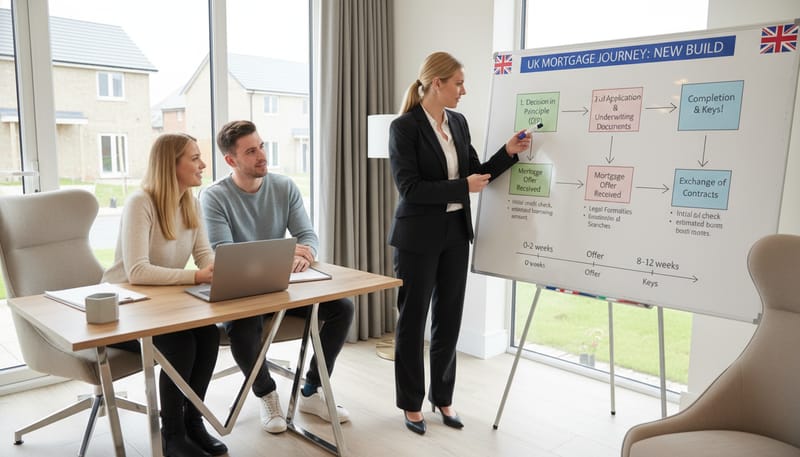
New Build vs Resale: How the Mortgage Process Differs
| Stage | Resale Purchase | New Build Purchase |
|---|
| When you apply | After having offer accepted | After reserving a plot (often months before the property is built) |
| Valuation | Physical inspection of existing property | May be desktop valuation, plans-based, or physical inspection of show home/completed unit |
| Offer validity | 6 months is usually sufficient | May need 9–12 months for off-plan — offer can expire before completion |
| Exchange to completion gap | Usually 1–4 weeks | Can be weeks or months — completion depends on build progress |
| Incentives to declare | Rarely any | Must declare all developer incentives — affects LTV calculation |
| Chain | Often part of a chain | No upward chain — but you may need to sell first |
| Completion date certainty | Agreed and fairly reliable | Developer gives estimated date that can shift weeks or months |
| Snagging / condition | Survey reveals issues before exchange | Snagging happens after completion — you're committed before seeing the finished home |
The Complete New Build Mortgage Timeline
Here is every step, in order, with what happens, who does it, and how long it typically takes.
Step 1: Research and Preparation
| Task | Detail | Timeframe |
|---|
| Check your credit file | Review Experian, Equifax, and TransUnion reports. Fix errors, dissociate old links. | 3–6 months before applying |
| Reduce debts | Pay down credit cards, loans, and close unused credit accounts. | 2–3 months before |
| Gather documents | Payslips (3 months), P60, bank statements (3 months), ID, proof of address. Self-employed: SA302 + accounts. | 1 month before |
| Calculate your budget | Use our affordability guide to estimate what you can borrow. | Before viewing any properties |
| Choose a broker or lender | Whole-of-market broker recommended. See our lender comparison guide. | Before visiting show homes |
Step 2: Decision in Principle (DIP)
| Aspect | Detail |
|---|
| What it is | An indicative statement from a lender confirming how much they'd lend you, subject to full application and valuation |
| What it involves | Basic income, expenditure, and credit check. Soft or hard credit search depending on lender. |
| How long it takes | Minutes online, or 1–2 hours with a broker appointment |
| How long it lasts | 60–90 days typically |
| Why you need it | Developers require a DIP before accepting a reservation. It proves you can get a mortgage. |
| Does it guarantee a mortgage? | No. It's indicative only. The full application, valuation, and underwriting can change the outcome. |
| Soft vs hard search | Soft search doesn't appear on your credit file. Hard search does. Ask which before applying. |
Get your DIP before visiting the sales office. Developers may pressure you to reserve on the spot — having a DIP means you can act confidently.
Step 3: Reservation
| Aspect | Detail |
|---|
| Reservation fee | Typically £500–£1,000 (some developers charge up to £2,000) |
| What it secures | Your chosen plot is taken off the market for an agreed period (usually 28 days) |
| Is it refundable? | Usually only if the developer withdraws. Consumer Code requires clear refund terms before you pay. |
| What you must do next | Instruct a solicitor and submit a full mortgage application within the reservation period |
| Incentives agreed | Stamp duty contribution, upgrades, and other incentives are usually confirmed at reservation |
This is the point of commitment. Once you reserve, the clock starts on your mortgage application. For reservation agreement details, see our contract checking guide.
Step 4: Full Mortgage Application
| What You Submit | Detail |
|---|
| Application form | Detailed income, expenditure, employment, and property details |
| Proof of income | 3 months' payslips + latest P60 (employed) or 2–3 years' SA302 + accounts (self-employed) |
| Bank statements | 3 months showing regular income and spending patterns |
| Proof of deposit | Savings statements, gift letter (if gifted), or sale agreement (if from existing property) |
| ID and address proof | Passport/driving licence + utility bill/council tax statement |
| Property details | Reservation confirmation, plot details, purchase price, developer incentives |
| Solicitor details | Your instructed solicitor's name, firm, and reference number |
Your broker submits this to the lender. Processing typically takes 2–5 working days before the valuation is instructed.
Step 5: Valuation
The valuation is the lender's check that the property is worth what you're paying for it. New builds are valued differently from resale.
| Valuation Type | When Used | What Happens | Cost |
|---|
| Desktop valuation | Standard new build from established developer with good comparable data | Valuer assesses remotely using plans, local data, and developer info. No site visit. | Often free (lender absorbs) |
| Drive-by valuation | Build near completion, established development | Valuer visits externally, checks location and comparable properties | £150–£300 |
| Physical inspection | Non-standard build, high value, or lender policy requires it | Valuer inspects property (or show home equivalent), checks quality and comparables | £250–£500 |
| Re-inspection | Property was valued from plans; lender requires confirmation when built | Second visit once property is physically complete | £100–£250 |
What Can Go Wrong at Valuation
| Issue | What Happens | Solution |
|---|
| Down-valuation | Valuer says property is worth less than purchase price | Negotiate with developer, increase deposit, appeal valuation, or switch lender. See our mortgage problems guide. |
| Incentives reduce valuation | Lender deducts incentive value, increasing effective LTV | May need larger deposit or to reduce incentives taken |
| Property type restriction | Lender won't lend on certain new build types (high-rise flats, non-standard construction) | Switch to lender that accepts the property type |
| Lease terms unacceptable | Lease too short, ground rent too high, or unfair clauses | Developer must amend lease to meet UK Finance Handbook requirements |
Step 6: Underwriting and Mortgage Offer
| Stage | What Happens | Typical Timeframe |
|---|
| Underwriting review | Underwriter reviews application, valuation, credit check, and documentation in detail | 3–10 working days |
| Additional queries | Underwriter may request further documents (explanation letter, additional payslips, etc.) | Adds 3–7 days per round of queries |
| Conditions to offer | Some offers have conditions that must be met before drawdown (e.g., proof of buildings insurance) | Ongoing — must be satisfied before completion |
| Mortgage offer issued | Formal document confirming the loan: amount, rate, term, monthly payment, conditions | Sent to you and your solicitor |
| Offer validity | Usually 6 months, extendable for new builds (see timing strategy) | Check the expiry date immediately |
Step 7: Between Offer and Exchange
| Task | Who Does It | Detail |
|---|
| Solicitor reviews contract pack | Your solicitor | Reviews developer's contract, title, searches, management company details. See our conveyancing guide. |
| Searches completed | Your solicitor | Local authority, environmental, water/drainage, mining (if applicable) |
| Enquiries raised and answered | Your solicitor ↔ developer's solicitor | Questions about title, restrictions, adoption of roads/sewers, management company |
| Report on title | Your solicitor → your lender | Solicitor certifies the property meets lender's requirements (UK Finance Handbook compliance) |
| Deposit arranged | You | Transfer deposit funds to solicitor's client account. Typically 10% of purchase price minus reservation fee. |
| Buildings insurance | You (or confirmed by developer's warranty) | Some lenders require buildings insurance from exchange; new builds are usually covered by NHBC/warranty provider during construction |
Step 8: Exchange of Contracts
| What Happens | Detail |
|---|
| Contracts exchanged | Both parties sign identical contracts. Your solicitor transfers the exchange deposit to the developer's solicitor. |
| You are legally committed | After exchange, pulling out means losing your deposit and potentially being sued for breach of contract. |
| Completion date | For ready-to-move-in: specific date agreed at exchange. For still-building: may be a target date or "within X days of notice of completion." |
| Notice period | Developer typically gives 10–14 days' notice that the property is ready to complete |
The gap between exchange and completion is where new builds differ most from resale. For a resale, it's usually 1–4 weeks. For a new build, it could be days or months depending on build progress.
Step 9: Pre-Completion
| Task | Detail | When |
|---|
| Developer issues notice of completion | Formal notification that the property will be ready on a specific date | 10–14 days before completion |
| Check mortgage offer is still valid | If offer has expired, you need to reapply or get an extension | Immediately on receiving notice |
| Solicitor requests mortgage funds | Your solicitor sends a "requisition on title" to the lender requesting drawdown | 5–10 working days before completion |
| Lender releases funds | Mortgage money sent to your solicitor's client account via CHAPS | Usually the day before or morning of completion |
| Arrange buildings insurance | Must be in place from completion day. Lender requires evidence. | Before completion |
| Final balance ready | Any remaining funds (stamp duty, solicitor fees, balance not covered by mortgage) must be in solicitor's account | 1–2 days before completion |
Step 10: Completion Day
| Time | What Happens |
|---|
| Morning | Lender sends mortgage funds to your solicitor via CHAPS (if not sent day before) |
| Mid-morning | Your solicitor transfers purchase price to developer's solicitor |
| Confirmation | Developer's solicitor confirms receipt of funds |
| Keys released | Developer's sales team releases keys to you — usually at the sales office on site |
| Home demonstration | Developer walks you through the property, showing meters, stopcock, consumer unit, warranties |
| Handover pack | You receive warranty documents, appliance manuals, emergency contacts, and after-sales information |
Step 11: Post-Completion
| Task | Who Does It | Deadline |
|---|
| Stamp Duty Land Tax (SDLT) payment | Your solicitor | Within 14 days of completion |
| Land Registry registration | Your solicitor | Within priority period (usually 30 working days) |
| First mortgage payment | You (direct debit) | Usually 1 month after completion — lender confirms exact date |
| Snagging inspection | You (or professional snagger) | Within first few weeks — report defects to developer |
| Council tax registration | You | Notify local authority of move-in date |
Timeline Comparison: How Long Does It All Take?
| Scenario | DIP to Reservation | Application to Offer | Offer to Exchange | Exchange to Completion | Total |
|---|
| Ready-to-move-in new build | 1–4 weeks | 2–4 weeks | 4–8 weeks | 1–4 weeks | 8–20 weeks |
| Nearly complete (3–6 months) | 1–4 weeks | 2–4 weeks | 4–8 weeks | 4–16 weeks | 11–32 weeks |
| Off-plan (6–12 months) | 1–4 weeks | Apply 6 months before completion | 4–8 weeks | Months (build-dependent) | 6–12+ months |
| Off-plan (12+ months) | 1–4 weeks | Apply 6–9 months before completion | 4–8 weeks | May be months | 12–24+ months |
| Resale (for comparison) | 1–2 weeks | 2–4 weeks | 4–8 weeks | 1–4 weeks | 8–18 weeks |
Off-Plan Purchases: Special Mortgage Considerations
Buying off-plan — before the property is built — creates unique mortgage timing challenges.
| Challenge | Why It Happens | How to Handle It |
|---|
| Cannot get mortgage offer yet | Lender needs a completion date within offer validity period | Get a DIP now. Apply formally when build is 6–9 months from completion. |
| Rates may change | You reserved at today's rates but won't complete for 12+ months | Budget based on rates 1–2% higher than current. Consider your product choice carefully. |
| Affordability may change | Your income or commitments could shift over 12+ months | Don't take on new debt between reservation and mortgage application. |
| Property may value differently | Market could rise or fall between reservation and valuation | Be prepared for down-valuation. Keep extra savings as buffer. |
| Developer may change specification | Materials or layout adjustments during build | Your solicitor should check final specification matches contract. See our contract guide. |
Part-Exchange and Its Impact on the Mortgage Process
If you're selling an existing property to buy a new build, the developer may offer part-exchange — they buy your current home directly.
| Aspect | Detail |
|---|
| How it works | Developer values your current home (usually via 2–3 independent estate agents), offers 85–95% of average valuation |
| Advantage | Guaranteed sale, no chain, certain completion date, reduces stress significantly |
| Disadvantage | You receive less than open market value — typically 5–15% below what you'd get selling privately |
| Mortgage impact | Your deposit is the equity from part-exchange. Lender values the new build independently — they don't consider what you got for your old home. |
| Timing | Part-exchange completes simultaneously with your new build purchase — no bridging needed |
| Eligibility | Usually your existing property must be worth less than 70% of the new build price. Some developers have other restrictions. |
What the Lender Needs from the Developer
Your solicitor must obtain and verify these items from the developer before the lender will release funds.
| Requirement | Why the Lender Needs It | Common Issues |
|---|
| NHBC or equivalent warranty | Protects lender's security for 10 years against structural defects | Some warranty providers aren't accepted by all lenders. Check before applying. |
| Building regulations completion certificate | Confirms property meets building regulations | May not be issued until shortly before completion — can cause last-minute delays |
| Clean title | Developer must have clear ownership and right to sell | Complex on large sites with multiple phases and planning conditions |
| Road and sewer adoption agreements | Lender wants assurance roads and sewers will be adopted by the local authority | Section 38 (highways) and Section 104 (drainage) agreements must be in place |
| Management company details | If an estate management company exists, lender checks it's properly constituted | Some lenders disqualify properties with certain management company structures |
| Lease terms (leasehold only) | Must comply with UK Finance Handbook — minimum term, ground rent limits, etc. | Ground rent escalation clauses can make property unmortgageable |
| EWS1 form (flats in buildings 11m+) | External Wall System fire safety assessment | May be required for flats in taller new build blocks — delays if not available |
Mortgage Offer Conditions Specific to New Builds
Beyond standard conditions, new build mortgage offers often include these special requirements.
| Condition | What It Means | Action Required |
|---|
| Re-inspection on completion | Lender requires valuer to visit the finished property before funds are released | Budget for additional valuation fee (£100–£250). Can delay completion by a few days. |
| Incentive declaration | Lender requires a written statement of all developer incentives offered | Provide full list of incentives to your solicitor and broker. Omitting incentives is mortgage fraud. |
| Warranty cover note | Proof of structural warranty from an accepted provider | Developer must provide before completion. Solicitor verifies it meets lender requirements. |
| Satisfactory lease review | Lender's legal team must approve the lease terms | Developer may need to amend lease if terms don't meet UK Finance Handbook standards |
| Management company confirmation | Details of estate/management company and share transfer process | Solicitor obtains from developer |
| Buildings insurance from completion | Lender requires adequate buildings insurance from day of completion | Arrange in advance — new builds may have specific requirements (rebuild cost, warranty interaction) |
What to Do If Your Mortgage Offer Expires
This is the most common new build mortgage problem. Here's what happens and what your options are.
| Option | How It Works | Risk |
|---|
| Request extension from current lender | Some lenders grant 3–6 month extensions for new builds, sometimes at the original rate | Not guaranteed. Lender may require fresh credit/affordability check. |
| Reapply with same lender | Submit new application at current rates and criteria | Rate may be higher. Affordability criteria may have tightened. You could be declined. |
| Switch to different lender | Apply to lender with longer offer validity or different criteria | New valuation required. Timeline resets. Rate may differ. |
| Ask developer to extend longstop date | If the delay is developer's fault, request more time in the contract | Developer may refuse. Check your contractual rights — see our legal pitfalls guide. |
Prevention is better than cure: choose a lender with the longest new build offer validity that covers your expected completion date plus a 3-month buffer.
The Role of Your Broker Throughout the Process
| Stage | What Your Broker Does |
|---|
| Before DIP | Assesses your affordability across multiple lenders, identifies best options for your situation |
| DIP | Submits DIP application, interprets results, advises on timing |
| Full application | Prepares and submits full application, handles document gathering, chases lender |
| Valuation | Liaises with valuer if issues arise, requests re-valuation or alternative lender if down-valued |
| Underwriting queries | Responds to underwriter questions, provides additional evidence, explains unusual income patterns |
| Offer received | Reviews offer terms, checks conditions, confirms rate and product match expectations |
| Offer expiry risk | Monitors completion timeline, requests extensions, arranges alternative lender if needed |
| Completion | Confirms funds release timing with lender, troubleshoots last-minute issues |
| Post-completion | Sets reminder for deal end date, starts remortgage process when current deal nears expiry |
A good broker is particularly valuable for new build purchases because of the timing complexities and the need to match lender criteria to developer requirements.
Documents Checklist: Everything You Need
| Document | Who Needs It | When |
|---|
| Passport or driving licence (photo ID) | Lender + solicitor | Application stage |
| Utility bill or council tax (address proof) | Lender + solicitor | Application stage |
| 3 months' payslips | Lender | Application stage |
| Latest P60 | Lender | Application stage |
| 3 months' bank statements (all accounts) | Lender | Application stage |
| SA302 + tax year overviews (2–3 years) | Lender (self-employed only) | Application stage |
| Company accounts (2–3 years) | Lender (directors only) | Application stage |
| Proof of deposit (savings statements) | Lender + solicitor | Application and pre-exchange |
| Gift letter + donor's bank statement | Lender + solicitor (if deposit is gifted) | Application stage |
| Reservation confirmation | Lender + solicitor | After reserving |
| Developer incentive schedule | Lender | With application or at valuation |
| Buildings insurance quote | Lender | Before completion |
Costs You'll Pay During the Mortgage Process
| Cost | Typical Amount | When Payable | Notes |
|---|
| Reservation fee | £500–£2,000 | At reservation | Deducted from deposit on exchange |
| Mortgage arrangement fee | £0–£1,999 | At application or added to loan | Fee-free products exist — see our comparison guide |
| Valuation fee | £0–£500 | At application | Often free on certain products |
| Broker fee | £0–£500 or commission from lender | At application or completion | Many brokers are free to the buyer |
| Solicitor/conveyancing fees | £1,000–£2,500 | On completion | Higher for leasehold — see our conveyancing guide |
| Search fees | £250–£400 | During conveyancing | Paid upfront to solicitor |
| Stamp Duty Land Tax | Varies by price and buyer status | Within 14 days of completion | See our stamp duty guide |
| Land Registry fee | £100–£500 | Post-completion | Depends on property price |
For a complete breakdown of all buying costs, see our new build budget planner.
Frequently Asked Questions
How long does it take to get a mortgage on a new build?
From full application to mortgage offer typically takes 2–6 weeks, depending on the lender's processing times, complexity of your application, and whether additional documentation is requested. The entire process from DIP to completion can range from 8 weeks (ready-to-move-in) to 12+ months (off-plan).
Can I apply for a mortgage before the property is built?
You can get a Decision in Principle (DIP) at any time. Full applications are usually submitted once you've reserved a plot and have a reasonable completion timeline within the lender's offer validity period (6–12 months). Applying too early risks the offer expiring before completion.
What happens if the valuation is lower than the purchase price?
This is called a down-valuation. Options include: negotiating a price reduction with the developer, increasing your deposit to cover the shortfall, appealing the valuation with comparable evidence, or switching to a different lender whose valuer may assess differently. This is covered in detail in our mortgage problems guide.
Do I need a survey on a new build?
The lender's valuation is not a survey — it only confirms value for lending purposes. A professional snagging inspection after completion is strongly recommended. A full structural survey is unusual for new builds since they're built to current building regulations and covered by a structural warranty.
What if my circumstances change between application and completion?
You must inform your lender of any material changes: job loss, reduced income, new debts, relationship changes, or additional dependants. Failure to disclose material changes could constitute mortgage fraud. If your circumstances deteriorate, the lender may withdraw or reduce the offer. This is another reason to maintain financial stability between reservation and completion.
Can I use my mortgage offer for a different plot on the same development?
Usually not without modification. The offer is for a specific property at a specific price. Changing plots typically requires a new valuation and potentially revised offer terms. Your broker can arrange this, but it adds time to the process.