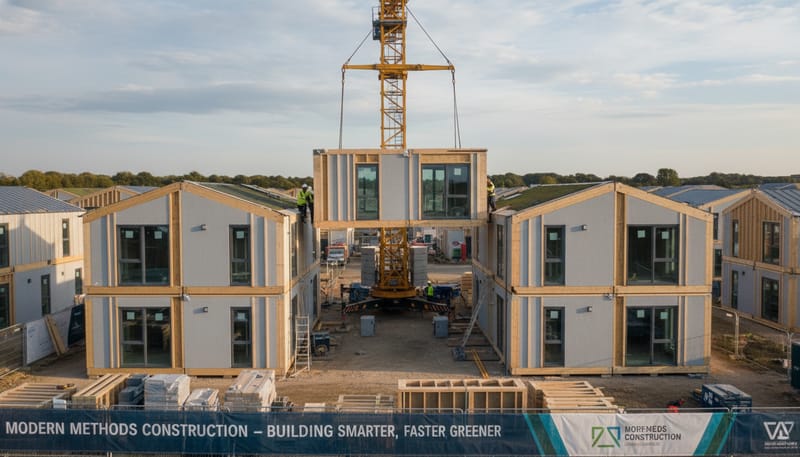
Modular and MMC Construction: The Future of New Builds
Published by New-Builds Team
The UK's housing industry is undergoing a quiet revolution. Modern Methods of Construction (MMC) — encompassing everything from fully modular volumetric homes manufactured in factories to advanced panelised systems and innovative sub-assemblies — are fundamentally reshaping how new build homes are designed, produced, and delivered. While traditional brick-and-block construction remains the dominant method, MMC adoption is accelerating rapidly, driven by compelling advantages in speed, quality, sustainability, and the urgent need to address the UK's persistent housing shortage. For homebuyers, understanding MMC is increasingly important because many of the new build homes being delivered today already incorporate some form of off-site manufacturing, and the proportion will only grow in the coming years.
In this comprehensive guide, we explore the different categories of MMC, examine how the major UK developers are embracing these technologies, learn from both the successes and challenges of early pioneers, and explain what MMC means for the quality, performance, and value of your new build home. The story of MMC in UK housebuilding is one of innovation, ambition, and an industry-wide commitment to building better homes more efficiently.
MMC at a Glance: Key Industry Figures
Understanding MMC Categories
Modern Methods of Construction is a broad term that encompasses a wide range of technologies and approaches. The NHBC and the Construction Industry Council have developed a seven-category framework to classify different types of MMC, ranging from fully manufactured volumetric modules to innovative on-site processes. Understanding these categories helps homebuyers appreciate the diversity of MMC approaches and how they can be combined to deliver optimal results.
Category 1: Volumetric Construction (3D)
Volumetric construction involves manufacturing complete three-dimensional room modules in a factory, which are then transported to site and assembled to create the finished home. Each module arrives with internal finishes, fixtures, and fittings already installed, meaning that a home can be made weathertight and ready for occupation far more quickly than with traditional construction. This is the most advanced form of MMC and delivers the greatest benefits in terms of speed and factory-controlled quality. Modules are built in precision-controlled factory environments where weather delays are eliminated, quality can be monitored at every stage, and waste can be minimised and recycled efficiently.
Category 2: Panelised Construction (2D)
Panelised construction involves manufacturing flat wall, floor, and roof panels in a factory, which are then transported to site and assembled. Panels can range from simple structural frames to fully finished panels complete with insulation, windows, doors, external cladding, and internal linings. Timber frame construction, which has been used in UK housebuilding for decades and accounts for approximately 25% of new homes in England and over 80% in Scotland, is the most established form of panelised MMC. More advanced panelised systems, such as structural insulated panels (SIPs) and cross-laminated timber (CLT), offer even higher levels of performance and are increasingly being adopted by forward-thinking developers.
Categories 3-7: Hybrid and Innovative Approaches
The remaining MMC categories cover a range of approaches including hybrid systems that combine volumetric and panelised elements, sub-assemblies and pre-manufacturing of components like pre-fabricated chimneys, dormers, and bathroom pods, and innovative on-site processes such as thin-joint blockwork and insulated concrete formwork. Many developers use a combination of these approaches, selecting the optimal MMC strategy for each development based on site constraints, house types, and local supply chain availability. This hybrid approach allows developers to capture the benefits of off-site manufacturing where they deliver the greatest advantage while retaining flexibility where traditional methods work well.
Speed Benefits: From Factory to Home in Weeks
One of the most compelling advantages of MMC is the dramatic reduction in construction time. A traditionally built home typically takes 16-20 weeks to construct on site, from laying foundations to completion. A volumetric modular home can be erected to weathertight stage in a single day once the modules arrive on site, with the complete home ready for occupation within 8-12 weeks. Even panelised systems offer significant time savings, with a timber frame home typically reaching weathertight stage in 2-3 weeks compared to 8-10 weeks for traditional masonry construction.
These speed benefits arise from the concurrent nature of off-site and on-site work. While foundations are being prepared on site, the home's structure and internal components are being manufactured in the factory simultaneously. This parallelisation of activity is impossible with traditional construction, where each trade must wait for the preceding one to complete before it can begin. In the factory environment, multiple trades can work on different elements simultaneously in comfortable, weather-protected conditions, with all materials and tools immediately to hand. This not only accelerates the overall programme but also improves labour productivity and reduces the total labour hours required to build each home.
Build Time Comparison: Weeks to Completion
Quality Improvements: Factory Precision
Quality is perhaps the most significant advantage that MMC offers homebuyers. Homes manufactured in factory conditions benefit from precision engineering, consistent quality control, and protection from weather damage during construction. Every joint, every connection, and every finish can be inspected in controlled conditions before the home leaves the factory, ensuring that defects are caught and corrected at the earliest possible stage. This stands in contrast to traditional site-based construction, where quality can be affected by weather conditions, material handling, and the inherent variability of on-site work.
The quality advantages of MMC are reflected in measurable performance data. Homes built using advanced MMC techniques consistently achieve better airtightness results than traditionally built homes, with many modular and panelised homes achieving air permeability rates of 2-3 m³/h/m² compared to the industry average of 5-7 m³/h/m² for traditional construction. This improved airtightness translates directly into better energy performance, lower running costs, and greater comfort for occupants. MMC-built homes also tend to have fewer defects at handover and fewer warranty claims during the defect liability period, according to NHBC data, reflecting the higher consistency achievable in factory production.
Pioneers and Leaders: L&G Modular and Beyond
Legal & General Modular Homes (L&G Modular) has been one of the most ambitious investors in UK modular housing. The company invested over 100 million pounds in a state-of-the-art factory in Selby, Yorkshire, designed to produce precision-engineered modular homes at scale. The factory uses advanced manufacturing techniques borrowed from the automotive and aerospace industries, including robotic assembly, laser-guided precision measurement, and digital twin technology that creates a virtual replica of every home for quality assurance purposes. L&G Modular homes are built to exceptionally high standards, with airtightness levels that comfortably exceed building regulation requirements and energy performance that aligns with the Future Homes Standard ahead of its implementation.
The L&G Modular approach delivers homes that are indistinguishable from traditionally built properties from the outside, using brick, render, and tile finishes that reflect local vernacular. Internally, the homes offer generous room sizes, high-quality finishes, and the kind of precision fit that is difficult to achieve consistently on a traditional building site. The company has delivered homes across the UK for housing associations, local authorities, and private buyers, demonstrating that volumetric modular construction can serve all market segments. For a broader look at how innovation is being recognised across the industry, see our article on award-winning new build developments across the UK.
The ilke Homes Legacy
ilke Homes was another significant player in the UK modular housing sector, having delivered over 1,000 modular homes before entering administration in 2023. While the company's financial challenges were widely reported, it is important to recognise the positive legacy that ilke Homes left for the sector. The company demonstrated that volumetric modular homes could be delivered at scale, meet all building regulations and warranty requirements, and satisfy homebuyers with their quality and performance. ilke Homes' experience also provided valuable lessons for the wider industry about the challenges of scaling modular production, managing the transition from prototype to volume, and the importance of securing a stable pipeline of orders to sustain factory operations.
The homes built by ilke continue to perform well for their occupants, with excellent energy efficiency ratings and low defect rates. Many of the company's innovations, including its approach to integrating heat pumps, its factory quality management systems, and its logistics solutions for module transportation, have been adopted by other companies in the sector. The ilke Homes story is a reminder that innovation in construction, as in any industry, involves risk, but the knowledge and experience generated benefits the entire sector in the long run.
Major Developers and MMC Adoption
The major UK housebuilders have adopted MMC to varying degrees, with most incorporating some form of off-site manufacturing into their construction processes. This pragmatic approach reflects the reality that different MMC technologies suit different situations, and that the optimal construction strategy depends on factors including site location, house type, programme requirements, and local supply chain availability.
Barratt Developments has been one of the most active major developers in exploring MMC, investing in timber frame construction, panelised systems, and pre-manufactured bathroom pods across its operations. The company has its own timber frame manufacturing facility that produces wall and floor panels for use across its developments, giving it direct control over quality, cost, and delivery. Barratt has also trialled volumetric modular construction on selected developments and has been a consistent advocate for the broader adoption of MMC across the industry through its role in industry bodies and its participation in government-funded innovation programmes.
Taylor Wimpey has invested in timber frame construction as its primary MMC approach, with the proportion of its homes built using timber frame increasing year on year. The company has found that timber frame delivers significant advantages in terms of build speed, thermal performance (timber frame homes achieve better U-values more easily than masonry construction), and sustainability (timber stores carbon and is a renewable material). Taylor Wimpey has also invested in exploring other MMC technologies, including advanced insulation systems and pre-manufactured service runs, that can be combined with timber frame to deliver even greater efficiencies.
Bellway uses timber frame construction across many of its developments, particularly in Scotland where timber frame is the dominant construction method. The company has invested in partnerships with specialist timber frame manufacturers to ensure a reliable supply of high-quality panels, and has trained its site teams extensively in timber frame erection and airtightness detailing. Bellway has also adopted pre-manufactured bathroom pods and pre-fabricated roof cassettes on selected developments, capturing the quality and speed benefits of off-site manufacturing for these complex building elements.
Persimmon has taken a selective approach to MMC, focusing on technologies that deliver clear benefits in quality and efficiency without adding significant cost. The company uses timber frame construction in regions where it offers advantages, and has invested in pre-manufactured components including pre-formed lintels, pre-insulated blocks, and factory-produced roof trusses. Persimmon's approach reflects a focus on practicality and affordability, ensuring that the benefits of MMC translate into better value for homebuyers rather than simply adding cost. For more on how developers maintain affordability for first-time buyers, see our guide on how developers support first-time buyers onto the ladder.
Berkeley Group has embraced MMC particularly for its apartment developments, where the benefits of off-site manufacturing are most pronounced. The company has used pre-cast concrete panels, bathroom pods, and MEP (mechanical, electrical, and plumbing) prefabrication across its large-scale urban regeneration projects. Berkeley's approach to MMC reflects its focus on delivering premium-quality homes in complex urban environments where speed, precision, and reduced site disruption are particularly valuable.
MMC Adoption by Major Developers
Sustainability Benefits of Off-Site Manufacturing
MMC delivers significant sustainability benefits compared to traditional construction. Factory production generates up to 80% less waste than on-site construction because materials can be ordered and cut precisely, offcuts can be recycled efficiently, and packaging waste is minimised. The reduced construction time on site means less disruption to local communities and ecosystems, fewer vehicle movements, and less noise and dust. Transport emissions are also reduced because the concentrated delivery of manufactured components replaces the multiple deliveries of different materials required for traditional construction.
From an embodied carbon perspective, timber-based MMC systems offer particular advantages because timber stores carbon absorbed during the tree's growth. A timber frame home can have significantly lower embodied carbon than an equivalent masonry home, and when the timber is sourced from sustainably managed forests (as required by FSC and PEFC certification), the carbon benefit is maintained in perpetuity as new trees grow to replace those harvested. Several MMC manufacturers have achieved carbon-neutral or even carbon-negative status for their factory operations, further reducing the environmental impact of home production. These sustainability benefits align closely with the wider industry push toward the Future Homes Standard, which you can explore further in our guide on how developers are meeting the Future Homes Standard.
Mortgages and Insurance for MMC Homes
A common concern among prospective buyers is whether MMC homes can be mortgaged and insured in the same way as traditionally built homes. The good news is that the mortgage and insurance industries have made significant progress in accommodating MMC, and the vast majority of MMC home types are now mortgageable through mainstream lenders. The key requirement is that the home is covered by an NHBC Buildmark warranty or equivalent structural warranty from a recognised provider, and that the MMC system used has been assessed and accepted by the NHBC or another Building Control body.
The NHBC has been proactive in developing standards and acceptance criteria for different MMC systems, and most established MMC approaches including timber frame, SIPs, and volumetric modular are now covered under standard NHBC warranty arrangements. The Council of Mortgage Lenders (now UK Finance) has also issued guidance confirming that lenders should not discriminate against MMC homes that are built to accepted standards and covered by appropriate warranties. In practice, buyers of MMC homes from established developers like Barratt, Taylor Wimpey, Bellway, and Berkeley will find that the mortgage and insurance process is identical to that for traditionally built homes.
Insurance for MMC homes is also straightforward. Standard buildings and contents insurance policies cover MMC homes in the same way as traditionally built homes, and insurers do not generally differentiate between construction methods when setting premiums. The improved quality and reduced defect rates associated with well-executed MMC may in fact lead to lower insurance claims over time, which could result in more favourable insurance terms for MMC homeowners in the future.
The Future of MMC in UK Housebuilding
The trajectory for MMC in UK housebuilding is firmly upward. Government policy continues to support MMC adoption, with the assumption that off-site manufacturing will play an increasingly important role in meeting the UK's housing targets. The Homes England strategic plan includes explicit support for MMC, with funding programmes designed to help developers invest in off-site manufacturing capacity and support the development of the skills and supply chains needed for MMC to reach its full potential.
Technology is also continuing to evolve, with new developments including the use of digital twin technology for design and quality management, robotic assembly of building components, 3D printing of structural elements, and the integration of smart home technology into factory-manufactured modules. These innovations promise to further improve the quality, efficiency, and customisation potential of MMC, making off-site manufactured homes an even more attractive proposition for homebuyers.
For homebuyers, the increasing adoption of MMC is unequivocally positive. It means better-built homes, delivered faster, with lower environmental impact, and often at lower cost. Whether the home you purchase is fully volumetric, built using timber frame panels, or incorporates pre-manufactured components, the benefits of factory-controlled production will be reflected in the quality, performance, and longevity of your home. As the UK housing industry continues to innovate and evolve, MMC will play an increasingly central role in delivering the high-quality, sustainable, affordable homes that the country needs.
For related reading, explore our guides on how developers are meeting the Future Homes Standard, award-winning new build developments, and developer commitments to biodiversity and green spaces.