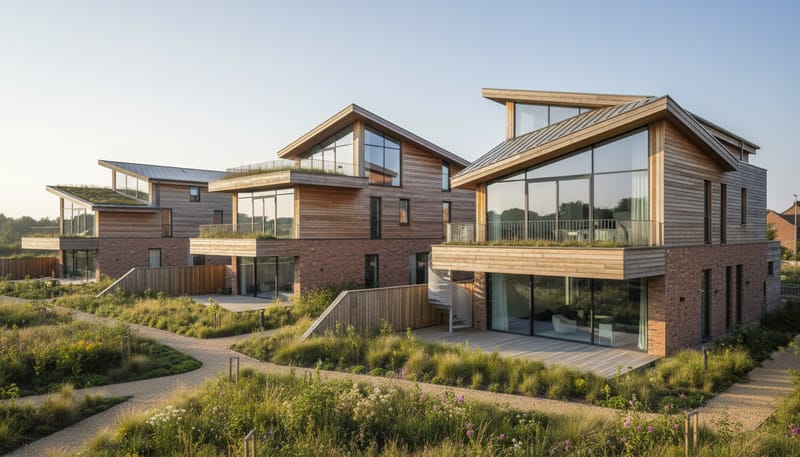
The architecture of new build homes in the UK is undergoing a quiet revolution. For decades, volume housebuilding was characterised by a perceived sameness, with the same handful of house types replicated across the country regardless of local context, climate or the evolving needs of residents. Today, that narrative is changing fundamentally. The country's leading developers are investing in design innovation at a scale and pace not seen since the post-war new town era, producing homes that are not only more energy efficient and technologically advanced but also more beautiful, more responsive to their settings and more attuned to the diverse ways people live, work and relax in the 2020s.
This transformation is being driven by a confluence of factors: planning authorities demanding higher design quality through updated National Design Codes, the influence of the Building Better Building Beautiful Commission's findings, consumer expectations shaped by design-led media, and the genuine ambition of forward-thinking developers to create places that stand the test of time. From Redrow's celebrated Heritage Collection drawing on Arts and Crafts traditions to Berkeley Group's contemporary urban apartments that rival the best private architecture, from biophilic design principles that blur the boundary between inside and out to flexible layouts that accommodate home working, multigenerational living and changing family structures, the new build sector is embracing design as a competitive advantage and a driver of lasting community value. This article explores the most significant architectural trends reshaping UK new build homes and the developers leading the charge.
The Evolution of Open-Plan Living
Open-plan living has been the dominant interior layout trend in UK new builds for the past two decades, and with good reason. By removing walls between kitchen, dining and living areas, developers create a sense of spaciousness and light that resonates strongly with buyers, particularly in the compact footprints typical of UK house types. However, the concept has matured significantly from the simple knocked-through rooms of the early 2000s into something far more nuanced and sophisticated.
The pandemic-era experience of working, schooling and exercising within the same four walls prompted a critical reassessment of fully open layouts. Developers responded not by abandoning open-plan but by evolving it into what the industry now calls broken-plan or zoned living. This approach maintains the visual connection and light flow of open-plan design while introducing subtle spatial divisions — changes in floor level, half-height walls, sliding pocket doors, glazed screens and strategically placed joinery — that allow different activities to coexist without conflict.
Taylor Wimpey's latest house type range exemplifies this trend. Their four and five-bedroom homes feature open-plan kitchen-dining-family spaces at the rear of the ground floor, connected to but distinct from a more intimate sitting room at the front. A utility room and cloakroom provide practical buffer zones, while many designs incorporate a dedicated study or home office, acknowledging the permanent shift toward hybrid working patterns. The company's research showed that 72% of buyers in their target demographic now consider a separate workspace essential or highly desirable.
Barratt Developments has taken a data-driven approach to layout design, conducting extensive buyer research and post-occupancy evaluations to understand how homes are actually used. Their findings revealed that while open-plan remains aspirational, the most satisfied residents were those in homes with a degree of flexibility, being able to close off spaces when needed for privacy, quiet or temperature control. This insight has informed the design of their latest house types, which feature wider openings with the option for pocket doors, allowing residents to choose between open and closed configurations.
For apartment living, the evolution is equally striking. Berkeley Group's urban developments in London and the South East feature apartments with thoughtful spatial planning that maximises both openness and functionality. Dual-aspect layouts flood interiors with natural light from multiple directions, while integrated storage solutions — full-height built-in wardrobes, under-stair cupboards and kitchen islands with concealed storage — ensure that living areas remain clutter-free. For more on what modern new build interiors offer, see our guide to what to expect from a new build interior.
Biophilic Design: Bringing Nature Indoors
Biophilic design, which seeks to strengthen the connection between people and nature through the built environment, has moved from architectural niche to mainstream trend in UK housebuilding. The term, derived from the biologist E.O. Wilson's biophilia hypothesis — that humans have an innate affinity for the natural world — describes a design philosophy that incorporates natural materials, daylight, greenery, water features and organic forms into buildings to enhance occupant wellbeing.
Research consistently demonstrates the benefits of biophilic design. Studies published in the journal Building and Environment found that homes with strong biophilic elements reduce occupant stress by up to 37%, improve cognitive function, enhance sleep quality and increase overall life satisfaction. For developers, these outcomes translate into stronger sales velocity, higher customer satisfaction scores and better word-of-mouth referrals.
In practice, biophilic design manifests in new builds through several key strategies. The most impactful is maximising natural daylight. Developers are specifying larger windows, including full-height glazed doors to rear gardens, rooflights in top-floor rooms and hallways, and dual-aspect layouts that ensure every principal room receives natural light. Crest Nicholson's new house types feature floor-to-ceiling windows in living areas, with window-to-wall ratios that exceed Building Regulations minimums by 40%, flooding interiors with light while maintaining thermal performance through high-specification triple glazing.
Natural materials are another cornerstone. Where budget permits, developers are incorporating timber cladding, stone detailing, brick with natural colour variation and exposed timber beams into their designs. Internally, engineered timber flooring, natural stone worktops, ceramic tiles in earthy tones and timber-framed internal glazing all reinforce the connection to natural materials. Redrow's Heritage Collection homes feature extensive use of natural stone and reclaimed brick detailing on their exteriors, with interiors that incorporate oak staircases, timber window boards and natural fibre carpets.
The boundary between inside and out is being deliberately blurred. Bifold and sliding doors that open living areas fully onto garden terraces create a seamless indoor-outdoor connection in warmer months. Covered porches, loggia-style extensions and partially enclosed courtyards provide sheltered transitional spaces that can be enjoyed in the UK's variable climate. Bellway's recent designs include covered outdoor dining areas on selected house types, extending the usable living space and strengthening the relationship between home and garden.
Wellbeing Fact: A 2023 study by the UK Green Building Council found that homes incorporating at least four biophilic design elements scored 28% higher in occupant wellbeing surveys compared to standard designs. The most impactful elements were natural daylight, views of greenery, natural materials and operable windows for natural ventilation.
Flexible Spaces for Modern Living
The concept of flexible, adaptable space has become central to new build design as developers recognise that homes must serve multiple functions and adapt to changing life stages. A home designed for a young couple should work equally well for a growing family, a household with teenagers needing their own territory, adults working from home, and eventually for downsizers who may want to consolidate their living space onto a single floor.
The home office is the most prominent example of flexible design. Since 2020, the proportion of new builds incorporating a dedicated workspace has risen dramatically. David Wilson Homes now includes a study or home office in over 70% of its four-bedroom-plus house types, while Countryside Partnerships has developed an innovative WFH (Work From Home) package that offers buyers the option of converting a bedroom into a fully fitted home office with enhanced broadband connectivity, acoustic insulation and integrated joinery.
How New Build Space Allocation Has Shifted (2019 vs 2025)
2019 Layout
2025 Layout
Multigenerational living is another driver of flexible design. With an ageing population and rising housing costs making it harder for young adults to leave the family home, developers are designing houses that can accommodate extended families comfortably. Some designs feature ground-floor bedroom suites with en-suite shower rooms, providing self-contained accommodation for elderly relatives. Others include annexe-style extensions or separate entrances that allow a degree of independence while keeping families close. Persimmon's larger house types now include a ground-floor bedroom option as standard in their specification, recognising that this flexibility is valued by a significant proportion of buyers.
Storage is an often-overlooked aspect of flexible design, yet it consistently ranks among the top priorities for new home buyers. Developers have responded with more generous built-in storage, including walk-in wardrobes in master bedrooms, under-stair storage pods, full-height hallway cupboards, garage storage systems and dedicated utility rooms that serve as both laundry and storage spaces. Bellway's premium house types feature a walk-in wardrobe in the principal bedroom as standard, along with a separate utility room and a boot room, addressing the practical storage needs that buyers consistently cite as important.
Contemporary Exterior Aesthetics
The external appearance of new build homes has arguably seen the most dramatic transformation. Planning authorities, guided by the National Design Code and local design guides, are demanding higher standards of architectural quality, material specification and contextual sensitivity. The days of identikit estates bearing no relationship to their surroundings are being consigned to history, replaced by developments that draw on local vernacular traditions while incorporating contemporary design elements.
Redrow has been widely praised for its Heritage Collection, which takes inspiration from the Arts and Crafts movement and local building traditions. These homes feature handmade bricks, natural stone detailing, steeply pitched roofs with gable features, cottage-style porches, decorative chimney stacks and carefully proportioned windows with authentic glazing bars. The effect is of a home that looks as though it has been part of the landscape for generations, yet behind the traditional facade lies a fully modern, energy-efficient dwelling with all the comforts buyers expect.
At the other end of the spectrum, developers are embracing unambiguously contemporary design where the context permits. Berkeley Group's urban developments in London feature crisp, modern facades with large-format glazing, clean lines, metal and timber cladding, projecting balconies and rooftop gardens. Their Royal Arsenal Riverside development in Woolwich combines converted heritage buildings with striking new-build blocks, creating a compelling dialogue between old and new.
Buyer Preference by Architectural Style
Material innovation is expanding the palette available to developers. High-quality brick remains the dominant external material across most of England, but it is increasingly being complemented by render, timber cladding, zinc, copper and reconstituted stone. Dark-toned bricks and charcoal renders are growing in popularity for accent features, adding visual depth and contrast. Metal standing-seam roofing, once reserved for commercial or high-end bespoke projects, is appearing on premium new build homes as an alternative to traditional tile.
The design of apartment buildings has undergone a particular transformation. Historically, new build apartment blocks were often utilitarian in appearance, with repetitive window patterns, flat facades and minimal landscaping. Today, the best examples feature articulated facades with balconies, recesses, changes in material and colour, rooftop communal spaces, generous ground-floor amenity areas and landscaped podium gardens. Developments such as Battersea Power Station (by a consortium including Barratt), King's Cross (Argent) and Greenwich Peninsula (Knight Dragon) set standards that are increasingly influencing apartment design nationwide.
The Kitchen as Heart of the Home
Kitchen design in new builds has been elevated to an art form. Once a purely functional space, the kitchen is now the centrepiece of domestic life, a room for cooking, eating, entertaining, socialising, homework and remote working. Developers are investing significantly in kitchen specification, recognising that it is often the room that most influences a buyer's purchasing decision.
The island kitchen has become almost ubiquitous in larger new build homes. A well-designed island provides additional worktop space, houses an integrated hob or sink, offers casual dining seating and creates a natural focal point around which the ground floor is organised. Taylor Wimpey's premium developments feature kitchen islands as standard in their three, four and five-bedroom homes, with integrated appliances from leading manufacturers such as Bosch, Neff and AEG.
Colour and finish trends have shifted markedly. The all-white kitchen that dominated the 2010s is giving way to richer palettes featuring deep blues, sage greens, warm greys and even bold blacks. Two-tone kitchens, with darker base units and lighter wall units or open shelving, create visual interest and depth. Matt finishes and handleless designs contribute to a clean, contemporary aesthetic, while natural materials such as engineered quartz worktops, timber detailing and terrazzo-inspired splashbacks add warmth and texture.
Bathroom Design Innovation
Bathroom design in new builds has been transformed from a functional afterthought into a space that offers genuine luxury and a sense of retreat. The hotel-inspired bathroom has become the aspiration, with developers investing in high-quality sanitaryware, contemporary tiling, stylish fixtures and thoughtful design details that elevate the everyday experience of bathing.
Walk-in showers with frameless glass screens and rainfall showerheads have become standard in en-suite bathrooms, replacing the traditional shower-over-bath arrangement. Many premium developments now feature wetroom-style en-suites with level-access tiling, adding a sense of spaciousness and contemporary style. Freestanding baths are making a comeback in the principal bathroom of larger homes, positioned as a centrepiece feature that conveys indulgence and relaxation. Wall-hung vanity units with concealed cisterns create a floating, minimalist aesthetic while making the floor easier to clean.
Tile trends in new build bathrooms are moving toward large-format porcelain, often in natural stone or concrete finishes, with fewer grout lines for a cleaner look. Coloured sanitaryware is returning after decades of dominance by white suites, with soft greens, warm taupes and muted pinks appearing in boutique and premium developments. Underfloor heating in bathrooms is increasingly standard, eliminating the need for radiators and ensuring warm feet on cold mornings, a small detail that consistently scores highly in buyer satisfaction surveys.
Smart Home Technology Integration
Technology integration has become a defining feature of modern new build design, with developers embedding smart home systems that enhance comfort, security and energy efficiency. The approach has matured from early experiments with isolated gadgets to coherent, integrated systems that work seamlessly together.
Smart thermostats, typically from Hive or Nest, are now standard in the majority of new builds, allowing homeowners to control heating and hot water remotely via smartphone apps. More advanced developments feature whole-home smart systems that integrate lighting, heating, security and entertainment. Barratt Developments has partnered with Google to offer Nest-integrated homes across selected developments, enabling voice control of thermostats, doorbells, cameras and smart lighting.
Structured wiring is a critical enabler of smart home functionality. Most major developers now pre-wire homes with Cat6 Ethernet cabling to all principal rooms, ensuring robust connectivity for smart devices, home working and entertainment. Wi-Fi mesh systems, either pre-installed or offered as an upgrade, eliminate dead spots in larger homes and ensure consistent coverage throughout. USB charging points, integrated into socket faceplates, have become a standard feature in kitchens, bedrooms and studies.
Security has been a particularly strong area of smart technology adoption. Video doorbells, keyless entry systems, smart locks and integrated alarm systems are all available across various developer ranges. Berkeley Group's premium developments include concierge-managed smart access systems, while Barratt's standard specification includes a smart doorbell and a pre-wired intruder alarm on selected house types. The ability to monitor and secure a home remotely via a smartphone gives buyers confidence, particularly first-time buyers and those relocating. For more on the technology features available in new builds, see our article on smart home technology in new builds.
Placemaking and Masterplanning
Good design extends far beyond the individual home. The best new build developments are distinguished by the quality of their masterplanning — the arrangement of homes, streets, open spaces, community facilities and transport connections into a coherent, attractive and functional place. The UK Government's National Design Guide, published in 2019 and since supplemented by the National Model Design Code, sets out ten characteristics of well-designed places: context, identity, built form, movement, nature, public spaces, uses, homes and buildings, resources, and lifespan.
Leading developers have embraced these principles wholeheartedly. Countryside Partnerships, which specialises in placemaking-led regeneration, designs every development around a clear hierarchy of streets and spaces, with pedestrian and cycling routes given equal or greater priority than vehicle access. Their developments feature central greens, play areas, allotments, orchards and community gathering spaces that are embedded in the masterplan from the outset rather than relegated to leftover corners of the site.
Placemaking Quality Scores by Developer (out of 10)
Street design has evolved significantly. The rigid cul-de-sac layouts that dominated housing development for decades are being replaced by more permeable, connected street patterns that offer multiple routes for pedestrians and cyclists. Home zones, shared surfaces and play streets create neighbourhoods where children can play safely and residents feel comfortable walking and socialising. Tree-lined avenues, landmark buildings at key intersections and carefully designed corners and gateways create visual interest and a sense of identity that distinguishes one neighbourhood from another.
Public art and landscape features add character to new developments. Many developers commission local artists to create bespoke sculptures, wayfinding features and integrated artworks that reflect the history or ecology of the site. Living walls, community gardens and wildflower meadows bring nature into the heart of developments, creating spaces that are not only beautiful but also support biodiversity and mental wellbeing. For more on how developments are integrating green spaces, see our article on developer contributions to parks and public spaces.
Sustainability as a Design Driver
Sustainability and design are increasingly inseparable in modern housebuilding. The most innovative architectural trends are often driven by environmental performance requirements, and the most sustainable homes tend also to be the best designed. Passive solar design, which orients homes and windows to maximise solar gain in winter while preventing overheating in summer, produces buildings that are both more comfortable and more visually engaging, with carefully considered facade compositions and well-proportioned elevations.
Green roofs and living walls are appearing on an increasing number of apartment developments, providing insulation, managing rainwater, supporting biodiversity and adding visual richness to building facades. Brown roofs, which use recycled aggregate substrates to recreate the conditions of brownfield sites, are particularly effective for supporting invertebrate species and are increasingly specified as part of Biodiversity Net Gain strategies.
The integration of renewable energy technology into architectural design is also improving. Early-generation solar panels were often installed as an afterthought, bolted onto roofs in positions that clashed with the overall design. Today, developments are designed from the outset with optimal roof orientations for solar generation, and building-integrated photovoltaics (BIPV) that replace conventional roof tiles with solar-generating alternatives are becoming commercially viable. These products, manufactured by companies such as Marley and Viridian, are virtually indistinguishable from standard roof tiles, allowing solar generation without compromising architectural aesthetics.
Design Awards and Industry Recognition
The growing emphasis on design quality is reflected in the expanding range of awards that celebrate excellence in UK housebuilding. The RIBA Stirling Prize, the What House? Awards, the Housing Design Awards and the NHBC Pride in the Job awards all recognise developers and developments that demonstrate outstanding architectural and build quality.
The Housing Design Awards, supported by RIBA, the Civic Trust and the MHCLG, are particularly influential. Recent winners have included developments by Lendlease, Countryside Partnerships, Berkeley Group and Alison Brooks Architects, demonstrating that design excellence is achievable across a range of scales, densities and tenures. The What House? Awards, judged by a panel including architects, surveyors and journalists, have celebrated developments by Barratt, Redrow, Taylor Wimpey and Bellway, recognising that volume builders can deliver genuinely high-quality design when the commitment is there.
Industry Benchmark: The NHBC Pride in the Job awards recognise the best site managers in the UK, with quality of workmanship and attention to design detail as key judging criteria. In 2024, over 450 site managers received awards across the categories, with Barratt, David Wilson Homes and Bellway among the top-performing developers. These awards drive a culture of excellence that directly benefits homebuyers.
Looking Ahead: The Future of New Build Design
The architectural trends shaping UK new builds point toward a future of homes that are more beautiful, more sustainable, more adaptable and more attuned to human wellbeing than anything the sector has produced before. The convergence of tighter design regulations, environmental standards, advancing technology and rising buyer expectations is creating a virtuous cycle where design quality and commercial success reinforce each other.
Emerging trends to watch include the growing use of computational design to optimise building forms for daylighting, energy and structural efficiency; the integration of circular economy principles into material specification; the development of net-positive homes that generate more energy than they consume; and the incorporation of community-scale infrastructure such as car clubs, shared workshops and co-working spaces into residential masterplans.
For homebuyers, the message is clear: the standard of design in UK new builds has never been higher, and it is continuing to improve. Whether your preference is for the warmth and character of traditional architecture or the clean lines and innovation of contemporary design, there are developers producing homes that will delight, inspire and endure. By choosing a new build from a developer with a strong design ethos, buyers are investing not just in bricks and mortar but in a home that reflects the very best of modern British architecture. For guidance on choosing the right developer, see our article on how UK housebuilders compare.