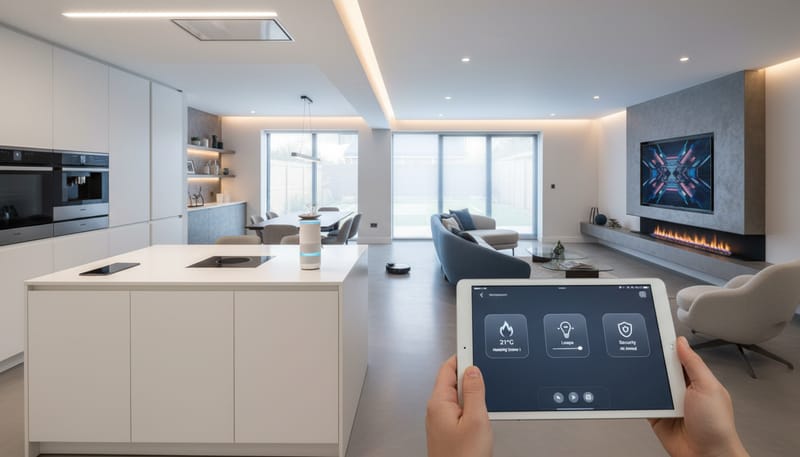
The British new build home of 2025 bears little resemblance to the properties being delivered just a decade ago. A wave of technological innovation is sweeping through the UK housebuilding industry, transforming every aspect of residential development from the materials used in construction to the smart systems that manage a home's energy, security, and comfort. Developers including Barratt, Taylor Wimpey, Persimmon, Bellway, and Redrow are investing hundreds of millions of pounds in research, development, and deployment of technologies that are making new homes smarter, more efficient, and more responsive to the needs of modern families. Whether it is app-controlled heating systems that learn homeowner preferences, integrated EV charging that supports the electric vehicle revolution, or advanced material science that delivers superior performance from thinner, lighter building components, the innovation agenda in UK housebuilding has never been more ambitious or more tangible.
This technology-driven transformation is being propelled by several converging forces. Consumer expectations are rising rapidly, shaped by the smart devices and seamless digital experiences that have become ubiquitous in everyday life. The regulatory environment is pushing developers towards higher standards of energy efficiency and environmental performance, which increasingly require technological solutions. And the economics of construction are demanding innovation — with labour shortages, material cost pressures, and the need to build faster without compromising quality, technology offers a path to greater efficiency and consistency. The result is a new generation of homes that offer buyers an experience that is genuinely different from anything previously available on the market. This article examines the key areas of innovation, profiles the leading developers driving change, and explores what these advances mean for buyers entering the new homes market.
Smart Home Integration: The Connected Home Becomes Standard
Smart home technology has moved from being an optional extra or a premium feature to becoming a standard component of new build homes across the UK. The integration of connected devices and intelligent management systems is being driven by both consumer demand and the practical benefits that smart technology delivers in terms of energy management, security, and convenience. According to research by the HBF, 78% of new home buyers now consider smart home features to be an important factor in their purchasing decision, up from just 34% in 2019.
Barratt Developments has been at the forefront of smart home integration, rolling out its Connected Home package across all new developments. This comprehensive system includes a smart thermostat (typically a Hive or Nest device) that learns the household's routine and optimises heating schedules accordingly, smart lighting controls that allow room-by-room adjustment via smartphone app or voice command, and a connected doorbell with video capabilities. The system is managed through a single app that gives homeowners complete control of their home's key systems from anywhere in the world. Barratt reports that homes equipped with its Connected Home package achieve energy savings of 12-18% compared to equivalent homes with conventional controls, simply through smarter management of heating and lighting.
Taylor Wimpey has developed its own smart home ecosystem, branded "TW Smart Living", which takes integration a step further. The system incorporates smart energy monitoring that provides real-time feedback on electricity consumption by circuit, enabling homeowners to identify energy-hungry appliances and adjust their usage patterns. The package also includes smart window sensors that automatically adjust the MVHR (mechanical ventilation with heat recovery) system based on whether windows are open or closed, optimising energy recovery without requiring any intervention from the homeowner. Taylor Wimpey's research indicates that these automated adjustments deliver an additional 8-10% energy saving on top of the baseline efficiency of the building fabric.
Persimmon Homes has focused on delivering smart home features that are accessible and easy to use, recognising that technology adoption is hindered when systems are overly complex. The company's smart home offering centres around voice-controlled assistants (Amazon Alexa or Google Home) pre-configured to control heating, lighting, and security systems. Persimmon's approach prioritises simplicity — every feature can be controlled by voice or through a single app, with no need for the homeowner to manage multiple platforms or accounts. This user-centred approach has contributed to high adoption rates, with 92% of Persimmon homeowners reporting that they actively use their smart home features on a daily basis.
Bellway has invested in infrastructure-level smart home preparation, ensuring that its homes are future-proofed for technologies that may not yet be mainstream. Every Bellway home is now built with Cat6 Ethernet cabling to all main rooms, providing the backbone for high-speed wired networking that supports bandwidth-intensive applications like 4K streaming, online gaming, and video conferencing without reliance on Wi-Fi. The company also installs conduit routes for future cable runs, making it straightforward for homeowners to add smart home devices, additional network points, or home office infrastructure as their needs evolve. This forward-thinking approach recognises that the smart home landscape is evolving rapidly and that the homes being built today need to adapt to technologies that may not yet exist.
Redrow has taken a distinctive approach by integrating smart technology within its heritage-style home designs, demonstrating that traditional aesthetics and modern technology are fully compatible. The company's smart home features are discreetly integrated — wireless sensors hidden within traditional-style light switches, smart thermostats designed to complement period-inspired interiors, and built-in speakers concealed within ceiling roses and cornicing. Redrow's approach appeals to buyers who want the benefits of smart technology without the visible tech aesthetic, proving that innovation can enhance rather than compromise architectural character.
Buyer Tip: When viewing a new build show home, ask the sales advisor to demonstrate the smart home features in action. Test the app controls, try the voice commands, and ask about the system's compatibility with devices you already own. A well-integrated smart home system should feel intuitive and seamless — if it takes more than a few minutes to understand, the developer may need to improve its implementation.
Electric Vehicle Charging: Powering the Transport Revolution
The transition to electric vehicles is one of the most significant shifts in personal transport since the invention of the motor car, and UK housebuilders are playing a crucial role in supporting this transformation. Since June 2022, Building Regulations have required every new home with an associated parking space to be equipped with an electric vehicle charge point. However, the industry has gone well beyond mere compliance, with leading developers investing in charging infrastructure that anticipates the future needs of EV owners and provides genuine convenience from day one.
The standard specification across most major UK developers is a 7kW Mode 3 charge point, typically a Pod Point, Rolec, or Andersen unit installed in the garage or on an exterior wall adjacent to the parking space. A 7kW charger will fully charge a typical 60kWh electric vehicle battery in approximately 8-9 hours, making overnight charging a practical and convenient option for most homeowners. The charger is connected to a dedicated circuit within the home's electrical installation, ensuring that charging does not interfere with other electrical loads and that safety protections are properly maintained.
EV Charger Specifications by Major UK Developers
The most forward-thinking developers are already exploring the integration of EV charging with home solar PV systems. This approach enables homeowners to charge their vehicles using electricity generated by their own solar panels, effectively providing free fuel for their car. Taylor Wimpey and Redrow have both piloted solar-integrated charging systems that automatically divert surplus solar electricity to the EV charger during daylight hours, with the option to switch to grid electricity for overnight top-ups. Early data from these pilots suggests that homeowners with a 4kW solar system and average driving habits can generate enough solar electricity to cover 60-70% of their annual EV charging needs, representing a saving of approximately £600-800 per year compared to public charging or grid-only home charging.
For apartment developments and schemes without individual parking, developers are implementing shared charging solutions. These typically feature a bank of chargers in a communal car park, managed by a specialist operator through a pay-per-use or subscription model. Barratt's shared charging installations on apartment developments typically feature a mix of 7kW and 22kW chargers, with the faster units allowing a practical top-up during the time it takes to unload shopping or prepare for an outing. The systems include smart management software that distributes available power across multiple chargers, preventing grid overload while ensuring that every connected vehicle receives an adequate charge.
Innovative Design and Layout Evolution
The way UK developers design and lay out new homes is evolving rapidly, driven by changing lifestyles, the legacy of the pandemic's impact on how people use their homes, and a growing understanding of how good design contributes to wellbeing. The most notable trend is the emergence of flexible, multi-functional spaces that can adapt to the varied demands of modern life — from home working and home schooling to entertaining, fitness, and relaxation.
Barratt Developments has led the way in rethinking interior layouts through its award-winning design review programme. Working with leading architects and interior designers, the company has developed a new generation of floor plans that prioritise flow, flexibility, and natural light. Key innovations include "zones within zones" — open-plan living areas with subtle architectural features such as changes in ceiling height, partial walls, and built-in storage units that allow different activities to coexist without conflict. Barratt's research found that 73% of buyers who had experienced working from home during the pandemic wanted a dedicated home office space, and the company has responded by incorporating study nooks, garden offices, and convertible rooms into its standard house types.
Taylor Wimpey's approach to design innovation focuses on what the company calls "life-stage flexibility" — homes that can adapt as their occupants' needs change over time. The company has introduced a range of design features that enable homeowners to reconfigure their living spaces without major structural work. These include demountable internal partitions that allow rooms to be split or merged, pre-installed electrical and plumbing provisions for future kitchen or bathroom relocations, and loft spaces designed to be easily converted into additional living accommodation. This approach recognises that the average homeowner stays in their property for 8-12 years, during which time their household composition and lifestyle needs are likely to change significantly.
Buyer Design Priorities (2025 Survey)
Persimmon has introduced its "Space to Grow" range, which features homes with adaptable ground-floor layouts. The key innovation is a series of standardised internal wall positions that allow buyers to choose between different layout configurations at the point of purchase — for example, opting for a larger open-plan kitchen-diner with a separate snug room, or a more traditional arrangement with a separate dining room and larger lounge. This approach gives buyers a degree of personalisation that was previously only available on self-build or custom-build projects, without the complexity and cost typically associated with bespoke design.
Outdoor space design has also seen significant innovation. The pandemic underscored the importance of private outdoor space, and developers have responded by giving greater attention to the design and quality of gardens, patios, and balconies. Bellway's "Living Landscapes" programme ensures that every home includes thoughtfully designed outdoor space, with features such as integrated planters, garden lighting, and outdoor power sockets that extend the usability of gardens throughout the year. For apartment developments, Bellway has invested in larger, more functional balconies and shared roof terraces that provide genuinely usable outdoor space rather than the token balconies that characterised many earlier developments.
Material Science and Construction Technology Advances
The materials used to build new homes are undergoing a quiet revolution, driven by advances in material science that are delivering better performance, lower environmental impact, and greater durability. These innovations are not always visible to the homebuyer — they are often hidden within walls, beneath floors, and above ceilings — but their impact on the quality, efficiency, and longevity of new homes is profound.
Advanced insulation materials represent one of the most impactful areas of progress. Aerogel-enhanced insulation, which was originally developed for space applications, is now being used in UK new builds where space constraints demand maximum thermal performance from the thinnest possible wall build-up. Aerogel insulation achieves thermal conductivity values as low as 0.015 W/mK — approximately twice as effective as standard mineral wool — enabling developers to meet demanding energy targets without increasing wall thickness. This is particularly valuable in urban developments where plot sizes are constrained and every millimetre of internal floor area counts.
Glazing technology has advanced significantly, with triple-glazed windows now becoming the standard specification for many UK developers. The latest generation of triple-glazed units features argon or krypton gas fills between the panes, low-emissivity coatings that reflect heat back into the room, and warm-edge spacer bars that minimise thermal bridging at the edges of the unit. These combined features deliver U-values as low as 0.8 W/m²K — roughly three times more thermally efficient than the single-glazed windows still found in millions of older UK homes. Beyond thermal performance, advanced glazing also delivers superior acoustic insulation, reducing external noise penetration by up to 40dB, which is particularly valuable for developments near roads, railways, or other noise sources.
Self-healing concrete is an emerging technology that several UK developers are monitoring closely. Developed at the University of Bath and other research institutions, this material contains bacteria capsules that activate when cracks form, producing limestone that fills the cracks and restores the concrete's structural integrity. While still in the pilot stage for residential applications, self-healing concrete has the potential to dramatically extend the lifespan of foundations and structural elements, reducing long-term maintenance requirements and the environmental impact associated with concrete repairs and replacement.
Phase-change materials (PCMs) represent another frontier in building material innovation. These substances, which absorb and release heat as they change between solid and liquid states, can be incorporated into walls, floors, or ceilings to provide passive temperature regulation. When the room temperature rises above a set threshold, the PCM absorbs heat as it melts; when the temperature drops, it solidifies and releases the stored heat. This natural buffering effect can reduce peak temperatures by 2-4 degrees and reduce heating energy consumption by up to 15%, all without any mechanical systems or energy input. Berkeley Group has piloted PCM-enhanced plasterboard in several London apartment developments, reporting positive results in both thermal comfort and energy performance.
Industry Insight: The construction technology sector in the UK attracted over £1.2 billion in venture capital investment in 2024, more than double the 2021 figure. This investment is fuelling a pipeline of innovations that will reach mainstream adoption over the coming decade, from robotic bricklaying and 3D-printed building components to AI-powered quality inspection and digital building passports that track the sustainability credentials of every component in a home.
Energy Management Systems and Battery Storage
The emergence of home energy management systems (HEMS) represents one of the most exciting areas of innovation in new build homes. These intelligent systems monitor and optimise energy consumption across all of a home's major electrical loads — heating, hot water, lighting, appliances, EV charging, and solar generation — to minimise energy costs and carbon emissions while maintaining comfort. The sophistication of these systems is advancing rapidly, driven by improvements in artificial intelligence and machine learning that enable increasingly accurate prediction of energy demand and supply patterns.
Taylor Wimpey's Advanced Energy Management System (AEMS), currently deployed across its premium developments, uses machine learning algorithms to analyse the household's energy usage patterns, weather forecasts, and electricity tariff structures to create optimised energy schedules. The system can, for example, pre-heat the home using cheap off-peak electricity, charge the EV battery when solar generation is at its peak, and export surplus solar electricity to the grid when wholesale prices are highest. Taylor Wimpey reports that homes equipped with AEMS achieve energy cost savings of 25-35% compared to equivalent homes without active energy management, translating to savings of £400-700 per year at current energy prices.
Controls
Thermostat
System
Solar + Battery
Average Annual Energy Costs by Technology Level (3-bed Detached)
Home battery storage systems are becoming an increasingly attractive option for new build homes, particularly those with solar PV installations. Battery storage allows homeowners to store surplus solar electricity generated during the day for use in the evening and at night, dramatically increasing the proportion of solar energy that is consumed on-site rather than exported to the grid. The Tesla Powerwall and GivEnergy systems are among the most commonly specified by UK developers, with capacities typically ranging from 5kWh to 13.5kWh — enough to power a typical home through an entire evening on stored solar electricity during the summer months.
Barratt has been piloting home battery installations on several developments in the South of England, where solar generation is highest. The company's pilot data shows that homes with a 10kWh battery achieve solar self-consumption rates of 80-85%, compared to just 30-35% for homes with solar panels but no battery. This means that the vast majority of the solar electricity generated is used within the home rather than being sold back to the grid at relatively low export tariffs, maximising the financial benefit for the homeowner. Barratt is now evaluating the business case for making battery storage a standard feature across its developments in high-solar-gain locations.
Vehicle-to-grid (V2G) technology represents the next frontier in home energy innovation. V2G-enabled EV chargers can not only charge the vehicle's battery but also draw stored energy from the vehicle back into the home or the grid during periods of peak demand. This effectively turns every electric vehicle into a mobile battery, with the potential to provide significant energy cost savings and grid-balancing benefits. While V2G technology is still in its early stages of residential deployment, several UK developers are installing V2G-ready electrical infrastructure in their new homes, ensuring that homeowners can take advantage of V2G chargers as they become more widely available. For a broader look at the energy features in modern new homes, visit our article on understanding new build energy ratings.
Digital Construction and Quality Assurance
The construction process itself is being transformed by digital technology, with UK developers adopting tools and systems that improve quality, reduce waste, and increase efficiency. Building Information Modelling (BIM), which creates detailed 3D digital models of buildings before construction begins, has become standard practice among the UK's largest housebuilders. BIM enables designers and construction teams to identify and resolve potential issues — such as clashes between structural elements and services routes — before they occur on site, reducing costly rework and delays.
Drone technology is being widely deployed for site surveys, progress monitoring, and quality inspections. Barratt uses drones equipped with high-resolution cameras and LiDAR sensors to create detailed aerial surveys of its sites at every stage of development. These surveys are processed using AI-powered software that automatically identifies deviations from the design model, flagging potential quality issues for investigation before they become significant problems. Taylor Wimpey has reported that the introduction of drone-based quality monitoring has reduced the number of post-completion defects on its sites by approximately 22%, demonstrating the tangible quality benefits of digital construction technology.
Artificial intelligence is also being applied to quality control during the construction process. Several developers are piloting AI-powered camera systems that monitor construction activities in real time and flag deviations from prescribed methods or sequences. These systems can detect issues such as incorrect material placement, inadequate mortar coverage, or missing insulation, alerting site supervisors to potential problems as they occur rather than after they have been covered up by subsequent construction stages. The NHBC has been working with technology companies to develop AI quality standards that could become part of the industry's standard inspection regime.
Digital handover is another area of significant innovation. Rather than providing new homeowners with a physical folder of paper manuals and certificates, leading developers are now delivering digital homeowner packs that can be accessed via smartphone app or web portal. These digital packs typically include operation manuals for all installed systems and appliances, maintenance schedules and reminders, warranty documentation and contact details, the home's energy performance data, and a direct link to the developer's aftercare team. Bellway's "My Bellway Home" app provides all of this functionality in a single platform, and has received consistently positive feedback from homeowners who appreciate the convenience of having all their home information available on their phone.
Health and Wellbeing by Design
An increasingly important area of innovation is the incorporation of health and wellbeing considerations into home design. Research consistently shows that the built environment has a profound impact on physical and mental health, and developers are responding by designing homes that actively promote wellbeing through natural light, air quality, acoustic comfort, and connection to nature.
Maximising natural light is a key focus. Taylor Wimpey's design guidelines now specify minimum daylight factors for all habitable rooms, ensuring that homes receive adequate natural light throughout the year. The company has invested in larger windows, carefully positioned rooflights, and light-reflective internal finishes that distribute natural light deep into the floor plan. Research commissioned by Taylor Wimpey found that homeowners in their naturally well-lit homes reported 15% higher levels of life satisfaction compared to those in homes with lower daylight levels — a finding consistent with broader academic research linking natural light exposure to improved mood, sleep quality, and productivity.
Indoor air quality (IAQ) is receiving growing attention from developers. The sealed, energy-efficient building envelopes of modern new homes require active ventilation to ensure that indoor air remains fresh and healthy. MVHR systems, which are now installed in a significant proportion of new homes, provide continuous filtered fresh air while recovering heat from the extracted air. Some developers are going further by incorporating air filtration systems that remove particulates, pollen, and pollutants, creating an indoor environment that is significantly cleaner than the air outside. This is particularly beneficial for residents with respiratory conditions such as asthma, and several studies have shown that homes with effective ventilation and filtration systems are associated with reduced respiratory symptoms and improved overall health outcomes.
Acoustic design is another area where innovation is delivering meaningful improvements to occupant wellbeing. The latest Building Regulations set minimum standards for sound insulation between adjoining homes, but many developers are exceeding these standards significantly. Barratt's acoustic specification for party walls and floors delivers sound reduction levels 8-12dB above the regulatory minimum, creating a noticeably quieter living environment. The company has also invested in acoustic design at the development level, using building orientation, green barriers, and noise-attenuating fencing to minimise the impact of external noise sources on residents. These measures are especially valued on developments near busy roads or commercial areas, where they can make the difference between a restful home and a noisy one.
The Buyer Experience: Technology in the Sales Process
Innovation is not limited to the homes themselves — it extends to the way they are marketed, sold, and delivered to buyers. UK developers have embraced digital technology throughout the sales journey, creating experiences that are more informative, more convenient, and more engaging than the traditional show home visit.
Virtual reality (VR) and augmented reality (AR) tours have become standard offerings at most major developer sales centres. These technologies allow buyers to explore homes that may not yet be built, walking through fully furnished virtual interiors and experiencing the sense of space and flow that is difficult to convey through floor plans alone. Taylor Wimpey's VR system enables buyers to customise finishes and fixtures in real time, seeing the impact of different kitchen worktops, flooring options, or bathroom tiles within the virtual environment before committing to their choices. The company reports that buyers who use VR tools make faster purchasing decisions and express higher satisfaction with their final selections.
Online configuration tools allow buyers to personalise their home from the comfort of their existing property. These web-based platforms present the available options and upgrades for each house type, with real-time pricing that enables buyers to make informed decisions about where to invest in their new home. Bellway's online configurator, for example, allows buyers to choose from a range of kitchen layouts, worktop materials, flooring finishes, bathroom fixtures, and electrical upgrades, building a personalised specification that is then confirmed during the formal reservation process. This digital-first approach reduces the time required for face-to-face option selection meetings and gives buyers the opportunity to discuss their choices with family members before committing.
Progress tracking apps keep buyers informed throughout the construction of their new home. These apps typically provide regular photo and video updates showing the construction progress, milestone notifications (such as the completion of the roof or the installation of the kitchen), and estimated completion dates that update dynamically based on actual site progress. Barratt's buyer app also includes a direct messaging function that allows buyers to communicate with their dedicated sales contact, ask questions, and share information without the need for phone calls or emails. This transparency builds confidence and excitement during what can otherwise be an anxious waiting period for buyers. For further guidance on the buying process, see our detailed article on step-by-step guide to buying a new build.
What Innovation Means for New Build Buyers
The innovation revolution in UK housebuilding delivers a clear and compelling proposition for new home buyers. Homes built today are more technologically advanced, more energy efficient, better designed, and more comfortable than at any point in the history of British residential development. The combination of smart home technology, renewable energy systems, advanced materials, and thoughtful design creates living environments that are genuinely superior to the vast majority of existing homes on the market.
The financial benefits are significant and measurable. Lower energy bills, reduced maintenance costs, and the potential for income from solar generation and grid services can save homeowners thousands of pounds over the lifetime of their ownership. The technology built into new homes also has the potential to enhance resale values, as buyers in the secondary market increasingly seek out homes with smart features, high energy ratings, and EV charging infrastructure.
Perhaps most importantly, these innovations deliver a better daily living experience. Homes that are warmer, quieter, brighter, and cleaner contribute directly to the health and happiness of their occupants. Smart technology that learns and adapts to the household's routines reduces the cognitive burden of managing a home, freeing up time and mental energy for the things that matter most. And the peace of mind that comes from knowing your home is built to the highest standards, with the latest materials and technologies, is a benefit that cannot easily be quantified but is deeply valued by those who experience it.
Key Takeaway: When comparing new build homes, look beyond the surface finishes and focus on the technology and innovation that sits beneath. Ask about smart home systems, energy management, construction methods, and material specifications. The best developers are happy to explain the technology in their homes in detail, because they know that an informed buyer is a satisfied buyer. The innovation gap between leading developers and the rest of the market is widening, so do your research and choose a developer that is genuinely investing in the future. For help comparing developers, explore our comprehensive top UK housebuilders compared guide.