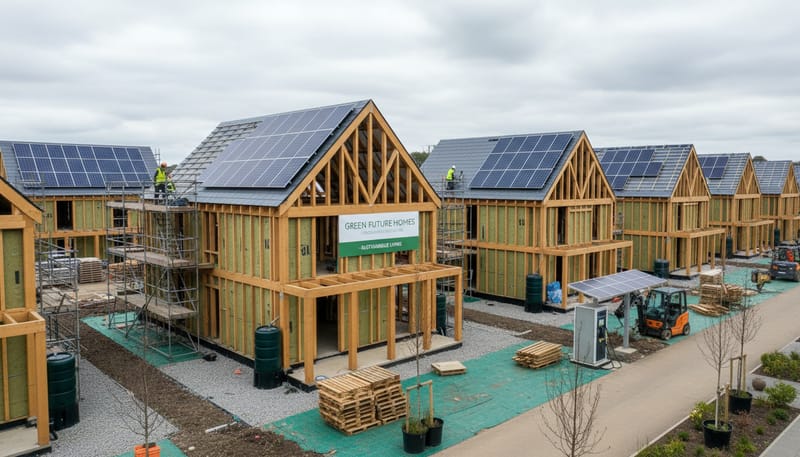
The UK housebuilding industry is undergoing one of its most significant transformations in decades, driven by increasingly ambitious sustainability targets, evolving building regulations, and a genuine commitment from major developers to reduce the environmental impact of new homes. From Barratt Developments' pledge to build zero carbon homes by 2030 to Taylor Wimpey's investment in modern methods of construction, the landscape of residential development is changing at a pace that would have seemed unimaginable just a decade ago. With the Future Homes Standard set to come into full effect, requiring new homes to produce 75-80% less carbon emissions than those built under previous regulations, the entire industry is accelerating its transition towards greener, more energy-efficient building practices that benefit both homeowners and the planet.
What makes this shift particularly noteworthy is the breadth of approaches being adopted. Rather than relying on a single technology or building method, UK developers are embracing a comprehensive toolkit that includes everything from air source heat pumps and solar photovoltaic panels to timber frame construction, enhanced insulation standards, and smart energy management systems. The result is a new generation of homes that are not only more environmentally responsible but also significantly cheaper to run — a crucial consideration for buyers facing rising energy costs. According to the Home Builders Federation (HBF), new build homes are already around 65% more energy efficient than the existing housing stock, and that gap is only widening as developers push the boundaries of what sustainable housebuilding can achieve. This article explores the key sustainable building methods being adopted across the UK, examines the progress made by leading developers, and considers what the future holds for green housebuilding in Britain.
The State of Sustainable Housebuilding in the UK
The UK's commitment to achieving net zero carbon emissions by 2050 has placed the construction sector firmly in the spotlight. Buildings account for approximately 25% of the nation's total carbon emissions, with residential properties representing a significant portion of that figure. The government's Clean Growth Strategy and subsequent policy updates have made it clear that new homes must lead the way in decarbonisation, creating both a challenge and an opportunity for the housebuilding industry.
The journey towards sustainable building has been accelerating rapidly. In 2025, the industry saw record levels of investment in green building technologies, with major developers collectively spending over £2.8 billion on sustainability initiatives. This investment spans everything from research and development into new materials and construction methods to the retrofitting of supply chains and the retraining of construction workforces. The NHBC Foundation has reported that the proportion of new homes achieving an EPC rating of A or B has risen from just 12% in 2015 to over 84% in 2025, demonstrating the tangible progress being made across the industry.
The regulatory framework has been a key driver of this transformation. The introduction of Part L updates to Building Regulations, which came into effect in June 2022, set an interim uplift requiring new homes to produce approximately 31% less carbon than under the previous standards. This was always intended as a stepping stone towards the more ambitious Future Homes Standard, which represents a fundamental rethinking of how new homes are designed, built, and heated. The industry has responded proactively, with many developers choosing to exceed current minimum requirements in anticipation of stricter future standards.
Industry bodies have played a crucial role in driving progress. The HBF's sustainability committee has worked with member builders to share best practice and develop common approaches to key challenges. The NHBC, as the leading warranty and insurance provider for new homes, has updated its technical standards to reflect the latest sustainability requirements and has invested heavily in research to support the industry's transition. Meanwhile, the New Homes Quality Board has incorporated sustainability criteria into its quality framework, ensuring that green building practices are embedded throughout the development process.
Heat Pumps: The End of the Gas Boiler Era
Perhaps the single most significant change in sustainable housebuilding is the wholesale shift from gas boilers to heat pump technology. The Future Homes Standard effectively bans fossil fuel heating in new homes, and the industry has moved decisively to adopt air source heat pumps (ASHPs) as the primary heating solution for the vast majority of new developments. This transition has been remarkably swift — while fewer than 5% of new homes featured heat pumps in 2020, that figure has risen to approximately 62% in 2025, with some major developers already achieving 100% heat pump installation rates across their developments.
Barratt Developments has been at the forefront of this transition, having committed to installing air source heat pumps as standard across all new developments from 2024 onwards. The company's investment in heat pump technology extends beyond simple installation — Barratt has worked closely with manufacturers including Vaillant, Daikin, and Samsung to develop bespoke solutions optimised for their house types. This collaborative approach has helped to address early challenges around noise levels, aesthetic integration, and performance optimisation, resulting in systems that deliver consistent comfort while keeping running costs competitive with traditional gas heating.
Taylor Wimpey has taken a similarly proactive approach, investing over £50 million in heat pump research and deployment since 2022. The company's technical team has developed detailed installation protocols that ensure optimal performance, including specific guidance on the positioning of external units, the design of internal distribution systems, and the integration of heat pumps with underfloor heating — a combination that Taylor Wimpey has found delivers the best balance of efficiency and comfort. The company reports that homes equipped with their heat pump systems achieve a coefficient of performance (CoP) of 3.2 on average, meaning that for every unit of electricity consumed, 3.2 units of heat are delivered to the home.
Heat Pump Adoption by Major UK Developers (2025)
Persimmon Homes, traditionally known for its focus on affordability, has also made significant strides in heat pump adoption. The company has developed a standardised heat pump specification that can be deployed efficiently across its high-volume developments, keeping costs manageable while delivering strong environmental performance. Persimmon's approach demonstrates that sustainable heating need not come at a premium that puts homeownership further out of reach for first-time buyers — a key concern as the industry navigates the transition away from fossil fuels.
Bellway has invested in training programmes that have seen over 2,500 of its construction workers achieve heat pump installation qualifications. The company has partnered with the Heat Pump Association to develop industry-leading installation standards, and its sites have become training hubs for the wider supply chain. Redrow, meanwhile, has integrated heat pumps within its signature heritage-style homes, proving that traditional aesthetics and modern heating technology can coexist seamlessly. For more information on what to expect from the latest energy-efficient homes, see our guide on new build energy efficiency explained.
Buyer Tip: When viewing a new build home with a heat pump, ask the site sales advisor about the system's coefficient of performance (CoP) rating and estimated annual running costs. A well-installed air source heat pump should achieve a CoP of at least 2.8, meaning your heating bills could be significantly lower than a comparable gas-heated home, particularly as gas prices continue to fluctuate.
Solar Panels and Renewable Energy Integration
Solar photovoltaic (PV) panels have become an increasingly common feature on new build homes across the UK, with developers recognising their dual benefit of reducing carbon emissions and lowering homeowners' energy bills. The cost of solar PV technology has fallen by approximately 89% over the past decade, making large-scale deployment economically viable across mainstream housing developments. In 2025, an estimated 71% of new homes were built with solar panels installed, up from just 28% in 2020 — a remarkable acceleration driven by both regulatory requirements and market demand.
Barratt Developments has been particularly ambitious in its solar deployment, installing panels on every new home where technically feasible. The company's standard specification typically includes a 3.5kW system on three-bedroom homes, rising to 4.5kW or more on larger properties. This generates an average of 3,000-4,000 kWh of electricity per year — enough to cover a significant proportion of a typical household's annual consumption. When combined with a heat pump and good insulation, homeowners can expect to see energy bills that are 50-70% lower than those in an equivalent older property.
Taylor Wimpey has gone further by piloting integrated energy systems that combine solar PV with battery storage on selected developments. The company's Project Green initiative, launched in 2023, has tested various configurations of solar panels, battery units, and smart energy management systems to determine the optimal combination for different house types and locations. Early results have been encouraging, with homes equipped with both solar and battery storage achieving energy self-sufficiency rates of up to 65% during summer months and 30-35% during winter.
Persimmon has focused on maximising the efficiency of solar installations through careful roof design and orientation planning. The company's design teams now work to optimise roof angles and orientations at the masterplanning stage, ensuring that every home on a development can benefit from effective solar generation. This proactive design approach has increased the average energy yield from Persimmon's solar installations by 18% compared to standard retrofit installations, demonstrating the advantages of integrating renewable energy considerations from the earliest stages of the development process.
Beyond solar panels, developers are exploring a range of other renewable energy technologies. Community-scale ground source heat pump networks, which serve multiple homes from a central energy centre, are being deployed by developers including Berkeley Group and Crest Nicholson. These systems can achieve even higher efficiencies than individual air source heat pumps, with CoP ratings of 4.0 or above, and they eliminate the need for external units on individual homes — an advantage for developments where aesthetic considerations are paramount.
Timber Frame and Modern Methods of Construction
Modern Methods of Construction (MMC) represent another crucial pillar of the sustainability revolution in UK housebuilding. Timber frame construction, in particular, has seen a remarkable resurgence, driven by its inherently lower carbon footprint compared to traditional masonry construction. Timber is a natural carbon store — every cubic metre of timber used in construction locks away approximately one tonne of CO2 — and when sourced from sustainably managed forests, it represents a genuinely renewable building material.
The proportion of new homes built using timber frame in the UK has risen steadily from around 22% in 2018 to approximately 38% in 2025. In Scotland, where timber frame has a longer established tradition, the proportion is even higher at around 85%. The increasing adoption across England and Wales reflects growing confidence in timber frame's performance, durability, and sustainability credentials, supported by extensive research from organisations including the Structural Timber Association and TRADA.
UK New Homes Built Using Timber Frame (%)
Barratt Developments operates one of the UK's largest timber frame manufacturing facilities through its subsidiary Oregon Timber Frame, based in Knaresborough, North Yorkshire. The factory produces precision-engineered timber frame panels that are transported to sites across the country, enabling faster construction times while maintaining exacting quality standards. Oregon's panels are manufactured to tolerances of just 2mm, significantly tighter than is achievable with traditional masonry construction, resulting in homes that are more airtight, better insulated, and more consistent in their build quality.
Stewart Milne Group, one of Scotland's leading housebuilders, has been a long-standing advocate of timber frame construction and has invested heavily in its offsite manufacturing capabilities. The company's Sigma II closed-panel system represents the cutting edge of timber frame technology, with factory-installed insulation, membranes, and external finishes that dramatically reduce on-site construction time and virtually eliminate weather-related delays. Homes built using the Sigma II system can be made wind and watertight in just 2-3 days, compared to 6-8 weeks for traditional masonry construction.
Beyond timber frame, other MMC approaches are gaining traction. Volumetric modular construction, where complete rooms or sections of homes are manufactured in factories and assembled on site, is being explored by several major developers. L&G Modular Homes, backed by Legal & General's significant financial resources, has developed a fully automated factory in Selby, North Yorkshire, capable of producing up to 3,500 modular homes per year. Ilke Homes, another modular pioneer, has delivered thousands of factory-built homes across the UK, demonstrating that offsite construction can deliver high-quality, sustainable homes at scale.
Industry Insight: The embodied carbon in a typical timber frame home is approximately 40% lower than an equivalent masonry-built home. When you factor in the carbon stored within the timber itself, some timber frame homes can be considered carbon-negative at the point of construction — meaning they have actually removed more carbon from the atmosphere than was produced in building them.
Insulation and Fabric-First Approaches
The concept of "fabric first" — prioritising the thermal performance of a building's walls, roof, floor, and windows before adding renewable technologies — has become a fundamental principle of sustainable housebuilding in the UK. The logic is straightforward: a home that retains heat efficiently requires less energy to maintain comfortable temperatures, regardless of the heating system used. This approach reduces both carbon emissions and running costs, delivering benefits that endure for the entire lifespan of the building.
UK developers have made significant progress in improving the thermal performance of new homes. The average U-value (a measure of heat loss, where lower is better) of external walls in new homes has improved from around 0.26 W/m²K in 2015 to approximately 0.15 W/m²K in 2025, representing a 42% improvement. Window specifications have similarly improved, with triple glazing becoming increasingly standard on new developments. These improvements in building fabric mean that new homes require dramatically less energy for heating, making the combination of high-performance insulation and heat pump technology an extremely effective strategy for achieving near-zero energy performance.
Wall U-Value Improvement Over Time (W/m²K — lower is better)
Bellway has been a notable champion of the fabric-first philosophy. The company's technical team has developed bespoke wall build-ups that achieve U-values as low as 0.13 W/m²K, well below the requirements of even the most stringent proposed standards. These high-performance wall systems use a combination of mineral wool and rigid insulation boards within a wider cavity, creating a thermal envelope that minimises heat loss while maintaining the traditional brick-and-block appearance that characterises Bellway's developments. The company has also invested in advanced airtightness testing, with every home undergoing a pressure test to ensure it meets the target air permeability rate of 3 m³/hr/m² — significantly better than the regulatory minimum.
Redrow's Heritage Collection provides an excellent example of how fabric-first principles can be applied to homes with a traditional aesthetic. The company has developed wall systems that conceal high-performance insulation behind period-style brickwork, achieving excellent thermal performance without compromising the architectural character that Redrow's buyers value. The homes feature triple-glazed windows with timber-effect frames, high-performance loft insulation, and insulated ground floor slabs, creating a comprehensive thermal envelope that keeps heating requirements to an absolute minimum.
Mechanical ventilation with heat recovery (MVHR) systems are another key component of the fabric-first approach. These systems extract stale air from kitchens and bathrooms and use it to pre-warm incoming fresh air, recovering up to 95% of the heat that would otherwise be lost through ventilation. MVHR systems are particularly effective in highly insulated, airtight homes, where they ensure excellent indoor air quality while minimising heat loss. An increasing number of developers are now installing MVHR as standard, recognising its benefits for both energy efficiency and occupant comfort. For a deeper look at what makes new builds stand out from older homes, read our article on new build vs older homes comparison.
Sustainable Materials and Supply Chain Innovation
The sustainability transformation extends well beyond the technologies installed in new homes — it encompasses the materials from which they are built and the supply chains that deliver them. UK developers are increasingly focused on reducing the embodied carbon of their developments, which refers to the carbon emissions associated with the extraction, manufacturing, transportation, and installation of building materials. Research by the UK Green Building Council suggests that embodied carbon accounts for approximately 50% of a new home's total lifetime carbon footprint, making it a critical area for improvement.
Concrete, one of the most widely used building materials globally, is a significant contributor to embodied carbon. The cement used in concrete production accounts for approximately 8% of global CO2 emissions, making it one of the most carbon-intensive materials in the construction industry. In response, developers are working with their supply chains to adopt lower-carbon concrete alternatives. Ground granulated blast-furnace slag (GGBS) and pulverised fuel ash (PFA) can replace a proportion of the Portland cement in concrete, reducing its carbon footprint by 40-70% depending on the replacement rate. Several major developers, including Barratt and Taylor Wimpey, have set targets to increase their use of these lower-carbon concrete mixes across all developments.
Cross-laminated timber (CLT) is emerging as a transformative material for medium-rise residential construction. CLT panels, made from layers of timber boards glued together at right angles, offer exceptional strength and stability while storing significant amounts of carbon. Several UK developers have begun using CLT for apartment buildings of up to eight storeys, displacing the steel and concrete that would traditionally be required. The material's precision manufacturing also reduces on-site waste, another important sustainability benefit.
Natural insulation materials represent another area of growing interest. Sheep wool insulation, produced by companies like Thermafleece and Black Mountain, offers excellent thermal performance combined with natural moisture management and a dramatically lower carbon footprint than synthetic alternatives. Hemp-lime (hempcrete), which combines the woody core of hemp plants with a lime-based binder, is being used as both insulation and walling material by innovative developers, offering the additional benefit of continued carbon absorption over time.
Supply chain sustainability extends to logistics and waste management. Major developers have implemented comprehensive waste management programmes that aim to divert at least 95% of construction waste from landfill through recycling and reuse. Barratt, for example, has reduced its construction waste per home by 34% since 2015, and the company's target is to achieve zero waste to landfill across all operations by 2030. These efforts are supported by digital tools that track material usage and waste generation in real time, enabling site teams to identify and address inefficiencies quickly.
Net Zero Commitments and Carbon Reporting
The UK's major housebuilders have been increasingly transparent about their carbon emissions and net zero ambitions, with most publishing detailed sustainability reports that track progress against defined targets. This transparency is being driven by a combination of investor pressure, regulatory requirements, and a genuine recognition that sustainability leadership is both a moral imperative and a commercial advantage.
Barratt Developments has set one of the most ambitious targets in the industry, committing to delivering net zero carbon homes by 2030 — well ahead of the government's own timeline. The company defines this as homes that produce zero operational carbon emissions when occupied, achieved through a combination of high-performance building fabric, renewable energy generation, and efficient heating systems. Barratt's 2025 sustainability report showed a 52% reduction in operational carbon intensity compared to its 2019 baseline, putting the company on track to meet its 2030 target.
Carbon Intensity Reduction vs 2019 Baseline (by Developer)
Taylor Wimpey's approach to net zero is built around what the company calls its "Building for Tomorrow" framework, which addresses both operational and embodied carbon. The company has committed to achieving operational net zero by 2035 and total net zero (including embodied carbon) by 2045. Taylor Wimpey publishes an annual carbon reduction roadmap that details the specific measures being implemented at each stage, from design and procurement through to construction and handover. The company's 2025 report showed a 45% reduction in operational carbon intensity, supported by the widespread deployment of heat pumps, solar panels, and enhanced insulation across its developments.
Persimmon Homes has focused on making sustainability accessible and affordable, recognising that the environmental benefits of green building must be available to all buyers, not just those purchasing premium homes. The company has committed to reducing its carbon emissions intensity by 50% by 2030, with a longer-term goal of achieving net zero across all operations by 2040. Persimmon's progress has been notable — the company reported a 40% reduction in carbon intensity in its most recent sustainability report, achieved through a combination of energy-efficient building practices, supply chain improvements, and operational efficiencies.
Bellway's sustainability strategy, branded "Building Responsibly", encompasses not just carbon reduction but also biodiversity, water management, and social value creation. The company has committed to a science-based emissions reduction target aligned with the Paris Agreement's goal of limiting global warming to 1.5 degrees. Bellway's 2025 report highlighted a 38% reduction in Scope 1 and 2 emissions since 2019, with additional progress on Scope 3 emissions (those occurring in the supply chain) through engagement with key suppliers and the adoption of lower-carbon materials.
Water Efficiency and Biodiversity
While carbon reduction dominates the sustainability conversation, UK developers are also making significant progress in other environmental areas, notably water efficiency and biodiversity. The pressure on water resources in the UK is increasing — parts of South East England receive less rainfall per head of population than some Mediterranean countries — and new homes must play their part in reducing water consumption. Building Regulations currently require new homes to achieve a water consumption rate of no more than 125 litres per person per day, but many developers are voluntarily targeting 110 litres or less, in line with the optional tighter standard.
Developers are achieving these targets through a combination of water-efficient fixtures and fittings, including dual-flush toilets, aerated taps, and low-flow showerheads. Some are going further by incorporating rainwater harvesting systems and greywater recycling on larger developments. Taylor Wimpey's water strategy includes the installation of smart water meters on all new homes, enabling homeowners to monitor their consumption in real time and identify opportunities to reduce usage. The company has also developed water-sensitive urban design principles that manage surface water runoff through sustainable drainage systems (SuDS), including permeable paving, swales, and attenuation ponds.
Biodiversity net gain (BNG) has become a mandatory requirement for new developments in England since February 2024, requiring developments to deliver at least a 10% net gain in biodiversity compared to the pre-development baseline. This represents a fundamental shift in how developers approach the natural environment, moving from a model of merely mitigating harm to actively enhancing ecological value. Many developers have embraced BNG as an opportunity to create more attractive and ecologically rich developments that benefit both wildlife and residents.
Barratt Developments has set a target of achieving 20% biodiversity net gain across all developments — double the mandatory minimum. The company works with ecological consultants to conduct detailed habitat surveys before development begins and designs landscape schemes that create new habitats, including wildflower meadows, hedgerow corridors, and native woodland planting. Barratt's developments at Kingsbrook in Aylesbury and Darwin Green in Cambridge have been recognised as exemplary models of biodiversity-led development, featuring extensive green infrastructure that supports a wide range of species including swifts, hedgehogs, and amphibians.
Bellway has partnered with wildlife trusts across the UK to develop biodiversity management plans for its developments. The company has installed over 15,000 bird boxes and bat boxes across its sites since 2021 and has created more than 200 hectares of new wildlife habitat. These measures go hand in hand with the creation of attractive green spaces for residents, demonstrating that biodiversity and quality of life are complementary rather than competing objectives. To learn more about green spaces in new build developments, check out our piece on green spaces in new build developments.
Electric Vehicle Charging and Sustainable Transport
The decarbonisation of transport is an essential complement to the decarbonisation of homes, and UK developers have responded by making electric vehicle (EV) charging infrastructure a standard feature of new developments. Since June 2022, Building Regulations have required all new homes with associated parking to be fitted with an EV charge point, and the industry has embraced this requirement as an opportunity to future-proof developments for the electric vehicle revolution.
Most major developers now install 7kW Mode 3 charge points as standard, providing a full overnight charge for most electric vehicles. Some are going further — Barratt has begun piloting 22kW chargers on selected developments, which can provide significantly faster charging times. On apartment developments and larger schemes, developers are installing shared charging hubs with rapid chargers of up to 50kW, managed by specialist operators such as Pod Point and Rolec.
Beyond EV charging, developers are investing in broader sustainable transport infrastructure. Well-designed cycle storage, proximity to public transport links, and pedestrian-friendly layouts are all features that contribute to reducing car dependency and associated emissions. Developers including Berkeley Group and Crest Nicholson have pioneered car-free or car-lite developments in urban areas, where the combination of excellent public transport links, car-sharing schemes, and comprehensive cycling infrastructure enables residents to live comfortably without owning a car. These developments demonstrate that sustainable transport can be an integral part of the new homes offering, enhancing both environmental performance and quality of life.
What This Means for New Build Buyers
For buyers considering a new build home, the sustainability revolution in UK housebuilding brings a wealth of tangible benefits. The most immediate and measurable advantage is energy cost savings. A new build home with a heat pump, solar panels, and high-performance insulation can deliver annual energy bills that are £1,200 to £2,000 lower than those in a comparable older property, according to analysis by the Energy Saving Trust. Over the typical period of homeownership, these savings can amount to tens of thousands of pounds — a significant financial advantage that goes beyond the environmental benefits.
The comfort benefits are equally compelling. Homes built to modern sustainability standards are warmer, quieter, and better ventilated than older properties. Triple glazing reduces external noise as well as heat loss, MVHR systems ensure a constant supply of fresh filtered air, and consistent insulation eliminates cold spots and draughts. Many buyers report that the comfort of their new build home was one of the most pleasant surprises of their purchase, far exceeding what they had experienced in older properties.
There are also potential financial benefits beyond energy savings. Properties with high EPC ratings are increasingly attracting a "green premium" in the resale market, with research by the Department for Energy Security and Net Zero suggesting that homes rated EPC A or B command prices approximately 5-14% higher than equivalent lower-rated properties. As energy regulations continue to tighten and the costs of retrofitting older homes become more apparent, this premium is expected to grow, making sustainable new builds an increasingly attractive investment.
When purchasing a new build home, buyers should ask about the specific sustainability features included and understand how they work. Request details of the expected EPC rating, the type and capacity of any heat pump system, the size of any solar PV installation, and the insulation specifications. A good developer will be happy to explain these features in detail and provide estimated running costs. For buyers who want to compare the sustainability credentials of different developers, the HBF publishes annual star ratings that include an assessment of environmental performance, and individual developers' sustainability reports are available on their corporate websites.
Key Takeaway: The sustainable building revolution is not a future aspiration — it is happening now, across developments of all sizes and price points throughout the UK. For buyers, this means that a new build home purchased today will not only be better for the environment but will also offer lower running costs, greater comfort, and stronger long-term value retention than the vast majority of existing homes on the market.
Looking Ahead: The Future of Sustainable Housebuilding
The pace of change in sustainable housebuilding shows no signs of slowing. The full implementation of the Future Homes Standard will represent another significant step change, effectively mandating that all new homes are designed for a zero-carbon future from the outset. Beyond regulatory requirements, the industry is increasingly driven by a combination of market demand, investor expectations, and a genuine desire among developers and their teams to build homes that they can be proud of.
Emerging technologies promise to push the boundaries even further. Hydrogen-ready boilers, while currently overshadowed by the heat pump revolution, remain a potential future option for areas with access to a hydrogen gas network. Phase-change materials, which store and release heat as they change between solid and liquid states, could provide passive temperature regulation that further reduces heating and cooling requirements. Advanced glass technologies, including electrochromic windows that automatically adjust their tint in response to sunlight, could optimise solar gain and reduce overheating risk without the need for blinds or shutters.
Digital technology will also play an increasingly important role. Building Information Modelling (BIM) is enabling developers to optimise the environmental performance of their designs before a single brick is laid, simulating energy flows, daylight levels, and thermal performance with ever-greater accuracy. Digital twins — virtual replicas of physical buildings — could enable developers and homeowners to monitor and optimise building performance in real time throughout the building's lifetime, ensuring that the sustainability benefits designed into new homes are fully realised in practice.
The transformation of UK housebuilding towards sustainability is one of the most positive stories in the construction industry. Driven by regulation, innovation, and a growing recognition that sustainable homes are simply better homes, the UK's developers are building a greener future — one home at a time. For buyers entering the market today, the opportunity to purchase a home that combines cutting-edge environmental performance with everyday comfort and affordability has never been greater. For further insights into what new builds offer compared to traditional properties, explore our comprehensive guide to benefits of buying a new build home.