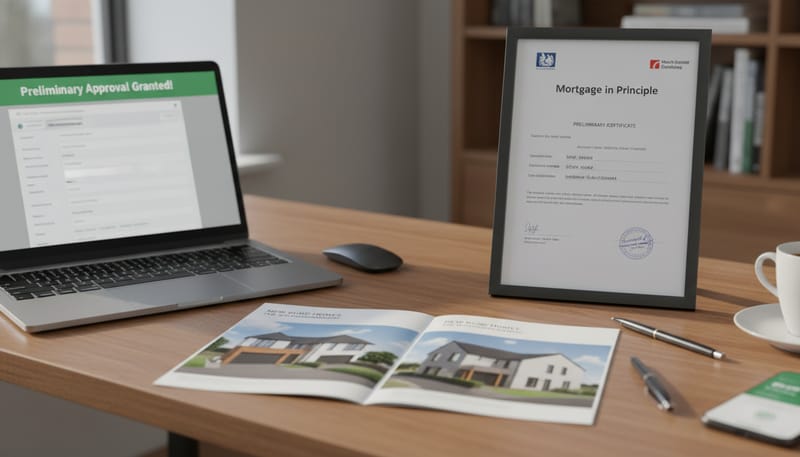
A mortgage in principle — also known as a decision in principle (DIP), agreement in principle (AIP), or mortgage promise — is one of the very first steps you should take when considering buying a new build home. It is a conditional statement from a lender confirming how much they would be willing to lend you based on a preliminary assessment of your income, outgoings, and credit history. For new build purchases specifically, having a mortgage in principle is not just advisable; it is almost always a requirement. The vast majority of housebuilders in the UK, from the largest national developers like Barratt Homes and Taylor Wimpey to smaller regional builders, will ask to see your mortgage in principle before they will accept a reservation fee and take a property off the market for you.
The process of obtaining a mortgage in principle has been streamlined considerably in recent years, with many lenders now offering online applications that can return a decision within minutes. However, for new build buyers, there are several nuances that make the process slightly different from a standard purchase. The validity period matters more because of build timelines, the amount you are approved for needs to align precisely with the purchase price of the plot, and some developers have specific requirements about which lenders they will accept a mortgage in principle from. Understanding these details before you begin will save you time, protect your credit score, and put you in the strongest possible position when you walk into a new build sales office. This guide covers everything you need to know about securing a mortgage in principle for your new build home, from the documents you will need to the impact on your credit file and how to handle developer-specific requirements. For broader guidance on choosing between a broker and applying directly, see our comprehensive guide on mortgage broker versus going direct for new builds.
What Exactly Is a Mortgage in Principle?
A mortgage in principle is a written indication from a lender stating the amount they are likely to lend you, subject to a full application, property valuation, and verification of the information you have provided. It is important to understand what it is and what it is not.
A mortgage in principle is a useful tool that demonstrates your borrowing capacity to sellers, developers, and estate agents. It shows that you are a serious buyer who has been provisionally assessed by a lender. It gives you a clear budget for your property search and can speed up the full mortgage application process when you are ready to proceed.
A mortgage in principle is not a guaranteed offer of lending. The lender has not yet verified your income documentation, carried out a full credit assessment, or valued the property you wish to purchase. Any of these steps could result in the lender offering a different amount, imposing conditions, or declining the application entirely. According to industry estimates, approximately 10–15% of mortgage in principle holders encounter issues when they progress to a full application.
What It Tells You
- ✓ Maximum borrowing amount
- ✓ That you pass initial credit checks
- ✓ Your affordable property price range
- ✓ How seriously lenders view your application
What It Does Not Guarantee
- ✗ A specific interest rate
- ✗ That the full application will succeed
- ✗ That the property will value correctly
- ✗ That your circumstances will not change
The MIP Process: Step by Step
The process of obtaining a mortgage in principle is relatively straightforward, but understanding each step helps you prepare effectively and avoid unnecessary delays or credit score impacts.
Gather Your Information
Before applying, collect details about your income, employment status, monthly outgoings, existing debts, and the deposit amount you have available. You will also need to know approximately how much you want to borrow and the type of property you are looking at.
Choose Your Route: Broker or Direct
Decide whether to apply through a mortgage broker or directly to a lender. A broker can obtain multiple MIPs from different lenders to give you options, while going direct keeps things simple if you already know which lender you want to use.
Complete the Application
Fill in the MIP application form online, by phone, or in person. This typically takes 15–30 minutes and asks about your personal details, employment, income, outgoings, and desired borrowing amount.
Credit Check
The lender will conduct a credit check. Most lenders now perform a soft credit search at the MIP stage, which does not affect your credit score. However, some still use hard searches, so it is important to ask beforehand.
Receive Your Decision
Most online MIP applications return a decision within minutes. You will receive a certificate or letter confirming the amount the lender is willing to consider, valid for a set period (typically 30–90 days).
Documents You Will Need
While the MIP stage itself typically requires only self-declared information, having the following documents ready will ensure a smooth transition to the full application and help you provide accurate figures during the MIP process:
Credit Checks: Soft vs Hard Searches
One of the most important considerations when applying for a mortgage in principle is the type of credit check the lender performs. This has a direct impact on your credit score and your ability to apply to multiple lenders.
Soft credit searches are only visible to you on your credit file and do not affect your credit score. They are sometimes called quotation searches or credit checks for eligibility purposes. Most major lenders including Halifax, Nationwide, HSBC, and NatWest now use soft searches for their MIP applications, which means you can apply to multiple lenders without worrying about the impact on your credit file.
Hard credit searches (also called full credit searches or application searches) are visible to other lenders and can temporarily reduce your credit score. Multiple hard searches in a short period can signal to lenders that you are desperate for credit, which may affect future applications. Some lenders and brokers still use hard searches at the MIP stage, so always ask before applying.
Important: Even with soft searches, the full mortgage application will always involve a hard credit search. This is unavoidable and expected. The key is to minimise unnecessary hard searches during the exploratory MIP stage. If using a broker, they will typically only submit one hard search to the lender they recommend.
How Much Can You Borrow? Understanding Income Multiples
The amount a lender is willing to offer through a mortgage in principle is primarily determined by your income and existing financial commitments. UK lenders typically use income multiples as a starting point, then refine the figure through affordability assessments that consider your specific outgoings.
The standard income multiple in the UK mortgage market is 4.5 times your gross annual income. This means that on a salary of £50,000, you could potentially borrow up to £225,000. However, some lenders will stretch to higher multiples in certain circumstances. Professionals such as doctors, lawyers, and accountants may qualify for 5 or even 5.5 times income multiples with lenders like Halifax, Barclays, and certain building societies. Nationwide has been known to offer up to 5.5x for first-time buyers purchasing new builds under certain criteria.
Borrowing Power by Income Level (4.5x Multiple)
For joint applicants, lenders typically combine both incomes before applying the multiple. So a couple earning £40,000 and £35,000 respectively (£75,000 combined) could borrow up to £337,500 at 4.5x. This combined borrowing power is one of the key advantages of joint mortgages for new builds, which we cover in a separate detailed guide.
MIP Validity Periods: Why They Matter for New Builds
A mortgage in principle is not open-ended. Each lender sets a validity period after which the MIP expires and you would need to reapply. Understanding these timeframes is particularly important for new build buyers, where the process from initial reservation to completion can span many months.
MIP Validity by Lender
For new build buyers, the typical timeline from reservation to exchange of contracts can be 4–8 weeks, but for off-plan properties where the home is not yet built, this can extend to 6–18 months. This means your MIP will likely expire at least once during the process. The good news is that renewing an MIP is usually straightforward, especially if your circumstances have not changed, but you should be prepared for this eventuality and factor it into your planning.
Tip for Off-Plan Buyers: Do not apply for your MIP too early if buying off-plan. Wait until you are within a few months of needing to make the reservation. This ensures your MIP is based on current lending criteria and rates, and reduces the number of times you need to renew. However, it is wise to use online affordability calculators first to get a rough idea of your borrowing power before visiting sales offices.
What Developers Look for in a Mortgage in Principle
New build developers have specific expectations when it comes to mortgage in principle documents. Unlike private sellers who might accept any credible offer, developers often have stricter requirements because they are managing an entire site of sales simultaneously and need confidence that each reserved buyer can complete.
Most developers will want to see an MIP that specifically covers the purchase price of the plot you are reserving. If you have an MIP for £250,000 but the property you want costs £275,000, the developer may ask you to obtain a new MIP that covers the higher amount. Developers also typically want the MIP to be from a recognised lender — while any FCA-regulated lender should be acceptable, some developers may be more cautious about MIPs from very small or specialist lenders they are unfamiliar with.
Additionally, developers usually have a preferred mortgage broker operating from their sales office. While you are not obligated to use this broker, many developers will encourage you to have an initial conversation with them. The developer's broker can often fast-track the MIP process because they understand the specific requirements of the development and have established processes for handling reservations.
The Affordability Assessment Behind Your MIP
Behind the scenes, when you apply for a mortgage in principle, the lender is running a preliminary affordability assessment. Since the Mortgage Market Review (MMR) reforms introduced in 2014, lenders are required to stress-test your ability to repay the mortgage at higher interest rates, not just the initial rate you would be paying.
The stress test typically adds 1–3 percentage points to the revert rate (the rate the mortgage would revert to after the initial fixed period). So if you are applying for a 5-year fixed rate at 4.09%, the lender might stress-test your affordability at 7–8%. This means that even if you can comfortably afford repayments at the initial rate, the lender may limit your borrowing based on what they calculate you could afford at the stressed rate.
The affordability calculation considers your gross income, tax, National Insurance, student loan repayments, childcare costs, existing credit commitments (credit cards, car finance, personal loans), regular financial commitments, and essential living costs. Lenders use either the Office for National Statistics (ONS) data or their own internal models to estimate living costs if you do not declare them specifically.
Factors That Can Affect Your MIP Amount
Several factors can reduce the amount a lender is willing to offer through a mortgage in principle, and being aware of these in advance can help you maximise your borrowing potential or manage your expectations accordingly.
Existing credit commitments: Car finance, credit card balances, student loans, and personal loans all reduce your available income for mortgage repayments. Each £100 of monthly credit commitment typically reduces your maximum borrowing by £15,000–£20,000. Before applying for an MIP, consider paying off smaller debts if possible, as this can significantly increase your borrowing power.
Credit score issues: Late payments, defaults, CCJs, or excessive credit applications can all result in a lower MIP or a decline. Before applying, check your credit reports with all three UK credit reference agencies (Experian, Equifax, and TransUnion) and address any errors or issues.
Employment type and duration: Lenders prefer applicants who have been in their current role for at least 6–12 months. If you have recently changed jobs or are still in a probationary period, some lenders may reduce the amount they are willing to offer. Self-employed applicants typically need at least 2 years of accounts, though some specialist lenders will consider 1 year. For a full breakdown of self-employed requirements, see our guide on self-employed mortgages for new build homes.
Deposit size: While the deposit does not directly affect the MIP amount (which is based on income), a larger deposit gives you access to lower LTV products with better rates, which can sometimes influence the stress-test calculations and marginally increase borrowing capacity.
Impact of Debt on Borrowing Capacity (£50,000 salary)
From MIP to Full Application: What Happens Next
Once you have your mortgage in principle and have reserved your new build property, the next step is converting the MIP into a full mortgage application. This is where the lender moves from provisional assessment to detailed verification, and it is where having prepared your documents in advance pays dividends.
The full application typically needs to be submitted within 28 days of reservation, though this can vary by developer. Your broker or the developer's mortgage adviser will guide you through this timeline. The full application process involves submitting all the documentation we listed earlier, having the property valued by the lender's surveyor, undergoing a full credit check, and having your application assessed by an underwriter.
For new builds, the valuation process can be more complex than for resale properties. If the property is not yet built or is mid-construction, the valuer will need to assess it based on the plans and specification. Some lenders will only instruct a valuation once the property reaches a certain stage of construction, such as roof-on or plastered stage. This is another area where a broker with new build experience can add significant value by ensuring the timing of the application and valuation aligns with the construction programme.
Typical New Build Mortgage Timeline
Obtain MIP, visit developments, reserve your plot
Submit full mortgage application with all documents
Valuation, underwriting, and mortgage offer issued
Conveyancing, searches, legal work proceeds
Exchange of contracts and await completion (build dependent)
Tips for Maximising Your MIP Amount
If the initial MIP amount is lower than you need for the new build you have your eye on, there are several strategies that can help increase your borrowing power:
Pay off existing debts: As shown in our earlier analysis, reducing your monthly commitments can significantly increase borrowing capacity. If you have credit card balances or small loans, clearing them before applying can boost your MIP by tens of thousands of pounds.
Close unused credit accounts: Even if they have a zero balance, unused credit cards and overdraft facilities represent potential borrowing to lenders. Closing accounts you do not use removes this concern from the affordability assessment.
Consider a longer mortgage term: Extending from 25 to 30 or 35 years reduces the monthly payment, which can increase the amount you pass affordability for. You can always make overpayments to reduce the term later, subject to your lender's overpayment allowance (typically 10% per year).
Apply jointly: If you have a partner, applying together combines your incomes for the affordability assessment. This can substantially increase your borrowing power and open up higher-value new builds that would be out of reach on a single income.
Use a broker to find the right lender: Different lenders have different affordability models. A broker can identify which lender will offer the highest MIP for your specific circumstances. The difference between the most and least generous lender for the same applicant can be £30,000–£50,000 or more.
Consider a guarantor: If you have a family member willing to support your purchase, a guarantor mortgage can significantly increase the amount you are able to borrow by using their income or property as additional security.
Common MIP Mistakes to Avoid
Avoiding these common pitfalls will give you the best chance of a smooth MIP process and an accurate reflection of your borrowing power:
Do not overstate your income: It might be tempting to round up your salary or include income you are not certain of receiving, but the full application will require documentary evidence of everything you declare. Overstating your income at the MIP stage only leads to disappointment and potential rejection at the full application stage.
Do not understate your debts: Similarly, do not omit credit commitments or understate your monthly outgoings. The lender will discover these during the credit check and document verification, and discrepancies raise red flags that can delay or derail your application.
Do not apply to too many lenders simultaneously: While soft search MIPs do not affect your credit score, applying to multiple lenders for hard search MIPs can cause damage. If you want to compare offers, use a broker who can obtain quotes from multiple lenders using a single set of searches.
Do not change your financial circumstances between MIP and full application: Taking on new credit, changing jobs, or making other significant financial changes between obtaining your MIP and submitting your full application can result in a different outcome. Keep your finances stable throughout the process.
When applicants follow best practice and provide accurate information
MIP for New Build Flats vs Houses
It is worth noting that some lenders have different policies for new build flats compared to new build houses. New build flats, particularly those in high-rise developments or those affected by cladding concerns post-Grenfell, face additional scrutiny from lenders. Some key differences include lower maximum LTV ratios (often 75–80% for flats versus 90–95% for houses), additional requirements around the EWS1 fire safety form, specific criteria about the size of the development and the proportion of units allocated to buy-to-let, and concerns about service charges and ground rent levels (particularly for leasehold properties).
If you are looking at a new build flat, be sure to mention this when applying for your MIP, as the amount and terms may differ from what you would be offered for a house. A broker with experience in new build flats can be particularly valuable in navigating these additional requirements and identifying lenders who are comfortable lending on the type of property you are considering.
Final Checklist: Before You Apply
Before you apply for your mortgage in principle, run through this checklist to ensure you are fully prepared:
It is also worth understanding the relationship between your mortgage in principle and any government schemes you may be using. If you are applying through Shared Ownership, for example, the mortgage in principle needs to cover only the share you are purchasing, not the full market value of the property. For a £300,000 property where you are buying a 40% share, your MIP would need to cover £120,000 minus your deposit. The housing association will want to see the MIP alongside evidence of your household income to confirm eligibility for the scheme. Similarly, if you are using any developer contribution schemes, make sure your MIP reflects the net amount you need to borrow after incentives are applied.
The timing of your MIP application relative to the broader property market can also have implications. In a rising rate environment, getting your MIP early and then moving quickly to a full application can lock in a rate before it increases. Most lenders will honour the rate that was available when you submitted your full application, not when you obtained your MIP. However, if rates drop between your MIP and full application, you are usually free to select a better product at that point. A broker can advise on rate trends and optimal timing for your application.
One frequently asked question is whether you can get a mortgage in principle from multiple lenders simultaneously. The answer is yes, provided they use soft credit searches. Having MIPs from two or three lenders can be useful if you want to compare maximum borrowing amounts or if you are unsure which lender will offer the best deal for the property you eventually choose. However, be cautious about applying to too many lenders, even with soft searches, as it can create confusion and may raise questions if lenders can see multiple applications during the full underwriting process.
Another important consideration is what to do if your MIP is declined. A decline does not necessarily mean you cannot get a mortgage. It may simply mean that particular lender's criteria do not suit your circumstances. Before applying elsewhere, try to understand the reason for the decline. Common reasons include insufficient income for the requested amount, credit history issues, employment that does not meet the lender's minimum criteria, or existing debt levels that are too high. A mortgage broker is particularly valuable in this situation because they can assess why you were declined and recommend a lender whose criteria are a better fit, without subjecting you to further unnecessary credit searches.
For new build buyers specifically, it is worth being aware that some lenders have started offering digital MIPs that can be shared directly with developers through secure portals. This streamlines the reservation process and gives developers greater confidence in the validity of the MIP. Ask your broker or lender whether they offer digital verification of your mortgage in principle, as this can speed up the reservation process and make you a more attractive buyer in the eyes of the developer.
Finally, remember that your mortgage in principle is just the beginning of the journey. The gap between MIP and mortgage offer is where the real work happens, and being organised, responsive, and prepared with documentation will make this transition as smooth as possible. Many new build sales teams report that the most common cause of delays in the purchase process is buyers being slow to provide documentation for their full mortgage application. By having everything ready from day one, you give yourself the best possible chance of a timely completion that aligns with your new build's construction schedule.
Getting your mortgage in principle is the essential first step towards owning your new build home. By preparing thoroughly, understanding the process, and choosing the right route for your circumstances, you can secure your MIP quickly and confidently, putting yourself in the best possible position when you walk into that show home and find your perfect property.