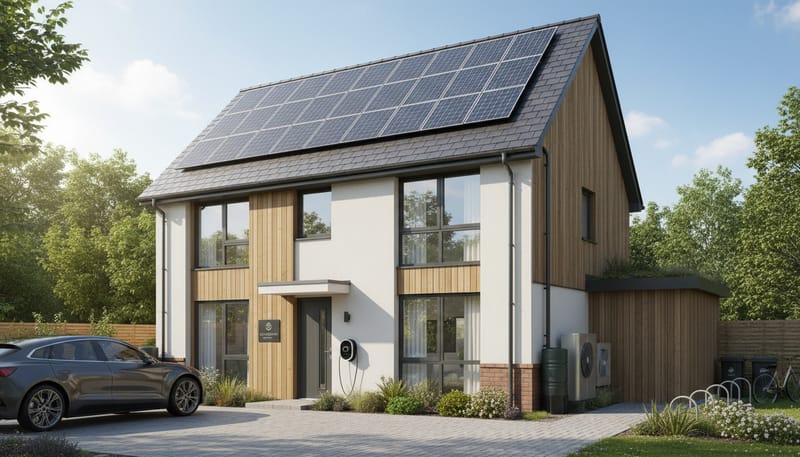
The UK housebuilding industry stands at a defining moment in its environmental journey. With the construction sector responsible for approximately 25% of the nation's total carbon emissions, developers are under unprecedented pressure from regulators, investors and homebuyers alike to demonstrate meaningful progress toward decarbonisation. What was once considered a distant aspiration has rapidly become a commercial imperative, and the leading names in UK housebuilding are responding with ambitious pledges, innovative construction methods and a fundamental rethinking of how new homes are designed, built and operated over their lifetimes.
The shift has been catalysed by several converging forces: the UK Government's legally binding commitment to reach net zero greenhouse gas emissions by 2050, the introduction of the Future Homes Standard in 2025 requiring new dwellings to produce 75-80% less carbon emissions than those built under previous Building Regulations, and a growing body of evidence that sustainable homes command premium valuations and attract stronger buyer demand. From Barratt Developments' science-based targets to Berkeley Group's pioneering work on embodied carbon measurement, the industry is proving that building responsibly and building profitably are not mutually exclusive goals. This article examines the full spectrum of carbon reduction strategies being deployed across the UK new build sector, from the extraction of raw materials through to the day-to-day operation of completed homes.
Understanding the Carbon Challenge: Scope 1, 2 and 3 Emissions
Before examining specific developer strategies, it is essential to understand the framework through which carbon emissions are categorised. The Greenhouse Gas Protocol, the most widely used international accounting tool, divides emissions into three scopes, each presenting distinct challenges for housebuilders.
Scope 1 emissions are direct emissions from sources owned or controlled by the company. For developers, this includes fuel burned in company vehicles, on-site generators, gas heating in offices and show homes, and any direct combustion on construction sites. These are typically the easiest to measure and the first area targeted for reduction, often through fleet electrification and the elimination of diesel generators.
Scope 2 emissions arise from the generation of purchased electricity, steam, heating and cooling consumed by the company. For developers, this covers electricity used in offices, sales centres and construction site compounds. Many developers have addressed Scope 2 by switching to renewable energy tariffs or generating on-site renewable power, making these emissions relatively straightforward to tackle.
Scope 3 emissions represent the real challenge. These are all indirect emissions that occur in the value chain, both upstream and downstream. For housebuilders, Scope 3 encompasses the embodied carbon in building materials (cement, steel, bricks, insulation), emissions from subcontractor activities, waste disposal, employee commuting, and critically, the operational carbon produced by completed homes over their lifetime. Scope 3 typically accounts for over 95% of a developer's total carbon footprint, making it the area where the greatest impact can be achieved but also the hardest to measure and control.
Net Zero Targets: Where the Major Developers Stand
The UK's largest housebuilders have set increasingly ambitious net zero targets, many validated by the Science Based Targets initiative (SBTi), ensuring alignment with the Paris Agreement's goal of limiting global warming to 1.5 degrees Celsius. The race to decarbonise has become a competitive differentiator, with developers recognising that strong environmental credentials attract institutional investors, improve planning outcomes and resonate with an increasingly environmentally conscious buyer base.
Barratt Developments has been at the forefront, becoming one of the first major housebuilders globally to have its near-term science-based targets validated by SBTi. The company has committed to achieving net zero across its entire value chain by 2040, a full decade ahead of the Government's 2050 deadline. Barratt has already reduced its Scope 1 and 2 emissions intensity by over 52% compared to its 2018 baseline, driven by fleet electrification, renewable electricity procurement and energy efficiency improvements at its offices and site compounds. The developer invested over 14 million pounds in sustainability initiatives during the 2023/24 financial year alone.
Berkeley Group achieved net zero on Scope 1 and 2 emissions as early as 2021, making it one of the first UK developers to reach this milestone. The company has since turned its focus to Scope 3, developing a proprietary carbon calculator that tracks embodied carbon across every material used in its developments. Berkeley's target is to reduce Scope 3 emissions by 40% per home by 2030, an extraordinarily ambitious goal given the complexity of supply chain decarbonisation. Their Kidbrooke Village development in south-east London has become a showcase for low-carbon construction, with homes achieving over 60% reduction in embodied carbon compared to industry averages.
Taylor Wimpey published its comprehensive carbon reduction strategy in 2022, targeting a 36% reduction in Scope 1 and 2 emissions intensity by 2025 and achieving net zero by 2045. The company has rolled out solar panels as standard on the majority of its new homes and invested heavily in air source heat pump technology, installing over 6,000 units across its developments in the past two years. Taylor Wimpey's partnership with the Supply Chain Sustainability School has helped embed carbon literacy throughout its contractor network.
Persimmon Homes, the UK's largest housebuilder by volume, has committed to net zero by 2040 and published detailed transition plans covering all three emission scopes. The company's Space4 timber frame factory, which manufactures structural components off-site in controlled conditions, has been central to its carbon strategy, reducing material waste by up to 30% compared to traditional masonry construction. Persimmon has also invested in a fleet of electric and hybrid company vehicles, targeting full fleet electrification by 2030.
Embodied Carbon: The Hidden Emissions in Building Materials
Embodied carbon refers to the greenhouse gas emissions associated with the extraction, manufacture, transport, assembly, maintenance and eventual disposal of building materials. For a typical new build home, embodied carbon can account for between 50% and 80% of its total lifecycle emissions, a proportion that will only increase as operational carbon falls in response to tighter energy efficiency standards and the decarbonisation of the electricity grid.
The RICS Whole Life Carbon Assessment methodology, which is increasingly being adopted by UK developers, provides a standardised framework for measuring embodied carbon across all building lifecycle stages: product stage (A1-A3), construction stage (A4-A5), use stage (B1-B7) and end-of-life stage (C1-C4). Some forward-thinking developers also account for Module D, which credits the potential reuse or recycling of materials at the end of a building's life.
Concrete and steel are the two largest contributors to embodied carbon in residential construction, together accounting for roughly 60% of a typical home's embodied emissions. Cement production alone generates approximately 8% of global CO2 emissions, making it a critical area for innovation. UK developers are responding by specifying lower-carbon concrete mixes, increasing the use of supplementary cementitious materials such as ground granulated blast-furnace slag (GGBS) and pulverised fuel ash (PFA), and exploring emerging technologies like carbon capture and storage in concrete production.
Embodied Carbon by Material (kg CO2e per typical 3-bed home)
Timber frame construction is gaining significant traction as a lower-carbon alternative to traditional masonry. Timber is a natural carbon sink, sequestering approximately 1.6 tonnes of CO2 per cubic metre, meaning that increasing timber usage can actually reduce a home's net embodied carbon. Companies such as Persimmon (through Space4), Stewart Milne and several Scottish developers have embraced timber frame as their primary structural system. Cross-laminated timber (CLT) is also being used for larger-scale residential developments, offering structural performance comparable to concrete while delivering embodied carbon savings of 40-60%.
Berkeley Group's detailed embodied carbon analysis across its portfolio revealed that design decisions made at the earliest planning stages have the greatest influence on a development's total carbon footprint. By optimising structural grids, reducing over-specification and selecting materials based on Environmental Product Declarations (EPDs), their design teams have achieved embodied carbon reductions of up to 35% without any increase in construction costs. This demonstrates that carbon reduction often aligns with material efficiency and cost savings.
Key Insight: A whole-life carbon assessment conducted by the UK Green Building Council found that a typical new build home generates approximately 50 tonnes of CO2e in embodied carbon. By switching to timber frame, specifying low-carbon concrete and optimising design, this can be reduced to below 30 tonnes — a 40% saving before the home is even occupied.
Operational Carbon: Building Homes That Cost Less to Run
Operational carbon encompasses the emissions generated during the day-to-day use of a home, primarily from space heating, hot water, lighting, cooking and appliance use. The Future Homes Standard, scheduled for full implementation in 2025, requires new homes to produce 75-80% less operational carbon than homes built to the 2013 Building Regulations. This represents a transformative shift in construction standards, effectively mandating a fabric-first approach combined with low-carbon heating systems.
The fabric-first approach prioritises the thermal performance of the building envelope — walls, roof, floor and windows — to minimise heat loss before any consideration of mechanical systems. Developers are achieving this through enhanced insulation levels, high-performance triple glazing, improved airtightness and the elimination of thermal bridges. A well-insulated, airtight home requires far less energy for heating, reducing both carbon emissions and energy bills for occupants.
Air source heat pumps (ASHPs) have emerged as the primary low-carbon heating technology for new builds, replacing gas boilers in the majority of developments approved under the updated Building Regulations. ASHPs extract heat from the outside air and amplify it using electricity, achieving coefficients of performance (COP) of 3.0 to 4.5, meaning they produce three to four-and-a-half units of heat for every unit of electricity consumed. As the UK electricity grid continues to decarbonise — renewable sources now generate over 40% of the nation's power — the operational carbon savings from heat pumps will only increase over time.
Taylor Wimpey has been particularly proactive in heat pump deployment, having installed over 6,000 air source heat pumps across its developments and training hundreds of site operatives in correct installation techniques. The company reports that homebuyers in properties with heat pumps are achieving annual energy bill savings of 25-40% compared to equivalent homes with gas boilers, a compelling selling point that also reduces lifetime carbon emissions.
Solar photovoltaic (PV) panels are increasingly being installed as standard on new build rooftops. A typical 3-4 kWp system can generate approximately 3,400 kWh of electricity per year in southern England, offsetting a significant portion of a household's energy consumption. When combined with battery storage systems, which are offered as optional upgrades by developers including Redrow and Crest Nicholson, homeowners can further reduce their reliance on grid electricity and lower their carbon footprint. For more on energy-efficient features available in new builds, see our guide on energy efficiency in new build homes.
Carbon Reporting and Transparency
Robust carbon reporting is the foundation of effective decarbonisation. Without accurate measurement, it is impossible to set meaningful targets, track progress or identify areas for improvement. The UK housebuilding sector has made significant strides in carbon reporting, driven by regulatory requirements, investor expectations and industry frameworks.
The Task Force on Climate-related Financial Disclosures (TCFD), now mandatory for large UK companies, requires developers to report on climate-related risks and opportunities across governance, strategy, risk management and metrics. All major UK housebuilders now publish annual TCFD reports, providing detailed breakdowns of their Scope 1, 2 and 3 emissions alongside transition plans and scenario analyses. The Streamlined Energy and Carbon Reporting (SECR) framework provides an additional layer of mandatory disclosure for qualifying UK companies.
Beyond mandatory reporting, many developers participate in voluntary frameworks such as the Carbon Disclosure Project (CDP), which provides standardised questionnaires covering climate governance, risks, targets and emissions data. Barratt Developments achieved a CDP score of A- in 2023, placing it in the leadership band and reflecting its comprehensive approach to carbon management. Bellway, Persimmon and Vistry Group have also improved their CDP scores year-on-year as their reporting capabilities mature.
The Home Builders Federation (HBF) has also played a pivotal role in standardising carbon reporting across the sector. Its annual Watt a Save report benchmarks the energy efficiency of new homes against the existing housing stock, consistently demonstrating that new builds are significantly more energy efficient. The 2024 report showed that a new build home uses approximately 55% less energy than the average existing home, translating to annual carbon savings of around 2.5 tonnes of CO2 per household.
Modern Methods of Construction and Carbon Savings
Modern Methods of Construction (MMC) encompass a range of off-site and advanced on-site techniques that can deliver significant carbon savings compared to traditional construction. By manufacturing building components in factory-controlled environments, MMC reduces material waste, improves quality consistency and shortens construction timescales, all of which contribute to a lower carbon footprint.
Volumetric modular construction, where entire rooms or house sections are manufactured in a factory and transported to site for assembly, can reduce construction waste by up to 70% and cut embodied carbon by 30-45% compared to traditional masonry. Legal & General Modular Homes, operating from a state-of-the-art factory in Selby, North Yorkshire, has been at the forefront of this approach, producing precision-engineered modules that arrive on site with kitchens, bathrooms and electrical installations already in place.
Panelised systems, including structural insulated panels (SIPs) and closed-panel timber frame, offer a balance between factory efficiency and on-site flexibility. These systems allow walls, floors and roof cassettes to be manufactured off-site with insulation, vapour barriers and sometimes even windows pre-installed, then assembled rapidly on site. Developers such as Ilke Homes and TopHat have invested heavily in panelised systems, demonstrating that high-quality, low-carbon homes can be delivered at scale.
The environmental benefits of MMC extend beyond embodied carbon. Factory production enables tighter tolerances and more consistent airtightness, directly improving operational energy performance. Reduced site activity means fewer vehicle movements, less noise and dust, and lower disruption to local ecosystems. For larger developments, the speed of MMC construction can reduce the overall site operational period by 30-60%, cutting the carbon emissions from temporary site infrastructure, machinery and worker commuting.
To learn more about how modern construction techniques are improving quality in new builds, see our article on construction quality standards for new homes.
Renewable Energy Integration on New Build Developments
The integration of renewable energy technologies into new build developments has accelerated dramatically in recent years, driven by the updated Part L Building Regulations and the commercial benefits of marketing energy-efficient homes. Solar PV, air source heat pumps, battery storage and, in some cases, ground source heat pumps and district heating networks are now standard features on many developments.
Barratt Developments has committed to installing solar panels on all new homes where technically feasible, an initiative covering over 90% of its annual completions. The company has also partnered with Octopus Energy to offer homebuyers smart tariffs that optimise energy usage based on when renewable generation is highest, further reducing the carbon intensity of household electricity consumption.
Larger developments are increasingly incorporating community-scale renewable energy. District heating networks powered by ground source heat pump arrays or biomass boilers can serve hundreds of homes from a single energy centre, achieving higher efficiencies than individual heating systems. St. Modwen's Keynsham development near Bristol features a community heat network powered by a large-scale ground source heat pump array, delivering heating and hot water to over 200 homes with carbon savings of approximately 70% compared to individual gas boilers.
Supply Chain Decarbonisation
Addressing Scope 3 emissions requires developers to look beyond their own operations and engage with the entire construction supply chain. This is perhaps the most complex aspect of decarbonisation, involving thousands of suppliers, subcontractors and material manufacturers, each with their own carbon footprints and decarbonisation trajectories.
The Supply Chain Sustainability School, a collaborative initiative supported by major UK developers and contractors, provides free training resources on carbon literacy, sustainable procurement and environmental management. Over 50,000 individuals from the construction supply chain have engaged with the School's learning pathways, helping to embed carbon awareness at every level of the industry.
Material manufacturers are responding to developer demand for lower-carbon products. Hanson UK, one of the country's largest cement and concrete suppliers, has committed to producing net zero concrete by 2050 and has already launched a range of low-carbon concrete products that reduce embodied carbon by up to 50%. Ibstock, the UK's largest brick manufacturer, has invested in more efficient kilns and is exploring hydrogen firing as a route to fully decarbonise brick production. Kingspan and Knauf have both developed insulation products with significantly reduced embodied carbon, using recycled content and renewable energy in their manufacturing processes.
Developers are also using procurement specifications to drive change. By requiring Environmental Product Declarations (EPDs) from suppliers and giving preference to products with lower embodied carbon, developers create market signals that incentivise manufacturers to decarbonise. Vistry Group has integrated carbon criteria into its procurement scoring, meaning that a supplier's environmental credentials directly influence their likelihood of winning contracts.
Supply Chain Fact: The construction materials supply chain is responsible for approximately 10% of the UK's total carbon emissions. By 2030, the industry aims to reduce this by at least 40% through a combination of product innovation, manufacturing efficiency and circular economy principles.
Waste Reduction and Circular Economy
Construction and demolition waste accounts for approximately 60% of the UK's total waste by weight, making waste reduction a critical component of the sector's carbon strategy. Every tonne of construction waste sent to landfill generates approximately 0.5 tonnes of CO2e through decomposition, transport and the lost embodied carbon in discarded materials. Developers are tackling this through a combination of on-site waste management, off-site manufacturing and circular economy principles.
Barratt Developments has achieved a construction waste intensity rate of just 4.2 tonnes per home, one of the lowest in the industry, through meticulous waste segregation, material re-use programmes and design for material efficiency. The company diverts over 97% of its construction waste from landfill, with materials sorted on site into separate streams for recycling. Persimmon has achieved similar results through its Space4 factory, where timber offcuts are collected and repurposed, and packaging waste is minimised through just-in-time delivery systems.
Waste Diversion Rates by Developer
Circular economy principles are gaining traction in the housebuilding sector. Designing homes for disassembly, using modular components that can be repurposed at end of life, and specifying materials with high recycled content all contribute to closing the material loop. Some developers are exploring material passports — digital records that catalogue every material used in a building, facilitating future recycling or re-use when the building is eventually demolished or refurbished.
Nature-Based Solutions and Biodiversity Net Gain
While not directly reducing carbon emissions from construction, nature-based solutions and biodiversity enhancements on new developments contribute to carbon sequestration and help offset residual emissions. The mandatory 10% Biodiversity Net Gain (BNG) requirement, introduced under the Environment Act 2021, requires all new developments to deliver a measurable improvement in biodiversity compared to the pre-development baseline.
Tree planting is a particularly effective nature-based carbon solution. A single mature tree can absorb approximately 22 kg of CO2 per year, and many developers are planting thousands of trees as part of their landscape strategies. Bloor Homes has committed to planting 10 trees for every home it builds, while Redrow's wildlife-friendly landscaping programme has created over 1,000 acres of new green space across its developments. These initiatives not only sequester carbon but also enhance the appeal of developments, improve air quality and provide recreational amenity for residents.
Sustainable Urban Drainage Systems (SuDS), now required on most new developments, can also deliver carbon benefits when designed using natural features such as ponds, swales and rain gardens rather than engineered solutions. These green infrastructure elements support carbon sequestration through plant growth and soil carbon storage while also managing flood risk, a benefit explored further in our article on flood risk and drainage in new builds.
Electric Vehicle Infrastructure and Transport Emissions
Transport emissions represent a significant portion of a new development's overall carbon impact. Since June 2022, Building Regulations have required every new home with associated parking to have an electric vehicle charge point, ensuring that new developments are ready for the transition to electric transport. Leading developers have gone beyond the minimum requirements, installing rapid chargers in communal parking areas and integrating EV charging into smart home energy management systems.
Location and connectivity also play a crucial role in transport-related carbon. Developments that are well served by public transport, cycling infrastructure and local amenities generate fewer car journeys and lower per-household transport emissions. Developers such as Crest Nicholson and Countryside Partnerships have embraced the 20-minute neighbourhood concept, designing developments where daily needs can be met within a short walk or cycle ride, significantly reducing the carbon associated with household travel.
The Future Homes Standard and Regulatory Roadmap
The Future Homes Standard represents the most significant upgrade to residential Building Regulations in a generation. When fully implemented, it will ensure that new homes are designed to produce 75-80% fewer carbon emissions than those built under previous regulations. The standard mandates a fabric-first approach with high levels of insulation and airtightness, low-carbon heating (effectively ruling out gas boilers in new builds), improved ventilation with heat recovery, and solar PV or equivalent renewable generation.
The interim uplift to Part L, which came into force in June 2022, required a 31% reduction in carbon emissions compared to the 2013 standard, serving as a stepping stone to the full Future Homes Standard. This interim standard has already driven significant changes in how homes are designed and built, with most developers adopting heat pumps and solar panels ahead of the 2025 deadline.
Looking beyond the Future Homes Standard, the Government has signalled its intention to introduce whole-life carbon regulations for new buildings, which would require developers to measure and limit the total carbon emissions associated with a building from cradle to grave. This would bring embodied carbon firmly into the regulatory framework and accelerate the industry's transition to lower-carbon materials and construction methods. The New Homes Quality Board (NHQB) has also incorporated energy performance into its quality benchmarks, ensuring that carbon efficiency is embedded in the broader quality framework for new homes.
Investor and Consumer Demand for Green Homes
The financial case for carbon reduction is strengthening rapidly. Institutional investors are increasingly incorporating Environmental, Social and Governance (ESG) criteria into their investment decisions, with carbon performance a key metric. Developers with strong ESG credentials and validated science-based targets attract lower costs of capital, better insurance terms and stronger analyst ratings. The Transition Pathway Initiative ranks UK housebuilders on their carbon management, and companies scoring highly benefit from inclusion in sustainability-focused investment indices.
Consumer demand for energy-efficient, low-carbon homes is also growing. Research by the HBF found that 78% of homebuyers consider a home's energy rating important or very important in their purchasing decision, and properties with EPC ratings of A or B command a price premium of 5-10% compared to equivalent properties with lower ratings. For new build buyers, the combination of lower energy bills, modern design and environmental responsibility creates a compelling value proposition.
Case Studies: Leading the Way
Berkeley Group — One Blackfriars, London: This landmark development achieved a 40% reduction in embodied carbon compared to a conventional building of similar scale. Innovations included optimised structural design, low-carbon concrete with 70% GGBS replacement, and a connection to the South East London Combined Heat and Power network. The building's operational carbon is offset by on-site renewable generation and high-performance building fabric.
Barratt Developments — The Zed House: Barratt's zero-carbon concept home showcased a fully electric, fossil-fuel-free dwelling with triple glazing, air source heat pump, solar PV with battery storage, and a mechanical ventilation heat recovery (MVHR) system. The home achieved EPC A rating and demonstrated that net zero operational carbon is achievable within standard construction budgets when designed holistically from the outset.
Countryside Partnerships — Beaulieu, Chelmsford: This 3,600-home development in Essex has been designed with sustainability at its core, featuring a community woodland of over 40,000 trees, extensive SuDS, wildlife corridors and allotments. The later phases are being built to Future Homes Standard specifications with air source heat pumps, solar panels and EV charging as standard, demonstrating how large-scale developments can integrate carbon reduction across both the built environment and natural landscape.
Looking Ahead: The Path to Net Zero Housebuilding
The trajectory is clear: UK housebuilding is on an irreversible path toward net zero. The combination of tightening regulation, investor pressure, consumer demand and genuine industry commitment is driving a pace of change that would have been unimaginable a decade ago. The Future Homes Standard will eliminate fossil fuel heating from new homes, while emerging whole-life carbon regulations will bring embodied carbon into the regulatory mainstream.
Technology will play an increasingly important role. Digital twins and Building Information Modelling (BIM) enable developers to optimise carbon performance at the design stage, while blockchain-enabled material passports could transform how embodied carbon is tracked through supply chains. Advances in low-carbon cement, green steel, bio-based insulation and carbon-negative materials will progressively reduce the carbon intensity of construction materials themselves.
Perhaps most importantly, the culture of UK housebuilding is changing. Carbon literacy is becoming embedded at every level, from boardrooms to building sites. The next generation of architects, engineers and site managers is being trained with sustainability as a core competence rather than an afterthought. Industry bodies including the NHBC, HBF and New Homes Quality Board are reinforcing this shift through updated standards, awards and benchmarking programmes.
For homebuyers, the message is overwhelmingly positive. New build homes are already significantly more energy efficient than the existing housing stock, and the gap is widening with every regulatory improvement. Choosing a new build from a developer with strong environmental credentials means lower energy bills, greater comfort, reduced maintenance and the knowledge that your home is part of the solution to the climate challenge rather than part of the problem. For a broader overview of why new builds represent good value, see our guide to the advantages of buying a new build home.
The journey to net zero housebuilding is far from complete, but the progress made to date is remarkable. From Scope 1 fleet electrification to Scope 3 supply chain engagement, from embodied carbon calculators to biodiversity net gain, UK developers are demonstrating that responsible, low-carbon housebuilding is not only possible but commercially advantageous. The homes being built today will stand for generations, and the decisions being made now about their carbon performance will shape the UK's emissions profile for decades to come. The industry's commitment to getting this right is one of the most encouraging stories in UK construction.