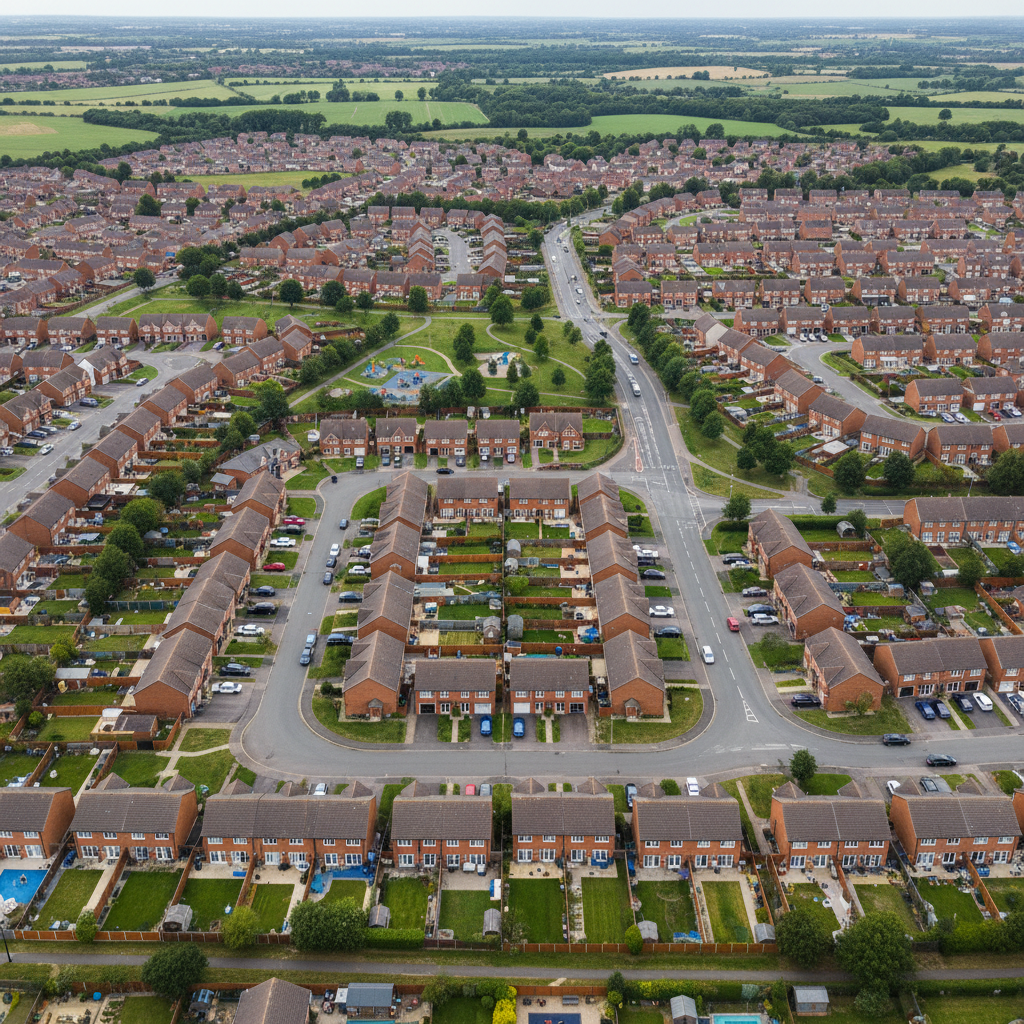
Government Housing Targets vs Actual Delivery: The Gap That Won't Close
Understanding the supply crisis requires starting with the gap between what the government says is needed and what is actually being built. The headline target of 300,000 net additional homes per year in England was first articulated in the 2017 Housing White Paper and has been reaffirmed by successive administrations. However, actual delivery has never come close:
| Year | Net Additional Dwellings (England) | Shortfall vs 300,000 Target |
|---|---|---|
| 2018/19 | 241,130 | -58,870 |
| 2019/20 | 243,770 | -56,230 |
| 2020/21 | 216,490 | -83,510 |
| 2021/22 | 232,820 | -67,180 |
| 2022/23 | 234,400 | -65,600 |
| 2023/24 | 212,600 | -87,400 |
| 2024/25 (est.) | 224,000 | -76,000 |
Even the best year in this period (2019/20, with 243,770 net additions) fell 56,000 homes short of the target. The pandemic years (2020/21) and the mortgage rate shock period (2023/24) saw particularly sharp drops. The cumulative shortfall over the seven years shown is approximately 495,000 homes — nearly half a million homes that were needed but not built.
This cumulative deficit is a major driver of the affordability crisis. Basic economics dictates that when supply consistently falls short of demand, prices rise. The Resolution Foundation has estimated that if housing supply had matched household formation over the past two decades, house prices would be approximately 15-20% lower than they are today.
Is the 300,000 Target Realistic?
Many industry figures have questioned whether 300,000 net additional homes per year is achievable with the current industry structure. The highest annual delivery on record is approximately 352,000 homes in 1968 — achieved with a much larger public housebuilding programme (local authorities built around 150,000 homes per year at the time, compared to near-zero today). To hit 300,000 in the current environment, where the private sector is responsible for the vast majority of delivery, would require:
- Major housebuilders to increase output by approximately 25-30% from current levels.
- A significant revival of the SME (small and medium enterprise) builder sector, which has shrunk dramatically over the past two decades.
- A substantial increase in housing association and local authority delivery.
- Faster and more predictable planning permissions.
- Resolution of labour and skills shortages that constrain the industry's capacity.
- Greater adoption of modern methods of construction (MMC) and off-site manufacturing to accelerate build programmes.
Without progress on most or all of these fronts simultaneously, reaching 300,000 remains highly unlikely. Current delivery of approximately 224,000 net additional dwellings represents a 25% shortfall against the target.
NHBC Registration and Completion Data: The Industry's Own Scorecard
The National House Building Council (NHBC) is the UK's leading provider of warranty and insurance for new homes. Its registration data — recording new homes registered for NHBC warranty cover prior to construction — is one of the most widely used leading indicators of housebuilding activity.
NHBC Registrations: Rolling Twelve-Month Data
| Period (12 months to) | Private Sector | Affordable/HA | Total | YoY Change |
|---|---|---|---|---|
| Q3 2021 | 118,400 | 39,200 | 157,600 | +34.2% |
| Q3 2022 | 112,800 | 36,400 | 149,200 | -5.3% |
| Q3 2023 | 83,600 | 29,800 | 113,400 | -24.0% |
| Q3 2024 | 92,400 | 31,000 | 123,400 | +8.8% |
| Q3 2025 | 104,200 | 34,000 | 138,200 | +12.0% |
The data tells a story of sharp correction followed by gradual recovery. The 24% drop in registrations between Q3 2022 and Q3 2023 was one of the steepest declines outside of a recession, driven by the mortgage rate shock of late 2022 and subsequent collapse in buyer confidence. The recovery since then has been meaningful (+12% in the latest twelve months) but registrations remain approximately 12% below the pre-correction level of 2022 and 20% below the post-pandemic peak of 2021.
Importantly, NHBC registrations represent intended construction, not completed homes. There is typically a lag of 12-24 months between registration and completion, meaning that the improved registration figures in 2025 will translate into higher completion numbers through 2026 and into early 2027.
NHBC Completions
| Period (12 months to) | Total Completions (NHBC-warranted) | YoY Change |
|---|---|---|
| Q3 2022 | 142,800 | +2.4% |
| Q3 2023 | 131,200 | -8.1% |
| Q3 2024 | 118,600 | -9.6% |
| Q3 2025 | 126,400 | +6.6% |
Completions lagged registrations as expected, with the trough coming in Q3 2024 — approximately 18 months after the registration trough. The recovery in completions is now underway, with a 6.6% increase in the latest twelve months. However, completions remain well below the 142,800 recorded in Q3 2022. Given the improving registration trend, we would expect completions to continue their recovery through 2026, potentially reaching 135,000-140,000 by mid-2027.
Note that NHBC data does not capture all new homes — some developers use alternative warranty providers (such as LABC Warranty, Premier Guarantee, or Checkmate). Total industry completions are therefore somewhat higher than NHBC figures alone suggest.
Major Developer Output: Who Is Building What?
The UK housebuilding industry is heavily concentrated among a relatively small number of large, publicly listed companies. The "top 10" developers collectively account for approximately 45-50% of all new homes built in England. Understanding their individual output and strategies provides crucial insight into the supply picture.
Top Developer Completions (Latest Full Year Results)
| Developer | Completions | YoY Change | Avg. Selling Price | Primary Regions |
|---|---|---|---|---|
| Barratt Redrow | 16,890 | +8.2% | £342,600 | Nationwide |
| Vistry Group | 16,200 | +14.8% | £268,400 | Nationwide (partnerships focus) |
| Taylor Wimpey | 10,480 | +6.8% | £318,400 | Nationwide |
| Persimmon | 10,160 | +11.4% | £262,800 | Nationwide (affordability focus) |
| Bellway | 8,240 | +5.6% | £316,200 | Nationwide |
| Berkeley Group | 4,020 | +2.1% | £612,400 | London & South East |
| Crest Nicholson | 2,180 | +4.3% | £384,600 | Southern England |
| Miller Homes | 3,400 | +7.2% | £328,400 | Midlands, North, Scotland |
The combined output of these eight developers alone totals approximately 71,570 homes — roughly half of all new homes built in the UK. The merged Barratt Redrow entity is now the largest housebuilder by volume, closely followed by Vistry Group, which has pivoted its business model towards partnerships (delivering affordable and mixed-tenure housing in partnership with housing associations and local authorities). This pivot has driven Vistry's impressive volume growth of nearly 15%.
Persimmon, traditionally focused on the more affordable end of the market, has shown strong recovery (+11.4%) as first-time buyer demand has improved. Berkeley Group, the premium London and South East specialist, continues to grow more cautiously, reflecting the particular challenges of the London apartment market.
What the Developers Are Saying
Analysing the trading commentary from major developers' latest results provides useful colour on the supply outlook:
- Barratt Redrow has guided for output of 17,000-17,500 homes in its current financial year, representing modest further growth as the integration with Redrow continues.
- Taylor Wimpey has described the market as "encouraging" and is planning to increase its outlet count (the number of active sales sites) by approximately 8-10% through 2026.
- Persimmon is targeting a return to output of 12,000+ homes per year by 2027, with a focus on maintaining quality standards following its well-publicised issues in previous years.
- Bellway has been acquiring new land at an accelerated rate, suggesting confidence in the medium-term demand outlook.
- Vistry is expanding its partnerships model and expects further volume growth, with a stated ambition to deliver 20,000+ homes per year.
The general tone from the major developers is cautiously optimistic, with most planning for modest volume increases in 2026-2027. However, none are signalling the kind of transformative increase in output that would be needed to close the gap to the 300,000 government target.
The Decline of SME Builders: A Critical Missing Piece
One of the most significant — and often overlooked — factors in the housing supply crisis is the dramatic decline of small and medium enterprise (SME) builders. These are companies that build fewer than 500 homes per year, and historically they played a vital role in housing delivery, particularly in smaller towns, rural areas, and infill sites that the major developers consider too small for their standardised processes.
The numbers are stark:
- In the late 1980s, SME builders delivered approximately 100,000 homes per year in England — around 40% of total supply.
- By 2010, this had fallen to approximately 50,000 homes per year.
- In 2025, SME builders are estimated to deliver approximately 22,000-25,000 homes per year — roughly 10% of total supply.
The decline has been driven by multiple factors:
- Planning system complexity: The time and cost of obtaining planning permission has become disproportionately burdensome for smaller builders, who lack the dedicated planning teams and financial resilience of the majors. The average time from planning application to determination for a major housing scheme is now over 18 months.
- Land access: SME builders struggle to compete with large developers and land promoters for available sites. Strategic land options and promotion agreements tend to favour larger players with deeper pockets and longer time horizons.
- Finance: Post-2008 lending restrictions made development finance harder and more expensive for smaller operators. While conditions have improved, the cost of borrowing remains a significant barrier.
- Regulation and compliance: The increasing complexity of building regulations, environmental requirements, and warranty standards creates a compliance burden that is proportionally heavier for smaller firms.
- Section 106 and CIL: Infrastructure contributions that are negotiable for large developers can be prohibitively expensive for smaller schemes.
The government has acknowledged this issue and introduced some measures to support SME builders, including:
- The Levelling Up Home Building Fund, which provides development finance to SME builders.
- Planning reforms aimed at simplifying the process for smaller sites (typically under 50 homes).
- The Small Sites Register, requiring local authorities to identify small sites suitable for housing.
However, progress has been slow, and the SME builder sector continues to operate at a fraction of its historical capacity. Reviving this sector is widely regarded as essential to reaching the 300,000 target, as large developers alone cannot fill the gap.
Affordable Housing Delivery: Falling Further Behind
The affordable housing component of the supply picture is particularly concerning. Affordable housing — which includes social rent, affordable rent, shared ownership, and other intermediate products — is typically delivered through a combination of Section 106 planning obligations (requiring private developers to include a proportion of affordable homes on their schemes) and direct delivery by housing associations and local authorities.
Affordable Housing Completions in England
| Year | Social/Affordable Rent | Shared Ownership | Other Intermediate | Total Affordable |
|---|---|---|---|---|
| 2019/20 | 31,480 | 17,620 | 8,340 | 57,440 |
| 2020/21 | 26,820 | 15,240 | 10,420 | 52,480 |
| 2021/22 | 28,400 | 16,800 | 9,060 | 54,260 |
| 2022/23 | 24,600 | 14,200 | 7,800 | 46,600 |
| 2023/24 | 22,400 | 11,800 | 6,200 | 40,400 |
| 2024/25 (est.) | 24,200 | 12,600 | 6,800 | 43,600 |
Affordable housing delivery has fallen significantly, from approximately 57,000 homes in 2019/20 to an estimated 43,600 in 2024/25 — a decline of nearly 24%. This is deeply concerning given that the housing waiting list in England stands at approximately 1.3 million households.
The decline reflects several compounding challenges:
- Housing association financial pressures: Rising costs (particularly for building safety remediation, decarbonisation, and maintenance of existing stock), combined with government-imposed rent caps, have constrained housing associations' ability to invest in new development.
- Section 106 viability challenges: In a market where developer margins are under pressure, the scope for cross-subsidising affordable housing through planning obligations has diminished. Developers are more frequently challenging Section 106 requirements on viability grounds, and local authorities are often accepting reduced affordable housing contributions rather than risk schemes becoming unviable.
- Grant funding constraints: The Affordable Homes Programme provides grant funding for affordable housing, but the level of funding has not kept pace with rising construction costs. Grant rates per unit have been broadly flat while costs have risen by 20-30%, meaning each pound of grant buys fewer homes.
- Shared ownership demand weakness: The combination of higher interest rates and the complexity of shared ownership (service charges, staircasing, restrictions on alterations) has dampened demand for this tenure, leading to slower sales and reduced developer appetite.
Planning Permission Bottlenecks
The planning system is often cited as the single biggest constraint on housing supply. While the planning debate is complex and politically charged, the data is clear: the system is not processing applications quickly enough, and an insufficient number of permissions are being granted for the volume of homes needed.
Key Planning Statistics
- Planning applications for major housing schemes (10+ units) in England have declined by approximately 18% since 2019, from around 12,400 per year to approximately 10,200 in 2024/25.
- Average determination time for major housing applications is approximately 42 weeks — well above the statutory 13-week target and more than double the time taken a decade ago.
- Only 58% of major housing applications are determined within the statutory timeframe (including agreed extensions of time).
- Planning officer shortages are acute, with the Royal Town Planning Institute (RTPI) estimating a deficit of approximately 2,000 planning officers across England.
- Approximately 35-40% of planning permissions granted for housing are not built out within the expected timeframe, though this includes a proportion that are still under construction or awaiting pre-commencement conditions.
Government Planning Reforms
The government has introduced or proposed several planning reforms aimed at accelerating housing delivery:
- Revised National Planning Policy Framework (NPPF): Published in late 2024, the revised NPPF strengthens the presumption in favour of sustainable development, introduces mandatory housing targets for local authorities, and removes the ability of councils to use neighbourhood plans to resist development below their assessed housing need.
- Planning and Infrastructure Bill: Introduced in 2025, this legislation aims to streamline the planning process for major developments, including new towns, strategic housing sites, and infrastructure projects. Key provisions include faster decision-making timelines, a new fast-track route for nationally significant developments, and reforms to the environmental assessment process.
- Planning officer recruitment: Funding has been allocated for 300 additional planning officers, though this falls short of the estimated 2,000 deficit.
- Permitted development extensions: Further expansion of permitted development rights, allowing certain types of development (including upward extensions of existing buildings) without full planning permission.
These reforms are a step in the right direction but are likely to take several years to have a meaningful impact on delivery numbers. The planning system is fundamentally under-resourced and under-staffed, and fixing this requires sustained investment rather than legislative changes alone.
Labour and Materials Shortages
Even when planning permission is granted and finance is available, the physical capacity to build homes is constrained by labour shortages that have plagued the construction industry for years.
The Skills Gap in Numbers
- The construction industry in the UK employs approximately 2.1 million people, but the Construction Industry Training Board (CITB) estimates that an additional 224,900 workers are needed by 2028 to meet demand.
- The most acute shortages are in bricklaying (approximately 15,000 unfilled positions), carpentry and joinery (12,000), plumbing and heating (10,000), and electrical installation (8,000).
- Brexit has exacerbated the issue by reducing the availability of EU workers, who previously accounted for approximately 8-10% of the construction workforce. While the post-Brexit immigration system allows skilled construction workers to enter on the Skilled Worker visa, the administrative burden and cost have deterred many.
- The industry has an ageing workforce: approximately 28% of construction workers are over 50, and retirement rates are expected to accelerate over the next decade.
- Construction apprenticeship starts have recovered somewhat but remain below pre-pandemic levels, with approximately 26,000 starts in 2024/25 compared to 29,000 in 2018/19.
Materials and Cost Pressures
While materials cost inflation has moderated significantly from the extreme levels of 2021-2022 (when prices rose by 20-30%), costs remain elevated compared to pre-pandemic levels:
| Material | Price Change (2019 to 2025) | Current Trend |
|---|---|---|
| Bricks | +32% | Stable |
| Concrete/cement | +28% | Stable to slightly declining |
| Timber | +18% | Declining (from peak of +60%) |
| Steel | +24% | Stable |
| Plasterboard | +36% | Stable |
| Copper/electrical | +42% | Rising (global demand) |
| Insulation | +38% | Stable |
The elevated cost base means that developers need higher selling prices to achieve their target margins, which in turn limits the volume they can sell in a market where buyer affordability is constrained. This creates a viability squeeze that particularly affects affordable housing delivery (where prices are effectively capped) and development in lower-value areas.
Modern Methods of Construction (MMC): The Future, But Not Yet the Present
Modern methods of construction — particularly off-site manufacturing, modular homes, and panelised systems — have been widely touted as a solution to the speed and labour constraints of traditional housebuilding. The promise is compelling: factory-built homes can be produced faster, with less waste, greater consistency, and reduced reliance on on-site skilled labour.
However, the reality of MMC adoption in 2026 remains somewhat sobering:
- MMC-built homes currently account for approximately 7-10% of new homes in the UK, up from around 5% in 2020 but still a small minority.
- Several high-profile MMC companies have faced financial difficulties, including the collapse of Ilke Homes in 2023 and financial restructuring at other modular builders. These failures have dented confidence in the sector.
- Mortgage lenders have become more willing to lend on MMC homes (particularly those certified by the NHBC), but some lenders still apply restrictions or require additional surveys, which can deter buyers.
- The cost advantage of MMC over traditional construction is not yet clear-cut. While factory production can be more efficient, the fixed costs of factory capacity, transportation of modules to site, and the need for large-scale orders to achieve economies of scale mean that MMC homes are not necessarily cheaper to build than traditional ones. The advantage lies more in speed (a modular home can be assembled on site in days rather than months) and quality consistency.
- Several major developers are investing in MMC capabilities — notably Legal & General Modular Homes (though with a revised strategy after initial difficulties), Berkeley Modular, and Top Hat. The build-to-rent sector has been the most enthusiastic adopter, valuing speed of delivery and consistent quality.
The long-term potential of MMC remains significant, but expecting it to transform housing supply within the next 3-5 years would be premature. A more realistic expectation is that MMC will gradually increase its market share to 15-20% by 2030, complementing rather than replacing traditional construction methods.
Regional Supply Gaps: Where the Shortage Is Most Acute
The housing supply shortage varies significantly by region. Using a combination of household formation projections, existing delivery rates, and affordability data, we can identify the areas where the gap between supply and demand is most acute:
| Region | Estimated Annual Need | Actual Annual Delivery (2024/25 est.) | Shortfall | Delivery as % of Need |
|---|---|---|---|---|
| London | 66,000 | 38,200 | -27,800 | 58% |
| South East | 42,000 | 28,400 | -13,600 | 68% |
| East of England | 32,000 | 24,600 | -7,400 | 77% |
| South West | 24,000 | 19,200 | -4,800 | 80% |
| West Midlands | 28,000 | 22,400 | -5,600 | 80% |
| East Midlands | 22,000 | 20,800 | -1,200 | 95% |
| North West | 28,000 | 26,200 | -1,800 | 94% |
| Yorkshire & Humber | 22,000 | 18,400 | -3,600 | 84% |
| North East | 8,000 | 7,800 | -200 | 98% |
London has by far the largest supply gap, delivering only 58% of its estimated annual housing need. This structural undersupply is the primary reason why London house prices remain at extreme multiples of earnings and why the affordability crisis is most acute in the capital. The South East also has a significant shortfall (68% of need), reflecting tight Green Belt constraints, complex planning environments, and strong demand pressures.
By contrast, the North East is almost keeping pace with estimated need (98%), and the East Midlands and North West are also relatively well-supplied. This does not mean that these regions have no housing issues — pockets of undersupply exist in popular locations, and much of the need is for affordable housing specifically — but the overall supply-demand imbalance is far less severe than in London and the wider South East.
What the Supply Picture Means for Buyers
The supply dynamics outlined above have several practical implications for buyers looking at new build homes in 2026:
In Undersupplied Areas (London, South East)
- Competition for well-located new builds remains strong. Developments in desirable areas with good transport links sell quickly, and the best plots go first. If you see a scheme you like, act promptly — particularly on family houses, which are in shorter supply than apartments.
- Prices are supported by constrained supply. The chronic undersupply in London and the South East provides a floor under prices. Significant price falls are unlikely absent a major economic shock, though rapid appreciation is also unlikely given affordability constraints.
- Apartment oversupply in certain London submarkets. While London overall is undersupplied, there are pockets of apartment oversupply — particularly in Nine Elms, parts of the Docklands, and some outer London schemes. In these locations, developers are pricing more aggressively and offering generous incentives. Buyers can benefit if they are comfortable with the specific micro-location.
In Well-Supplied Areas (North, Midlands)
- Greater choice and more negotiating power. In areas where supply is closer to matching demand, buyers have a wider selection of developments and house types to choose from, and are in a stronger position to negotiate on price and incentives.
- Risk of slower capital growth in some locations. In areas where supply is plentiful relative to demand, price growth may be more muted. This is less of a concern for owner-occupiers (who benefit from lower entry prices) but is relevant for investors focused on capital appreciation.
- Good value for money. The combination of lower prices, generous incentives, and strong energy efficiency specifications means that new build homes in well-supplied northern and Midlands locations can offer excellent value — particularly for first-time buyers prioritising getting onto the ladder.
For a data-driven look at how many homes are being completed and where, see our complementary article: New Build Completions Tracker: How Many Homes Are Being Built and Where. And for the latest pricing data, see our regional price breakdown.
Conclusion: Building More, But Not Enough
The UK is building more homes than it was at the trough of 2023/24, and the direction of travel is positive. NHBC registrations are up 12%, housing starts are up 6.4%, and developer output is increasing across the board. But the pace of recovery is insufficient to close the gap to the government's 300,000-home target, and the cumulative deficit of nearly half a million homes built up over the past seven years continues to weigh on affordability and availability.
Addressing the supply crisis requires action on multiple fronts simultaneously: planning reform, SME builder support, affordable housing funding, workforce development, and the maturation of modern construction methods. These are long-term structural challenges that will not be resolved by any single policy intervention.
For buyers, the practical implication is that new build supply will remain constrained relative to demand for the foreseeable future, supporting prices and limiting the risk of a significant downturn. The best advice is to research thoroughly, compare developments, negotiate assertively on incentives, and focus on locations and property types where supply is relatively more plentiful — giving you better choice and better value.