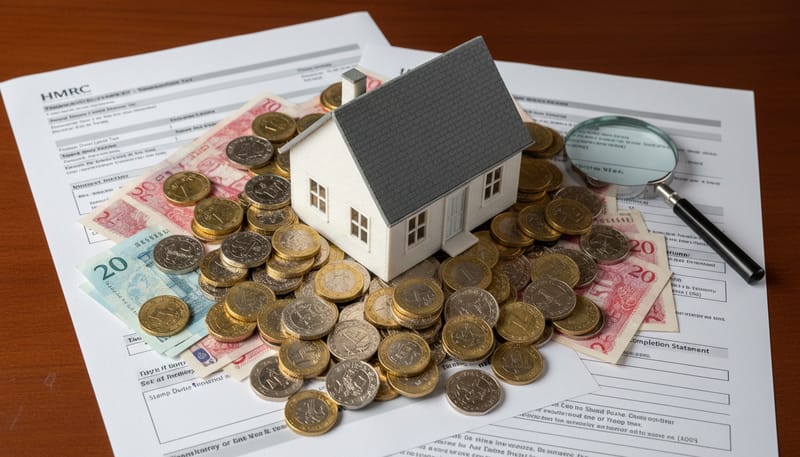
How "Free Stamp Duty" Actually Works
When a developer advertises "stamp duty paid" on a new build home, they are offering a financial contribution equal to the stamp duty bill. The legal obligation to pay Stamp Duty Land Tax (SDLT) remains with the buyer — HMRC does not recognise developer contributions as a waiver.
In practice, the contribution is applied in one of two ways:
- Direct payment at completion: The developer's solicitor transfers the stamp duty amount to your solicitor at completion, who then pays HMRC on your behalf
- Deducted from the completion balance: The stamp duty amount is offset against the final payment due on the property, with your solicitor paying the SDLT separately from the proceeds
Either way, the result is the same: you do not pay the stamp duty out of your own pocket.
Current UK Stamp Duty Rates (2025/26)
Stamp Duty Land Tax in England and Northern Ireland is calculated on the portion of the purchase price that falls within each band:
Standard Rates (Home Movers and Second-Time Buyers)
- Up to £250,000: 0%
- £250,001 to £925,000: 5%
- £925,001 to £1,500,000: 10%
- Over £1,500,000: 12%
First-Time Buyer Rates
- Up to £425,000: 0%
- £425,001 to £625,000: 5%
If the property costs more than £625,000, the first-time buyer relief does not apply and standard rates are charged on the full amount.
Additional Property Surcharge
Buyers purchasing a second home or buy-to-let property pay an additional 5% surcharge on top of the standard rates, applied to the entire purchase price.
Note: Scotland uses Land and Buildings Transaction Tax (LBTT) and Wales uses Land Transaction Tax (LTT), which have different thresholds. The examples below use SDLT rates for England.
How Much Does the Incentive Save? Worked Examples
The value of a stamp duty incentive depends entirely on the purchase price and whether you qualify for first-time buyer relief.
£250,000 New Build
- Standard buyer: £0 stamp duty (below the threshold) — incentive saves nothing
- First-time buyer: £0 stamp duty — incentive saves nothing
- Additional property buyer: £12,500 (5% surcharge on full amount) — incentive saves £12,500
£350,000 New Build
- Standard buyer: £5,000 (5% on £100,000 above £250,000) — incentive saves £5,000
- First-time buyer: £0 (below £425,000 threshold) — incentive saves nothing
- Additional property buyer: £22,500 (£5,000 SDLT + £17,500 surcharge) — incentive saves £22,500
£450,000 New Build
- Standard buyer: £10,000 (5% on £200,000 above £250,000) — incentive saves £10,000
- First-time buyer: £1,250 (5% on £25,000 above £425,000) — incentive saves £1,250
- Additional property buyer: £32,500 — incentive saves £32,500
£600,000 New Build
- Standard buyer: £17,500 — incentive saves £17,500
- First-time buyer: £8,750 (5% on £175,000 above £425,000) — incentive saves £8,750
- Additional property buyer: £47,500 — incentive saves £47,500
When This Incentive Is Worth Nothing
The most important thing to understand is that a stamp duty incentive has zero value if you would not owe stamp duty anyway. This applies to:
- First-time buyers purchasing under £425,000: You already pay no stamp duty. The developer is "paying" a £0 bill. If a developer advertises "stamp duty paid" on a £380,000 property and you are a first-time buyer, the incentive is effectively worthless to you.
- Any buyer purchasing under £250,000: Standard rates start at 0% up to £250,000, so there is nothing to pay regardless of buyer status.
In these situations, negotiate a different incentive instead — flooring, kitchen upgrades, or legal fees paid — rather than accepting a stamp duty contribution that saves you nothing. For negotiation tactics, see our negotiation guide.
How Stamp Duty Incentives Affect Your Mortgage
Stamp duty contributions count toward the total incentive package that must be disclosed to your mortgage lender. Most lenders accept total incentives up to 5% of the purchase price without adjusting the valuation.
Example
You are buying a £400,000 new build. The developer offers:
- Stamp duty paid: £7,500
- Flooring package: £4,000
- Legal fees: £1,500
- Total: £13,000 (3.25% of purchase price)
At 3.25%, this is within the 5% lender threshold and should not affect your mortgage valuation. However, if additional incentives push the total past 5% (£20,000), the lender may reduce the valuation by the excess amount.
For a detailed explanation of how incentives interact with mortgage valuations, see our guide on hidden conditions behind incentives.
Stamp Duty Paid vs Other Incentives: Which Is Better?
Stamp duty contributions are one of the most transparent incentives because the value is exact — it is a fixed tax bill that you can calculate to the penny. Compared to other incentives:
- Better than flooring/kitchen upgrades in terms of transparency — there is no inflated "retail value" to question
- Better than deposit contributions because lenders have no issue with stamp duty payments (they do scrutinise gifted deposits)
- Less valuable than a price reduction for long-term equity — a lower purchase price means lower stamp duty, a smaller mortgage, and less interest paid over the mortgage term
For a full comparison, see our incentives vs price discounts analysis.
Can You Combine Stamp Duty Incentives with First-Time Buyer Relief?
Yes. If you are a first-time buyer purchasing a property between £425,000 and £625,000, you benefit from the reduced FTB rate (0% on the first £425,000, then 5% on the remainder). The developer can still offer to pay the stamp duty bill on the portion above £425,000.
For example, a first-time buyer purchasing at £500,000 would owe £3,750 in stamp duty (5% on £75,000). The developer's "stamp duty paid" incentive would cover this £3,750.
However, if you are a first-time buyer purchasing under £425,000, there is no stamp duty to pay and the incentive offers you nothing. In that case, ask the developer to redirect the incentive value elsewhere.
Things to Check Before Accepting
- Calculate your actual stamp duty bill before assuming the incentive is valuable. Use the HMRC stamp duty calculator to confirm the exact figure.
- Check whether the contribution is capped. Some developers offer "stamp duty contribution up to £X" rather than covering the full bill. If your stamp duty is £10,000 but the contribution is capped at £5,000, you still pay £5,000.
- Confirm the incentive is in the contract. A "stamp duty paid" banner on the website is marketing. The commitment must be written into your reservation agreement and contract of sale.
- Ask if it can be swapped. If the stamp duty incentive has no value for your situation (e.g. you are a FTB under £425,000), ask the developer to offer an equivalent incentive in a different form — flooring, appliances, or legal fees.
- Understand the total incentive package. The stamp duty contribution counts toward the 5% lender threshold alongside all other incentives. Make sure the combined total does not cause a mortgage valuation issue.
Stamp Duty in Scotland and Wales
If you are buying a new build in Scotland or Wales, different taxes apply:
Scotland — Land and Buildings Transaction Tax (LBTT)
- Up to £145,000: 0%
- £145,001 to £250,000: 2%
- £250,001 to £325,000: 5%
- £325,001 to £750,000: 10%
- Over £750,000: 12%
First-time buyers in Scotland pay no LBTT on the first £175,000.
Wales — Land Transaction Tax (LTT)
- Up to £225,000: 0%
- £225,001 to £400,000: 6%
- £400,001 to £750,000: 7.5%
- £750,001 to £1,500,000: 10%
- Over £1,500,000: 12%
Wales does not currently offer first-time buyer relief on LTT.
Developer stamp duty incentives work the same way in all three nations — the developer contributes to whichever transaction tax applies. However, the savings amounts will differ because the thresholds and rates are different.
Frequently Asked Questions
Is "stamp duty paid" the same as a stamp duty holiday?
No. A stamp duty holiday is a government-announced temporary change to the tax thresholds (like the COVID-era holiday in 2020–2021). "Stamp duty paid" by a developer is a private incentive where the developer covers your existing tax bill. The two are completely separate.
Do I still need to file a stamp duty return?
Yes. Your solicitor files the SDLT return with HMRC regardless of who pays. Even if the developer covers the cost, the return must be submitted within 14 days of completion.
Can the developer pay the additional property surcharge?
In theory, yes — a developer can offer to cover the surcharge as part of the incentive. However, the surcharge significantly increases the amount (5% of the full purchase price), which will push the total incentive package well above the 5% lender threshold on most properties. Check with your mortgage broker.
What happens if stamp duty rates change after I reserve?
The stamp duty bill is calculated on the date of completion, not the date of reservation. If rates change between reservation and completion, your bill may increase or decrease. A "stamp duty paid" incentive should cover whatever the bill is at completion — confirm this in your contract.
Can I claim the stamp duty incentive and first-time buyer relief at the same time?
Yes. First-time buyer relief reduces your stamp duty bill. The developer's incentive then covers whatever remains. You benefit from both.