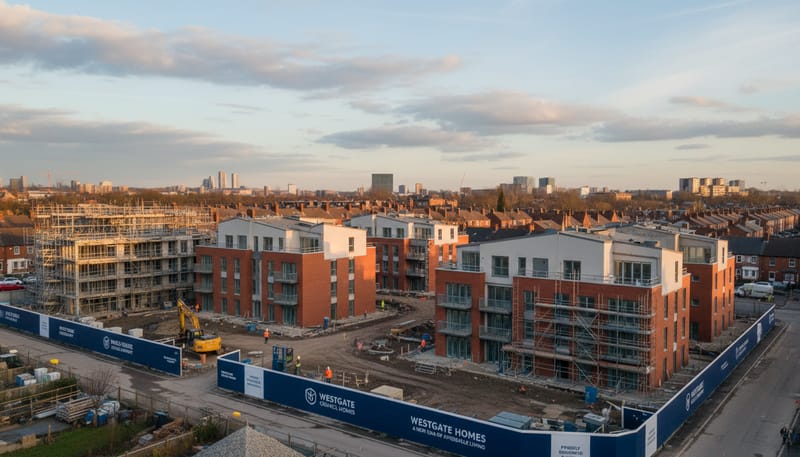
Why Councils Are Building New Homes Again
After decades of decline following the introduction of Right to Buy in 1980, council housebuilding is experiencing a significant revival. Local authorities across the UK are once again commissioning, developing, and managing new homes at scale — driven by a combination of acute housing need, reformed financing rules, and political will to address the housing crisis directly rather than relying solely on the private sector.
The turning point came with the lifting of the Housing Revenue Account (HRA) borrowing cap in 2018, which removed the artificial ceiling on how much councils could borrow to build new homes. This reform, combined with growing frustration at the pace and affordability of private sector delivery, has unleashed a wave of council-led development programmes across England, with similar ambitions in Scotland, Wales, and Northern Ireland.
In 2026, over 100 local authorities in England have active new build programmes, with thousands more homes in planning and pre-construction stages. This represents a fundamental shift in how affordable housing is delivered, with councils taking direct control of quality, design, allocation, and long-term management. The result is a new generation of council homes that challenge outdated perceptions of what public housing looks like.
Housing Revenue Account Reforms and Funding
The financial architecture underpinning council housebuilding has been transformed in recent years, enabling local authorities to invest at a scale not seen since the 1970s.
HRA borrowing: The Housing Revenue Account is a ring-fenced account that councils use to manage their social housing stock. Since the borrowing cap was lifted, councils can borrow as much as they can prudentially afford — meaning borrowing is limited only by their ability to service debt from rental income, not by an arbitrary government-imposed ceiling. This has unlocked billions in potential investment across the country.
Right to Buy receipt reinvestment: Reforms now allow councils to reinvest up to 50% of Right to Buy receipts in replacement housing (increased from the previous 30% cap). Councils have five years to spend receipts, with greater flexibility to combine them with other funding sources. This means every council home sold under Right to Buy now generates more investment in new homes.
Homes England grants: Councils can bid for grant funding through the Affordable Homes Programme to subsidise construction costs, particularly for social rent homes where rental income alone may not cover development costs. Grant rates vary but can cover 30–50% of build costs for social rent homes.
Major Council Building Programmes
Several councils are leading the way with ambitious programmes that demonstrate the scale and quality achievable through public-sector-led housebuilding.
London boroughs are collectively the largest council housebuilders in the country. Hackney, Enfield, Newham, Barking and Dagenham, Southwark, and Lambeth each have programmes delivering thousands of homes. Enfield’s ambitious programme targets 10,000 homes across a mix of council rent, affordable rent, and shared ownership. Hackney’s programme prioritises high design quality, with several award-winning developments by leading architects.
Manchester is delivering through its “Our Town Hall” regeneration and wider housing strategy. The city’s Northern Gateway scheme — a joint venture between the council and Far East Consortium — plans over 15,000 homes across north Manchester, with a significant proportion of affordable and council-rent housing.
Birmingham has committed to building 8,000+ council homes, addressing a waiting list of over 20,000 households. The city’s programme focuses on brownfield regeneration and estate renewal, with an emphasis on family-sized homes to address chronic overcrowding.
Bristol aims to deliver 5,000+ affordable homes by 2030 through a combination of direct council building and partnerships with housing associations. The council has adopted a “Bristol standard” for housing quality that exceeds national minimums, including enhanced space standards and sustainability requirements.
Leeds is building through its council housing growth programme, targeting 4,500+ new homes. The programme includes a notable commitment to modular construction methods, which can reduce build times by 30–50% and improve quality consistency.
Types of Homes Being Built
Council-led programmes deliver a mix of tenures to create balanced, sustainable communities and to cross-subsidise the most affordable homes.
Council rent (social rent) is set using a national formula based on property size, local earnings, and property value, resulting in rents significantly below market rates — typically around 50% of the local market rent. These homes are allocated to households with the greatest housing need and offer secure, lifetime tenancies. The majority of homes in most council programmes are at social or council rent level.
Affordable rent homes are set at up to 80% of local market rent, though many councils voluntarily cap this at 60–65% to keep homes genuinely affordable. Affordable rent tenancies are usually fixed-term (5–10 years) rather than the lifetime tenancies offered at social rent.
Shared ownership and discount market sale homes within council programmes serve a dual purpose: they provide affordable homeownership options and generate sales income that cross-subsidises the construction of social rent homes. This mixed-tenure model is essential for programme viability.
Quality Standards and Design Excellence
One of the defining features of the new generation of council housing is a commitment to design quality that matches or exceeds the private sector.
Space standards: Most council programmes adopt the Nationally Described Space Standard (NDSS) as a minimum, ensuring homes are generously sized. This is in contrast to some private sector developments that build to smaller specifications. A council-built 2-bedroom flat typically offers at least 70m² of floor space, with 3-bedroom houses at 93m² or above.
Sustainability: Council programmes are increasingly leading on sustainability. Norwich City Council’s Passivhaus programme, Exeter’s net zero carbon council homes, and Enfield’s commitment to exceeding the Future Homes Standard demonstrate that public sector housing can set the benchmark for environmental performance. Lower energy bills directly benefit tenants on low incomes.
Design quality: Many councils commission leading architects through design competitions, producing award-winning developments that challenge stereotypes about social housing. Goldsmith Street in Norwich, designed by Mikhail Riches, won the RIBA Stirling Prize in 2019 — the first social housing scheme to win architecture’s highest honour in over 20 years. This set a new benchmark that other councils are now striving to match.
How to Get a Council New Build Home
Accessing a new council home depends on whether you are seeking a rental or ownership tenure.
For rental homes: You must join the council’s housing register (sometimes called the housing waiting list). You will be assessed on your housing need — factors including overcrowding, homelessness, medical need, and current housing conditions determine your priority banding. Most councils use choice-based lettings systems where available properties are advertised and you bid for those that suit your needs.
New build council homes are typically popular and attract many bids, so you may need patience. However, because council programmes deliver at scale, they create more opportunities than trickle-feed allocations from existing stock. Some councils also hold back a proportion of new builds for direct offers to households in the highest-need categories.
For ownership homes: Shared ownership and discount market sale homes on council schemes are marketed through the council’s development company, their housing association partner, or through the Share to Buy portal. Local connection criteria typically apply, with priority given to local residents and workers.
Waiting Lists vs Choice-Based Lettings
Understanding how allocation works is key to navigating the system effectively.
Most councils now use choice-based lettings (approximately 90% of English local authorities), which gives applicants more control. Properties — including new builds — are advertised weekly with details of size, location, rent, and eligibility criteria. You bid for properties you want, and the highest-priority applicant who meets the criteria receives the offer.
For new build council homes specifically, some authorities hold back a proportion of units for direct offers to households in the highest need bands, particularly those in temporary accommodation or fleeing domestic abuse. Others allocate all new builds through the standard CBL process.
Demand for council housing vastly exceeds supply in most areas, with waiting lists often running to tens of thousands. However, new build programmes are gradually improving the picture, and the mix of tenures within these programmes means there are opportunities across the affordability spectrum — from social rent for the lowest incomes through to market sale for those with more resources.
For related schemes, see our guides on First Homes, Rent to Buy, sustainability incentives, and shared ownership.