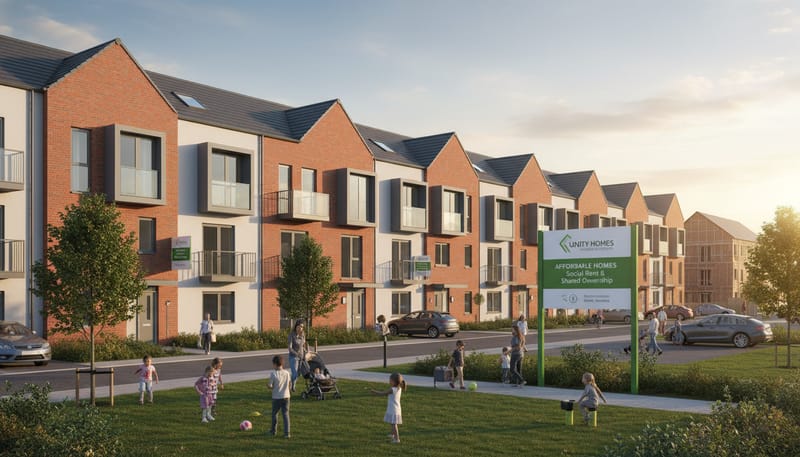
Affordable housing is the defining challenge of the UK housing crisis. While market-rate new build homes attract the bulk of media attention and investment analyst scrutiny, it is the delivery of genuinely affordable homes — social rent, affordable rent, shared ownership, and discounted market sale — that determines whether the government's housing ambitions translate into improved outcomes for the millions of families priced out of the open market. In England alone, more than 1.3 million households sit on local authority housing waiting lists, a figure that has grown by 11% since 2020 despite record levels of overall housing delivery in some years. The gap between need and supply is not narrowing — it is, by most measures, widening.
New build development is the primary mechanism through which affordable housing is delivered in the UK, either through Section 106 planning obligations on private developments or through direct construction by housing associations (Registered Providers). The interplay between planning policy, developer economics, housing association capacity, and government funding determines how many affordable homes get built, what tenure they are, and where they are located. This article provides a comprehensive analysis of the current state of affordable housing delivery, the trends shaping it, and the reforms that could accelerate — or impede — progress. It draws on data from the Department for Levelling Up, Housing and Communities (DLUHC), the Regulator of Social Housing, Homes England, the National Housing Federation, and individual housing association financial statements.
The Scale of Affordable Housing Need
Before examining supply trends, it is essential to understand the scale of the challenge. The most commonly cited estimate of affordable housing need comes from the National Housing Federation and Crisis, whose joint research concluded that England needs approximately 90,000 new social rent homes per year to clear the backlog of need within a generation. When affordable rent, shared ownership, and other intermediate tenures are included, the total affordable housing requirement rises to approximately 145,000 homes per year — representing roughly half of the government's overall target of 300,000 homes annually (recently restated as 1.5 million over the parliament).
The numbers are stark. At current delivery rates of approximately 63,400 affordable homes per year, England is meeting less than 44% of the estimated annual need. The shortfall of 81,600 homes per year is not merely a statistical abstraction — it translates directly into longer waiting lists, increased homelessness, overcrowding, and a growing dependency on expensive temporary accommodation that is costing local authorities an estimated £1.7 billion per year.
Affordable Housing Delivery by Tenure
Not all affordable housing is created equal. The term encompasses a range of tenures with very different cost implications for residents, different funding requirements, and different delivery mechanisms. Understanding the tenure mix within affordable housing delivery is critical because it determines who actually benefits from the homes being built.
Two trends stand out from the tenure breakdown. First, the welcome increase in social rent completions — up 18% to 10,200 — reflects the government's renewed emphasis on this tenure following years of decline (social rent fell to just 5,955 completions in 2021/22, the lowest level since records began). Second, the decline in shared ownership completions (-6%) reflects both the mortgage market challenges of 2023-2024 (shared ownership mortgages proved particularly difficult to obtain at elevated interest rates) and growing consumer scepticism about the product, fuelled by negative media coverage of service charges, building safety remediation costs, and the difficulties of staircasing to full ownership.
Social rent is the most affordable tenure, typically set at around 50% of local market rents and determined by a national formula. Affordable rent can be set at up to 80% of market rent and provides housing associations with higher rental income, enabling greater borrowing capacity. Shared ownership allows buyers to purchase a share (typically 25-75%) and pay rent on the remainder. First Homes are sold at a minimum 30% discount to market value, with the discount locked in for future resales. Each tenure serves a different income band, and the balance between them within Section 106 agreements has become a major point of negotiation between developers and local authorities.
Section 106: The Engine of Affordable Housing Delivery
Section 106 of the Town and Country Planning Act 1990 is the single most important mechanism for delivering affordable housing in England. It allows local planning authorities to require developers to provide a proportion of affordable homes on any development above a specified threshold (typically 10 or more units). In 2024/25, Section 106 obligations accounted for approximately 52% of all new affordable housing completions, making it the dominant delivery channel ahead of direct Homes England grant-funded programmes.
The operation of Section 106 in practice is far more complex and contentious than the simple policy figures suggest. Local plan policies typically require 25-40% affordable housing on qualifying sites, but the actual delivery rate is often significantly lower due to viability negotiations. Developers who can demonstrate that the full affordable housing requirement would render a scheme financially unviable can negotiate a reduced obligation through a viability assessment process overseen by the local authority. DLUHC data indicates that approximately 38% of Section 106 agreements deliver fewer affordable homes than the local plan policy requires, with the shortfall particularly acute in areas where land values are high and build costs have risen sharply.
The viability assessment process has been a source of persistent controversy. Developers employ specialist consultants to prepare assessments based on assumed construction costs, sales values, land values, and profit margins — all of which can be contested by the local authority. Critics argue that the process is weighted in favour of developers, who have greater resources and expertise to make the viability case. The government's planning reform programme includes proposals to standardise viability inputs and increase transparency, but implementation has been slow.
Affordable Housing Targets by Local Authority
Affordable housing requirements vary significantly across local authorities, reflecting differences in local need, land values, and policy priorities. The table below illustrates the range of requirements across a selection of English local authorities, demonstrating the geographic variation in both policy targets and actual delivery outcomes.
The gap between policy targets and actual delivery is evident across the board, though some authorities (notably South Cambridgeshire and Manchester) achieve closer alignment due to either stronger land values or lower policy requirements. The government's review of Section 106 is considering whether to introduce a national minimum affordable housing requirement — potentially 25% — with a presumption against viability reductions except in exceptional circumstances. This would significantly increase affordable delivery in areas with weak current enforcement but could slow overall development in marginal viability locations.
Shared Ownership: A Tenure Under Pressure
Shared ownership has been a cornerstone of intermediate affordable housing for decades, allowing buyers who cannot afford full market purchase to buy a share of a property (typically 25-75%) and pay subsidised rent on the remainder. However, the product has come under increasing scrutiny, and delivery has declined for two consecutive years. Understanding why requires examining both the demand-side challenges facing buyers and the supply-side economics facing housing associations.
On the demand side, the 2023-2024 interest rate environment was particularly hostile to shared ownership. Because lenders assess affordability based on both the mortgage repayment on the purchased share and the rent on the retained share, the total monthly cost of shared ownership can be higher than a full-ownership mortgage at equivalent property values — making the product harder to sell during high-rate periods. Additionally, the 2021 Model Lease reforms (designed to improve consumer protection) introduced a 10-year initial repair responsibility for landlords and more flexible staircasing terms, but also added complexity and cost that some housing associations found difficult to absorb.
The low staircasing rate of just 12% is a particular concern. Shared ownership was designed as a stepping stone to full ownership, but in practice the majority of buyers never staircase beyond their initial share, often because rising property values make additional shares progressively more expensive. This has led to criticism that the product functions more as a high-cost rental with a nominal ownership element rather than a genuine pathway to homeownership.
Social Rent: The Critical Gap
Social rent — housing let at rents determined by the national rent formula, typically around 50-60% of local market rents — is the tenure that most directly addresses housing need. It serves the lowest-income households, those on housing waiting lists, and those at greatest risk of homelessness. Yet it has been the most neglected affordable tenure over the past decade, with annual delivery falling from 36,700 in 2010/11 to a low of 5,955 in 2021/22 as government funding shifted towards homeownership products and housing associations prioritised affordable rent (which generates higher income) over social rent.
The recovery to 10,200 social rent completions in 2024/25 is encouraging but still represents barely 11% of the estimated annual need for 90,000 social rent homes. The government has signalled its intention to prioritise social rent within the next Affordable Homes Programme (AHP), with the 2025 Spending Review allocating £6.9 billion over five years — the largest affordable housing investment in a generation. However, even with full delivery of this programme, annual social rent completions are unlikely to exceed 20,000-25,000 by 2029, leaving a substantial gap.
Housing Association Partnerships with Developers
The relationship between private sector housebuilders and housing associations (Registered Providers) is central to affordable housing delivery. On Section 106 sites, the developer typically builds the affordable homes and then sells them to a housing association at a transfer price agreed during the planning process. This transfer price is significantly below market value — typically 40-60% for rented units and 65-75% for shared ownership — reflecting the affordable designation and the restrictions on future resale.
Beyond Section 106, several major housebuilders have developed strategic partnership models with housing associations. Vistry Group has been the pioneer in this area, building its entire business strategy around "partnership housing" — large-scale delivery of homes for housing associations, local authorities, and the private rented sector. In 2025, Vistry delivered over 10,000 homes through partnerships, making it the largest single contributor to affordable housing delivery in the UK. For a broader view of builder strategies, see our UK Housebuilder Output Report 2026.
| Housing Association | Completions | % Social Rent | Total Stock |
|---|---|---|---|
| L&Q | 3,100 | 28% | 108,000 |
| Clarion Housing Group | 2,800 | 32% | 125,000 |
| Peabody | 2,400 | 35% | 107,000 |
| Hyde Group | 1,900 | 30% | 50,000 |
| Notting Hill Genesis | 1,800 | 25% | 66,000 |
Building Safety and Its Impact on Affordable Housing Costs
The ongoing legacy of the Grenfell Tower tragedy and the Building Safety Act 2022 continues to impose significant costs on housing associations, diverting resources that could otherwise fund new affordable housing delivery. The Regulator of Social Housing's 2025 sector risk profile identified building safety remediation as the single largest unplanned financial liability facing the sector, with total estimated costs across all Registered Providers exceeding £10 billion.
Several large housing associations have explicitly curtailed their new build programmes to fund building safety works. Notting Hill Genesis reduced its development programme by 30% in 2024/25, diverting approximately £180 million to cladding and fire safety remediation on existing stock. L&Q similarly paused several planned developments while it assessed its building safety liabilities. The government's Building Safety Fund and the developer-funded remediation scheme have helped offset some of these costs, but the burden remains significant and is likely to continue constraining housing association development capacity for several years.
The Homes England Affordable Homes Programme
Homes England's Affordable Homes Programme (AHP) is the primary grant funding mechanism for affordable housing outside of Section 106. The current programme (2021-2026) had an initial budget of £7.4 billion, subsequently increased to £8.6 billion, and is expected to deliver approximately 130,000 affordable homes over its lifetime. The successor programme, announced in the 2025 Spending Review with a budget of £6.9 billion over five years, is expected to place a greater emphasis on social rent.
- Social rent priority: At least 50% of the programme's homes must be for social rent, up from approximately 10% in the current programme.
- Higher grant rates: Average grant per unit is expected to increase from £68,000 to approximately £95,000, reflecting the higher per-unit cost of social rent homes (which generate lower rental income for providers).
- MMC encouragement: A 10% grant premium is available for schemes using Modern Methods of Construction, to drive efficiency and speed of delivery.
- Nutrient neutrality solutions: Dedicated funding for nutrient mitigation on sites affected by Natural England's nutrient neutrality requirements, unblocking approximately 160,000 homes currently stalled.
- Strategic partnerships: Continued use of multi-year strategic partnerships with the largest housing associations, providing funding certainty and enabling longer-term planning.
The Role of Local Authorities as Direct Builders
After decades of minimal involvement in direct housebuilding, local authorities are increasingly re-entering the arena as developers of affordable housing. The relaxation of the Housing Revenue Account (HRA) borrowing cap in 2018 gave councils the financial headroom to invest in new council housing, and many have seized the opportunity. DLUHC data shows that 72 local authorities now have active council housebuilding programmes, up from 24 in 2018, with combined delivery reaching approximately 4,200 completions in 2024/25.
While 4,200 completions is modest in the context of the overall need, the significance is greater than the numbers suggest. Council-built homes are almost exclusively for social rent (the most needed tenure), they remain permanently within the public housing stock (unlike some housing association homes which can be converted to other tenures over time), and they are delivered at nil land cost when built on council-owned land. Several councils — including Enfield, Ealing, Bristol, and Sheffield — have established dedicated housing companies to accelerate delivery and attract external investment.
Policy Reforms on the Horizon
The government's housing reform agenda includes several measures that will directly impact affordable housing delivery through new build development. Understanding these upcoming changes is essential for developers, housing associations, and anyone involved in the planning process.
The government has proposed replacing Section 106 and the Community Infrastructure Levy (CIL) with a new, unified Infrastructure Levy. This would be charged as a percentage of the final sales value of a development, collected after completion, and used by local authorities to fund both affordable housing and infrastructure. The proposal remains controversial — developers fear it will reduce flexibility and increase costs, while local authorities worry about losing the ability to negotiate bespoke S106 agreements. The government has indicated a phased introduction, potentially beginning with a pilot in 2027.
The government has signalled its intention to reform Right to Buy to stem the loss of social rent stock. Proposed changes include increasing the qualifying period from 3 to 10 years, reducing discounts, and requiring that all Right to Buy receipts are fully reinvested in replacement social rent homes on a like-for-like basis. Since its introduction in 1980, Right to Buy has resulted in the sale of approximately 2 million council homes, the vast majority of which have not been replaced.
The revised NPPF includes strengthened guidance that local authorities should prioritise social rent within their affordable housing requirements. While not yet a statutory mandate, the direction of travel is clear. Some analysts expect the Planning and Infrastructure Bill to include a provision requiring that at least 50% of affordable homes delivered through Section 106 are for social rent, which would represent a significant shift from the current position where many local authorities accept predominantly affordable rent and shared ownership.
Frequently Asked Questions
Conclusion: Progress, But Far From Enough
The affordable housing picture in the UK's new build sector is one of incremental progress against a backdrop of overwhelming need. The recovery in social rent delivery, the increased government funding commitment, and the renewed focus on affordable housing within planning policy are all positive developments. But the gap between need and delivery remains vast, and the structural challenges — viability constraints on Section 106, housing association balance sheet pressures from building safety costs, and the sheer scale of the waiting list — will take many years of sustained investment and policy commitment to overcome.
For those working in or around the new build sector — whether as developers negotiating Section 106 agreements, housing associations planning their development programmes, or local authorities setting their planning policies — the direction of travel is clear. Social rent is back at the centre of government housing policy for the first time in a generation. The Affordable Homes Programme is being reoriented towards genuinely affordable tenures. And the political pressure to deliver at scale is intense, driven by visible homelessness, soaring temporary accommodation costs, and growing public awareness that housing affordability is a crisis that affects far beyond the poorest in society. The question is not whether affordable housing delivery will increase — it almost certainly will — but whether it will increase fast enough to make a meaningful difference to the 1.3 million households on waiting lists across England. For broader market context, see our analysis of new build sales velocity and market confidence trends.
Data sources: DLUHC Affordable Housing Supply Statistics, Homes England, Regulator of Social Housing, National Housing Federation, Crisis, ONS, individual housing association annual reports. Data current as of January 2026.